Farewell to a Gatsby mansion…
 Peter Applebome’s article in today’s New York Times mourns the loss of a Colonial Revival mansion on Long Island, said to have inspired F. Scott Fitzgerald, who danced and drank and played croquet there.
Read “Adieu, Sweet Life of ’20s Luxury” here.
The 1902 structure, called “Lands End” and once home to media mogul Herbert Bayard Swope, will be replaced by a subdivision, where houses are expected to price at $10million each.
Maybe someone will write today’s “Gatsby.” Or maybe it would just be an epic tweet: “Yo, Gatz. Blue lawn, green light, so close, but too far. Ahh, Daisy. We beat on, boats vs. the current, borne back, lol, into the past.”
For more info on the mansions and estates of Long Island’s Gold Coast, check out the blog Old Long Island.
This article from the National Trust for Historic Preservation.
Foto Friday: First Bank of the United States, 1791
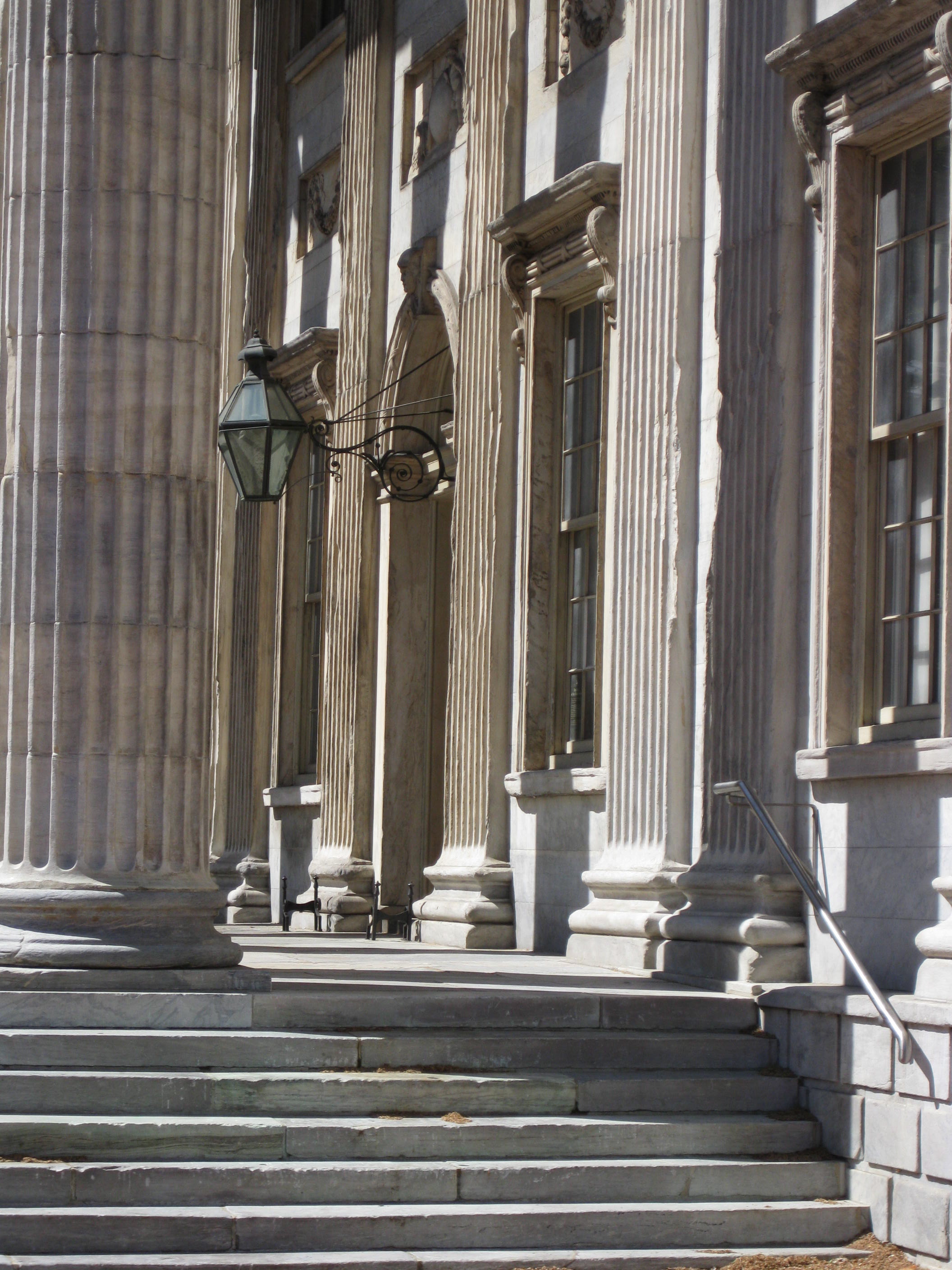 Built in Philadelphia while it served as the young nation’s capitol.
Church of the Assumption: Be there

Photo by A. Palewski
UPDATE: Decision expected week of April 25
UPDATE: CONTINUED UNTIL MARCH 28, 11 am, 1515 Arch Street, 18th fl — PlanPhilly coverage here
Here’s a recap if you’ve missed any of the twisting fate of the Church of the Assumption. Click here for Matt Golas’s overview at PlanPhilly
Calendar note: L&I Review Board will meet met on the demolition of Church of the Assumption, Monday, March 14, 10 am, 1515 Arch Street, 18th floor — but needed to continue the sesssion….
More information via the Callowhill Neighborhood Association, which is challenging the demolition approval.
 With the hearing taking place just a few days before St. Patrick’s Day, it would be a shame if this former Catholic church, designed by Patrick Charles Keely, were not given a reprieve. Keely, an Irish immigrant who arrived in New York in 1842, was the country’s most prolific ecclesiastical architect in the 19th century. His first commission was built in 1842. Completed in 1849, Church of the Assumption is the oldest surviving Keely structure of the more than 600 that were built.
Church of the Assumption landmark designation nomination
Michael Greenle’s Opinion piece, Philadelphia Inquirer, March 14
Baltimore Avenue Coalition Venue Menu: encourages community to use space in local churches
Flights of fancy that float
Sometimes I sit in on design debates — what should be done with that plaza? what would best compliment that Queen Anne building? — and when the answers all seem too predictable or just not creative enough, I let my mind wander and ponder what result we’d get if we let the minds at Pixar, Apple, Disney, Industrial Light & Magic, or the set designers for the Harry Potter films play with the idea.
They are not bound by notions of what has been and always will be. If you have a building that looks like a castle, or a wedding cake, what would they create to sit next door?
For anyone else who enjoys such flights of fancy — and who perhaps actually possesses some design chops — let me highlight for you an exciting design challenge.
Miami — the city that hosts Art Basel Miami Beach, one of the most exciting art and design escapades in the world — is hosting a design competition for a floating stage to sit in front of the newly-rescued, design wonder, open-air stadium you may have seen on the National Trust‘s and World Monument Fund’s at-risk lists. What an exciting way to revitalize this site!
Here’s the scoop from World Monument Fund:

Click here to go to Miami's competition page
Floating Stage Design Competition: Miami Marine Stadium
Competition open to anyone anywhere in the world, including architects, landscape architects, designers, engineers, artists, and students.
Following the inclusion of Miami Marine Stadium on the 2010 Watch, WMF became involved in efforts to save this dramatic modern structure and return it to regular use as an important entertainment venue in Miami. Although originally conceived as a stadium for boat races, it became apparent by the mid-1960s that this activity was not enough to sustain it financially.
The city government purchased and refurbished an old oil barge and parked it in front of the stadium, creating a floating stage for performances. Concerts on this floating stage were a key feature of this stadium in its heyday, but this stage is now gone. To revitalize the site as a potential entertainment venue, WMF suggested a design competition to replace the missing floating stage. This idea was accepted, and a competition run by Miami-based DawnTown is now underway.
Prizes will be as follows: first prize $5000; second prize $2500; third prize $1000; fourth prize $500; fifth prize $250; There will also be 5 honorable mentions (*honorable mentions do not receive a cash prize).
I’ll have to ask my Basel Miami friend to take a picture of the end result once it’s built.
Churches that were; unique spaces that still could be

Painting from 1895 (4 years after St. Cecilia's was built), "St. Cecilia" by John William Waterhouse, in the collection of the Montreal Museum of Fine Arts
I’m reading in the New York Times about a Brooklyn church, St. Cecilia’s. I’m nodding along because the story is so familiar — an 1891 church, drawing a third of its 800-person capacity, a shuttered school, an empty convent and residence building, the high costs of maintaining it all. Do you think you know the end of the story? Will it end with someone wanting to demolish it all, as could happen with Philadelphia’s Church of the Assumption (1849) and a host of other empty church buildings around the country, across the globe?
In this particular circumstance, St. Cecilia herself may have intervened. The patron saint of music (as she was dying, she sang to God), St. Cecilia’s has found new life hosting musicians and other artists within its walls.
When Reverend James Krische arrived at the church in 2008, there was no money for maintenance of the buildings, the school had a declining enrollment, the church a shrinking congregation. Still focusing on mission and service to the community, the pastor sought to connect with local artists. The raw space was ideal for photo shoots. Word began to spread.
A parishioner with friends in a band told them about the space. Another parishioner with art contacts suggested St. Cecilia’s. And an arts program was accidentally launched.
One artist remarked “it’s like a weird commune or something that nobody ever intended to exist.”
The first large art show opened in 2009, with more than 30 artists, 2 bands and young and hip visitors who admired the art, enjoyed the music and marveled at the space.
Now there are 36 artists in residence (with 93 on the waiting list) and photo and film shoots that pay for the buildings’ upkeep.
NYT: Artists Find Accommodating Landlord: A Struggling Brooklyn Parish (3/6/11)
Could this model work without St. Cecilia as a patron?
I suspect the answer is an artful, tuneful yes.
(In February, the NYT reported on a twin-spired church in Sheepshead Bay that is slated to lose its landmark spires. A Neighborhood’s Steeples Are Set to Disappear Quietly)
Just a reminder — the hearing date regarding demolition of Church of the Assumption is March 14, 10 am, 1515 Arch Street.
Foto Friday: Moffatt-Ladd House
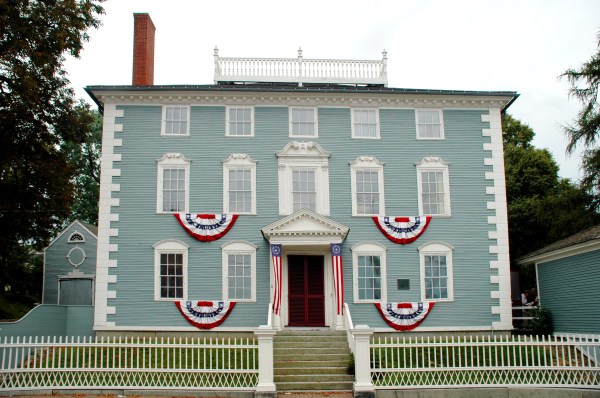 The Moffatt-Ladd House & Garden is a National Historic Landmark in Portsmouth, New Hampshire.
From their website (who knew there was colonial pre-fab housing?)
In 1760, craftsmen under the direction of master joiner Michael Whidden III offloaded the frame of the house from a vessel docked at Moffatt’s wharf, and raised and finished the frame. In his bill for services, Whidden III notes “Bringing ye frame from ye warf on ye Spot to Raise finding all ye Men finding all ye Vittles And all ye Drink of Every Kind at my own Expence at my house.” Between 1760 and 1763 Whidden and nine apprentices, two journeymen, and other related craftsmen put in total of 3,272 working days on “your house fences & garding” and also erected a barn and a shop on the site. Other bills document the exquisite details throughout the house to Portsmouth carver Ebenezer Dearing. Architectural historians have attributed the distinctive balusters of the main staircase to turner Richard Mills (1730-1800) on the basis of similar balusters in Mills’s own home in Portsmouth.
The Counting House that overlooks the family wharves on the Piscataqua River was built about 1832. The Coach House, comprised of an original warehouse and shop to which a carriage bay was added, dates from the late eighteenth century.
Be still my beating heart, the preservationist doth approach

Marblehead Harbor from the old burial ground (read the book to discover Marblehead's plot significance), Photo by me
Hunky love interests in novels tend to be rich guys, or rich guys who hide their wealth — only revealing at the end that they have a trust fund in their wallet (so that we don’t suspect that the heroine loves him only for his money).
How refreshing then to read a novel with a historian as a protagonist and a hunky love interest who’s a preservationist (cuz we all know that preservationists are not rich, though I suppose one might be attached to a trust fund).
The Physick Book of Deliverance Dane won’t be winning the National Book Award anytime soon, but it’s diverting enough to merit a place on a summer beach reading list. The blurbs on the front of the paperback read “Spooky” from People, “Bedeviling” from the New York Daily News and notes the book made USA Today‘s” Top Ten Books of 2009″ list (USA Today‘s endorsement seems proof it’s a book best for the beach).
I’d say that “spooky” is overstating the case. Is it because I’m also somewhat of a historian that I knew what was going to happen before it did, or is it simply the skill level of this writer’s debut effort?
Shifting between past and present, between Salem and Cambridge the book revisits the magic of the 17th century witches that capture our imagination to this day. Grad student Connie Goodwin is pursuing her doctorate at Harvard. Entering a Salem church to consult its archive, she calls out “hello” and then, as if descending from the heavens….
Connie heard more rustlings, followed by a shrill whine like a fishing reel being cast, and a dark shape thunked down about three feet in front of her, right in the center aisle of the church. She stepped back in surprise. Presently the shape unfolded into the form of a rangy young man, dressed in paint-dappled overalls, with a tool belt slung around his slim hips. He unhooked his rappelling harness from the ropes that Connie now perceived to be hanging from a scaffold near the ceiling, and strode forward to take her hand.
No. It’s not Spiderman.
He “grins crookedly at her surprise” — she plays with her hair to indicate nervous excitement and that makes him smile. He explains the work he’s doing. He’s a steeplejack. “I worked for awhile at the Society for the Advancement of New England Antiquarianism.”
“They have an awesome preservation program,” Connie interjected, recognizing the name. “Some of those properties would just be knocked down if it weren’t for them.”
“That’s true,” Sam agreed. “They do great things. But I hated sitting at a desk all day. I mean, I went into preservation so that I could touch cool old stuff that no one else is allowed to. So” — he gestured to his tool belt — “I moved into restoration work. New England is just about the only place with enough antique steeples to go around.”
They visit archives together, there are fireworks — no, really, I mean actual fireworks. And so it goes. There’s a sort of mystery. There’s a bad guy. There are mystical doings. There are witches — or are there?
Like I said, it was a diverting enough read for a weekend spent in bed with a cold.
But…
I take great issue with this discussion suggestion from the book club guide in the back of the book:
Connie is a historian who likes to interpret the past in light of the present. Sam, however, is a preservationist: He likes to keep the past intact, at the expense of the present. Are you more of a historian or a preservationist? Do you see a difference between Connie’s and Sam’s feelings about the past?
Now, hold your horses there you Hyperion publicist, you! I take objection to that characterization! Preservationists holding on to the past at the expense of the present? Do you have an ax to grind? Did someone not let you tear out your old windows in a historic district or something?
Preservation is not about losing the present or the future — it’s about using these touchstones from the past to enrich our present and future. Connie goes digging in archives to look at papers no one has seen for decades. Sam is up on that steeple re-gilding it so that it continues to shine every day as a community beacon and neighborhood landmark. How is that costing the present anything?
Go on. Discuss.
Happy Birthday, Mr. President!
 In 1909, this postcard celebrating George Washington’s birthday left the Fairhill Station post office in Philadelphia on February 21 at 10:30 pm, and presumably reached Master Paul White in Greenlane, Pennsylvania, the next day, February 22, George Washington’s birthday.

Here’s to George Washington, the father of our country! Today’s the perfect day to visit his home at Mount Vernon. In honor of his birthday, admission is free. There’s a surprise birthday party at 1:30 (don’t tell him and ruin the surprise!).
Of course, it makes even more sense to visit George Washington’s birthplace on his birthday. It’s a National Historic Site. Except it seems that they celebrated his birthday on Monday (Presidents Day! Bah, humbug! See previous post with the truth about Presidents Day!)
We used to have Washington’s birthday and Lincoln’s birthday — February was a very Presidential month!
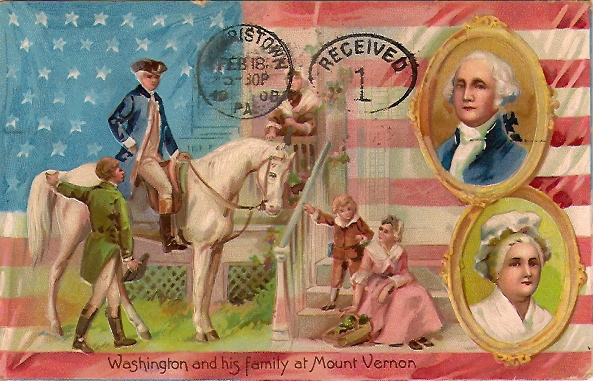
My grandfather received this postcard in 1908 for Washington's birthday. The caption on the front reads "Washington and his family at Mount Vernon" and it's signed by his Aunt Bertha on the back.
Have you ever wondered whatever happened to Lincoln’s birthday and how we ended up with this “Presidents Day” holiday? And just what does it mean? Is it a mashup of Washington and Lincoln’s birthday? That’s what I always assumed, until Snopes set me straight. This post, explains how Nixon (yes, Nixon) created “Presidents Day” as a holiday meant to honor all presidents — not just Washington and Lincoln. (So I guess we are celebrating Nixon today, too….)
NEW HEARING DATE: Will Church of the Assumption survive?
Photo by A. Palewski
The Philadelphia Historical Commission ruled on September 10, 2010 to recognize economic hardship and allow demolition of the 1849 twin-spired Church of the Assumption on Spring Garden Street. An appeal of the decision was originally scheduled to be heard by the L&I Review Board on November 30, 2010. As the appeal was explained, the decision was made to continue the hearing until January 20, 2011.
WHEN: 10:00 am, Thursday, January 20
NEW DATE: Monday, March 14 at 10:00 AM
WHERE: 1515 Arch Street, 18th floor
WHAT: Appeal of the Philadelphia Historical Commission’s decision to allow demolition of the Church of the Assumption by the Callowhill Neighborhood Association.
There is a Plan Philly article about the Nov. 30 hearing here.
A quick overview of the current issues:
- The City’s attorney wants the case thrown out and is challenging CNA’s standing.
- Wayne Spilove, chair of the Pennsylvania Historical and Museum Commission, testified that state funds from the Department of Community and Economic Development issued to Siloam for demolition are illegal and should be returned. Read his letter here.
National Trust for Historic Preservation article on Church of the Assumption


 Nostalgic for the original Wayback Machine?
 My Own Time Machine: Buildings, Places, People & Things