Nostalgia of the future?

Photo by Karen Neal – © 2010 American Broadcasting Companies, Inc. All rights reserved.
Phil/Dad (on hill overlooking their California hometown): Wow. This place has really changed. Time marches on, eh? See that Starbucks down there? You know what that used to be?
Alex/Daughter: An orange grove?
Phil/Dad: No. A Burger King. You can still see some of the architecture.
Claire: Thank you, for this. I really do feel better already.
Phil/Dad: You can go home again, Claire. [kiss]
This little bit of dialogue from the First Episode (“The Old Wagon”), Season Two of “Modern Family (air date: 22 September 2010) made me laugh. (The nostalgia event was prompted by the need to get rid of the old family station wagon — and the trauma of letting go of all the memories attached to it, including sipping milkshakes on the hilltop overlooking town.)
The idea of waxing nostalgic for a long-lost Burger King made me wonder about the future. Will we fight preservation battles to save the “neighborhood” big box store? Will a Friends group form to save a 2009 pharmacy, complete with drive-thru window, from the wrecking ball? Will that highly dense country club development, townhouses mixed with McMansions, be nominated as a potential National Historic Landmark District?
In the future, what do you think will speak to us of this time?

Photo by Karen Neal – © 2010 American Broadcasting Companies, Inc. All rights reserved.
He’s packed his bags, and left Church of the Assumption behind…

Photo by A. Palewski
Social service group Siloam has lost leader Joe Lukach, who becomes CEO at the Center of Autism. You may recall that under Lukach, Siloam received controversial approval to demolish the 1849 Church of the Assumption, the twin-spired landmark on Spring Garden Street in Philadelphia. One wonders what impact the leadership vacuum may have on the fate of the historic church.
See previous post here and here.
Read Inga Saffron’s Philadelphia Inquirer thoughts here and here.
The National Trust for Historic Preservation’s October take on the Church of the Assumption is here and commentary on the value — and vulnerability — of historic houses of worship is here.
Center for Autism names Lukach CEO
Philadelphia Business Journal – by John George , Staff Writer
Date: Wednesday, December 22, 2010, 12:19pm EST
The Center for Autism said Wednesday Joseph A. Lukach is taking over as CEO of the nonprofit autism treatment and evaluation center based in Philadelphia.
Lukach succeeds David St. Clair, who was serving as the center’s interim executive director.
Lukach has more than 20 years of experience managing organizations focused on improving the lives of special needs populations. He was previously executive director of Siloam, a Philadelphia HIV/AIDS service organization. Lukach has also served as a senior marketing and operations executive at Friends Life Care in Plymouth Meeting.
He holds a master’s degree in business administration from Temple University and a master’s degree in social work from the University of Pennsylvania.
“Joe is a leader that brings vision, experience and enthusiasm to the center during a time in which it enters a new phase of growth.” said St. Clair.
As CEO, Lukach will lead the Center for Autism’s strategic plan — which focuses on increasing the availability of its evaluation and treatment services to people in the Philadelphia region. He will oversee the organization’s $10 million annual budget, programs that serve 700 people annually, two locations and 120 employees.
Had just settled in for a long winter’s nap…
Raising my eggnog to you all…..
Ho, ho, ho, my dears. Have a wonderful holiday season with those you love in the places that are special to you.
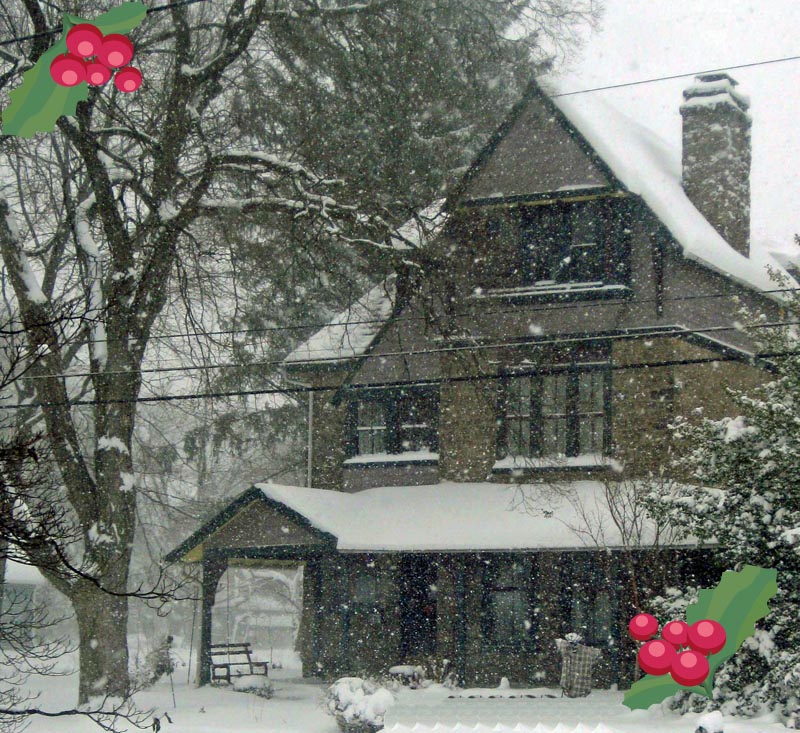
The perfect stocking stuffer
 The children were nestled all snug in their beds, while visions of…… toy candy danced in their heads!
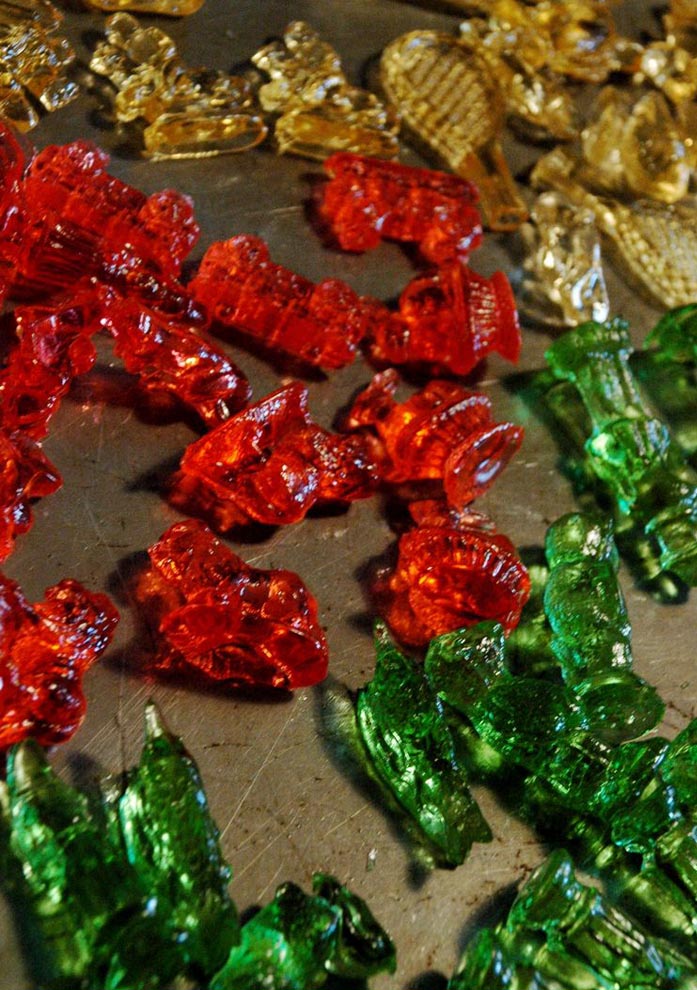
Camel. Eagle. Cat. Frog riding a bicycle. Fireman. Sailing ship. Choo choo train. Rocking horse. Lion. Dog. Monkey. Rabbit. Leaping stag.
 In glittering, glass-like jewel tones of red and green and yellow.
Ah, one of those lovely Christmas traditions that makes you smile and assures you that all is right with the world.
Clear toy candy, or “Dierich Orde Glass” (as its Pennsylvania-German origins would have it), is a holiday tradition that dates to the 18th century.
I had the great opportunity to visit the candy workshop in an 1860s building where these marvels are created in vintage molds, on vintage equipment, and finished with delicate, loving, individual care and attention to each sweet detail.
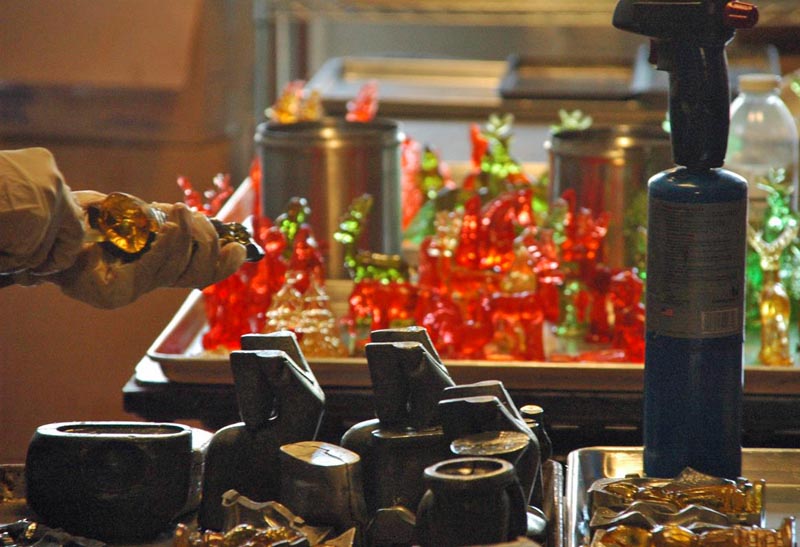
Brothers Eric and Ryan Berley, the taste-makers behind fabulous step-back-in-time Franklin Fountain in Old City Philadelphia (116 Market Street between Front and Second at the corner of Letitia), purchased more than 250 molds that have been turning out these lovely treats since 1897 at the former Young’s Candies on Girard Avenue. Since then, they have perfected the craft of making the traditional candy confections.

I hope my family isn’t reading this. The toy candies were a childhood tradition for my mother and I have a stockingful of them for her, but it was so hard choosing which of the charming shapes to buy!
Want to thrill your own family and friends and perhaps start a new holiday tradition? Visit Franklin Fountain to see a beautiful display of the large-sized versions of the candy, which were traditionally featured as banquet table decor, then hammered into bite-sized pieces at the end of the meal.
Then browse the baskets and see if you don’t find yourself agonizing between the red scotty dog and the green locomotive….

Candy is available for sale in both large and small sizes, or you can custom order from their vast list of options, including George Washington, an elephant with tusks, an ocean liner, a fabulous reindeer, Santa climbing into the chimney, and more. Orders can be shipped, but visiting the store to pick up your goodies is a great excuse to order the delicious home-made egg nogg ice cream (though my favorite is chocolate chip with their to-die-for hot fudge topping).
Don’t wait! Clear toy candy is only available in the chilly season!
Download this pdf to see the amazing selection! And this one to order.
Read more about Franklin Fountain’s clear toy candy in the Philadelphia Inquirer.
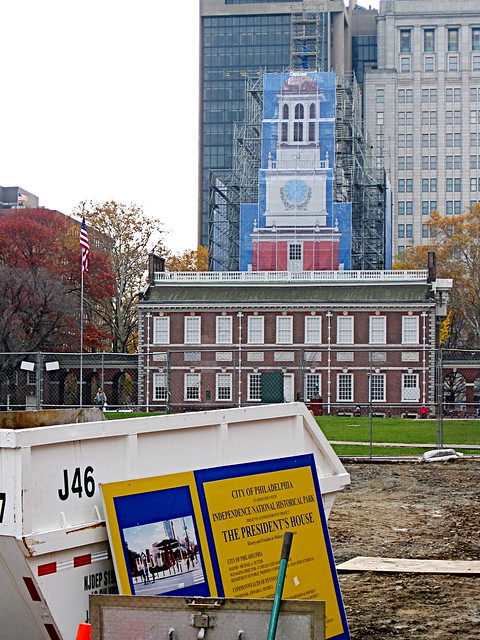
Foto Friday: Independence Hall
When preservation means basic living standards
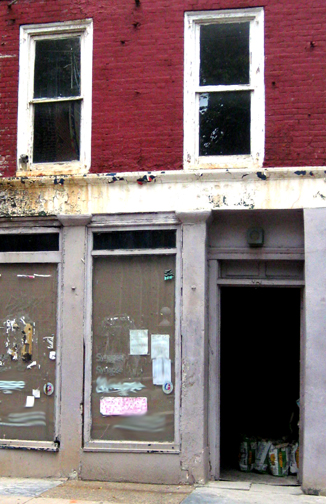 Reading this New York Times blog article by Village Voice writer Elizabeth Dwoskin, I became aware of my own “preservation” filter and contemplated the many various meanings that “historic preservation” can have in contemporary society. In the story of this author’s quest to investigate the worst buildings (and landlords) in New York City, you read about buildings — and their occupants — left to slowly decay into nothingness. Until demolition — and homelessness — is the only option.
Within the story is the bright spark of another definition of “preservation” — the building resident who mustered volunteers and paid for paint herself because she couldn’t stand the peeling facade any longer or who patrolled the halls to try to fend off the drug dealers. It’s that spirit that cares for old buildings and creates a home for the people who find shelter within.
Read the full story here. And this time of year, it’s important to do so — to count your own blessings and make an effort to help those less fortunate — be they buildings or people.
Here’s the passage where I came to realize this story wasn’t about brick inlay and exotic-revival details:
Lorillard — the street was named after the tobacco family who, after the Civil War, gave their estate to the nearby St. Barnabas Hospital, then called the Hospital for Incurables — was never an upscale building. But I could tell from the carefully arranged brick inlay and the Egyptian design on the doorway that it once had its charm. Decades before, the building was likely to have been home to an upwardly mobile-class of immigrant Italians who had the means to escape Lower Manhattan and had come to work in the nearby Bronx Zoo. Today, it mostly houses tenants that have a portion of their rent paid through Section 8 federal rent assistance, or any number of special programs that provide subsidies to recovering addicts, formerly homeless and substance abusers, or people with H.I.V.
Justin’s mom and I passed the line of broken mailboxes. Broken mailboxes, like busted locks and New York Police Department “Clean Halls Project” plaques, are some of the telltale signs that I had come to recognize in a neglected building. They make great places to stash drugs; tenants at Lorillard complained they were always opening their mail to find little illicit packages. I was only just beginning to understand that every crumbling building in New York forms its own chaotic, self-contained world.
Endangered: Historic Heidelberg – Kerlin Farm

Heidelberg/Kerlin Farm; Photo by Ron Tarver, Philadelphia Inquirer Staff Photographer
This call for help comes from the Northeast Philadelphia History Network:

WHAT: Now under threat of demolition, one of the oldest residences in Pennsylvania at 1050 Ashbourne Road, Cheltenham, PA. The 300+ year old estate hearkens to the very beginning of European settlement in this region. It would be difficult to stand in a place that more completely describes the settlement and growth of a particular place over the course of three centuries. Now it is facing the wrecking ball.
Circa 1682 William Penn sold a land grant for 1,000 acres, part of which would eventually become Cheltenham Township, to Everard Bolton and others shortly after their arrival in the New World. Bolton’s share of the land was three hundred acres and he is believed to have constructed a home, known in the nineteenth century as Heidelberg, now as Kerlin Farm, here in the late seventeenth century. According to eighteenth century tax records, the original portion of the house was a two-story stone structure and there were several additions, including a third story, during the nineteenth century. The property remained in the hands of Bolton family heirs until the mid-twentieth century. This house is likely the oldest residence in Cheltenham Township and may be one of the oldest in Pennsylvania. It appeared on the 2004 Preservation Pennsylvania Endangered List
WHEN: Thursday, December 9, 2010, 7:00 p.m., Cheltenham Township Historical Commission will consider an application for demolition of the Heidelberg-Kerlin Farm. Click here to view demolition application.
Let your voice be heard: contact Cheltenham Township Historical Commission to share your thoughts about this property.
KEY ISSUES:
- Is total demolition of the buildings and landscape the only option?
- Is the new owner in an unrealistic rush to demolish based on assumptions that future zoning variances and permits will be approved? Will the empty lot lie vacant for years until the economy rebounds only to have hindsight kick in and leave us saying, “If we had only waited, we could have rehabbed the place and passed it on to future generations.”
- What about a partial restoration and preservation of the landscape with its venerable Pennsylvania State Champion tree and many other trees and shrubs of uncommon age and species?
- Is the community sufficiently informed to understand the change in character which the neighborhood will undergo? Will the ongoing dilemma of the former Ashbourne Country Club (across the street) develop into a domino effect which would adversely effect the nearby watershed?
- Whether the structures remain standing or not, an archaeological study of the site is in order. This ground of this property has not been scraped to the bone as much of the region has been. Thirty decades of European American history lie atop many other centuries of Native American history. Imagine the stories and information which might be gleaned from a careful, professional study.
Additional information resources:
“Love affair with a crumbling Cheltenham mansion,” by Daniel Rubin, Inquirer Columnist, August 12, 2010
Website by farm advocate Ellen Gartner about the Heidelberg – Kerlin Farm with photos, floorplans, family histories and more
Slideshow tour by Fred Moore
November 2007 article in the Quad City Times explains the morass that led to the current situation
Happy Hanukkah! Preservation & a festival of light and glass
In honor of the festival of lights, I share this piece from CBS Sunday Morning on the Eldridge Street Synagogue (1887) in New York City. It’s worth noting that the congregation had dwindled to nearly nothing, to the point where the main space of the building was closed to the public because it was falling apart. Yet, before the National Historic Landmark building reached the point of no repair, there was a realization of what would be lost if no action were taken, and the community banded together to rescue the building — a 20-year effort. (I like to think this could be the same story for the Church of the Assumption, but there will be a final demolition appeal hearing in January. Stay tuned.)
Watch the segment to see the beautiful, star-filled windows designed by artists Kiki Smith and Deborah Gans that replaced the lost stained glass.
Daily architecture tours at the Eldridge Street Synagogue at 11:30, 1:30 and 3:30.
CBS News video: Synagogue’s Stained Glass Celebrates Festival of Lights – Hannukah is the Festival of Lights, and this holiday season the Eldridge Street Synagogue, in the heart of New York’s Chinatown, has a lot of light to celebrate. Serena Alstchul visited the completely refurbished Synagogue that is capped off by a magnificent new stained glass window designed by avant-garde artist Kiki Smith and architect Deborah Gans.
Vodpod videos no longer available.
[Looking for Fitzwater genealogy information? Then you’ll want this post.]
The following two articles appeared in the Ambler Gazette, page 2, on 14 July 1898:
THE FITZWATER GRAVEYARD
This old family burial place is about one-third of a mile northeast of the tollgate at Fitzwatertown, on the east side of the road running to Horsham. It is on the north side of a steep declivity, the surface of the country here being quite rugged. Here is a walled space, within which are many graves and a less number of tombstones. The area enclosed is 20 perches. It is a very small part of 222 acres, conveyed by John Penn, Thomas Penn and Richard Penn in 1740 to Thomas Fitzwater and which by his will of 1742 was given to his son, John Fitzwater. In 1780 John Fitzwater conveyed 118 acres of it to his brother, Matthew Fitzwater, for £400.
Just when this spot began to be used by the family for a burying ground is not apparent, but it was before the Revolution. The oldest stone with an inscription is to the memory of Thomas Fitzwater, who died in 1771. In 1799 there was a formal conveyance of 20 perches from Matthew Fitzwater to John and George Fitzwater. In 1847 it was conveyed by John Fitzwater as trustee to Jacob Fitzwater.
Besides the tomb of Thomas Fitzwater, mentioned above, are the following [rearranged according to chronology]:
1795, John Fitzwater;
1842, July 2, Robert McCurdy, son of Robert and Hannah McCurdy, born Nov. 15, 1748, reaching his 94th year;
1857, May 10, John Fitzwater, born July 12, 1776;
1876, April 3, Jacob Fitzwater, born Sept. 19, 1789;
1876, March 22, Tacy, his wife, born Feb. 22, 1795;
1877, March 16, Mary Fitzwater, born May 27, 1802
1877, March 25, Jacob Fitzwater, born Jan. 4, 1830;
1879, Feb 7, George W. Fitzwater, born April 3, 1823;
1889, Jan. 26, Robert E. Potter, born Aug. 25, 1834
FITZWATERTOWN
This old hamlet took its name from the Fitzwater family and has been known as such for more than 100 years. Here is Niblock’s hotel, a store, the old mill, limekilns and a dozen or more dwellings, situated in the deep depression through which passes one of the branches of Sandy Run. There has been no appreciable growth of the village for a long while. Its connection with the outside world is at Edge Hill or Oreland, only a mile away, however, and the turnpike, as of yore, furnishes the avenue of communication north and south.”
The Fitzwater mill was one of the earliest in Montgomery county. It is propelled by the waters of Sandy run, here flowing from the eastward and crossing the pike. The mill, now belonging to Samuel Conrad, is on the east side of the highway and near the north bank of the stream. As elsewhere mentioned, William J. Buck speaks of this mill as existing in 1705, and then owned by Thomas Fitzwater. Of course the present structure was built at a much later period. The plantation upon which was the mill was inherited by John Fitzwater in 1742, who in turn conveyed part of it to Mathew Fitzwater in 1780, comprising 118 acres.
The same estate came into possession of George Fitzwater and which was sold after his death in 1826 by Sheriff Christian Snyder to William Jarrett. Only the next year, 1827, the will of William Jarrett conveyed the property to his children, who were Ann Jarrett, Mary, wife of William Hallowell; Jane, wife of Thomas Thompson; Hannah, wife of William Penrose; Tacy, wife of Charles Lippencott. Later the property came into possession of Mrs. Isaac Hallowell and Mrs. Jane Lippencott. It was bought by John W. Price of Israel Hallowell in 1852. The next conveyance was in 1863 from John W. Price to Catharine, wife of William W. Price. Lastly it was sold by William W. Price in 1869 to Samuel Conrad, who by the date of 1898 has become an aged man of over 80 years.
Charles Fitzwater (Sep 20 1833 – 2 Dec 1900)
From the Ambler Gazette, December 6, 1900, page 8:
Charles Fitzwater, a life-long resident of Flourtown, near Wheel Pump, on Bethlehem pike, died Sunday aged 67 years. He was one of the family of Fitzwaters, which resided in Upper Dublin township in the vicinity of Fitzwatertown, being the son of John Fitzwater, who owned nearly all the property about that village and burned lime in the vicinity. The deceased was a brother of Washington, John, Jacob and Mrs. Lottie Potter. Over 35 years ago he married Emily, daughter of ‘Squire Rex, of Flourtown. He has been crippled up with rheumatism for a number of years. The funeral was held this Wednesday afternoon from his late residence.
From geneaology files:
198. Charles FITZWATER (John-5, John-4, John-3, Thomas-2, Thomas-1) was born on 20 Sep 1833 in Montgomery Co., PA. He was the son of John Fitzwater and Mary Lukens. He died on 2 Dec 1900 and was buried on 6 Dec 1900 in Fitzwater Burial Ground, Fitzwatertown, Montgomery Co., PA.
The 1860 census for Upper Dublin Township, Montgomery County, shows Charles as age 28 and Emma as age 31. His realestate was valued at $8,000 and his personal property at $1,645. In the 1870 census, Charles and Emily were living in the 20th Ward, 68th District of Philadelphia. Shown with them in the 1870 census were Kate, age 12; Mary, age 11; Margt, age 3; and Charles S., age 5/12th.
Charles FITZWATER and Emilie V. REX were married about 1860 in Montgomery Co., PA. Emilie V. REX was born in 1829 in Pennsylvania. Charles FITZWATER and Emilie V. REX had the following children:
288 i. Tacy FITZWATER was born in 1857 in Upper Dublin Twp., Montgomery Co., PA.
289 ii. Mary A. FITZWATER was born in 1859 in Upper Dublin Twp., Montgomery Co., PA.
290 iii. Samuel R. FITZWATER was born in 1863 in Montgomery Co., PA. He died about 7 Mar 1864 in Montgomery Co., PA. He was buried on 10 Mar 1864 in St. Thomas Church, Whitemarsh Twp., Montgomery Co., PA.
291 iv. Margaret FITZWATER was born in 1867.
292 v. Charles S. FITZWATER was born in Jan 1870 in Philadelphia, PA.


 Nostalgic for the original Wayback Machine?
 My Own Time Machine: Buildings, Places, People & Things