Fashion for the preservationista
Darlings, don’t we all need one of these for those days we’re stomping through the countryside doing windshield surveys? Or hacking through the landscape on horseback scouting a rare extant example of a Dutch barn? Or maybe just because it’s called a National Historic Landmark blazer? This would go great with my Wellingtons…..

Quickie News Digest
You might say this is cheating as a blog post, but I really enjoyed these articles from the NYT this week and wanted to share them, in case you missed out.
- Ralph Waldo Emerson. His house, a National Historic Landmark in Concord, Massachusetts, has lucked out in having dedicated, long-term caretakers. This article looks at the young couple that have recently taken over the job and wonders about generations, gender roles and the future of dusting. Keeping Mr. Emerson’s House – Sept 19, 2010
- John Steinbeck. I remember reading Steinbeck’s Travels with Charley and dreaming of someday having a dog of my own and setting off to travel the country. He wrote the book at this Sag Harbor bungalow, where you can still find a doorframe marked with the height of anyone who came to visit (including the dog Charley), Steinbeck’s scrawl in cement (“To my Ladye, In thee I have myn erthly joye”) and fading handwritten labels on drawers of tools (“Knives, Chisels, and Bladey Things,” “Glory! Nails, In Excelsis”). How poignant when the longtime caretaker says “I wish there was some way to preserve this.” At Steinbeck’s Getaway as Heirs Feud Revives – Sept 23, 2010
- Bing Crosby. Crooner, song and dance man, movie star, the pipe-smoking dad who launched a thousand Christmas specials….. and avid baseball fan who was part owner of the Pittsburgh Pirates, Bing Crosby buried treasure in the wine cellar of his California home. The perfectly preserved, five-reel print of The Greatest Game of Baseball Ever Played (Game 7 of the 1960 World Series; Yankees vs. Pirates) was made for Crosby who was afraid of jinxing the game if he watched it live. In Bing Crosby’s Wine Cellar – Vintage Baseball – Sept 23, 2010
Foto Friday
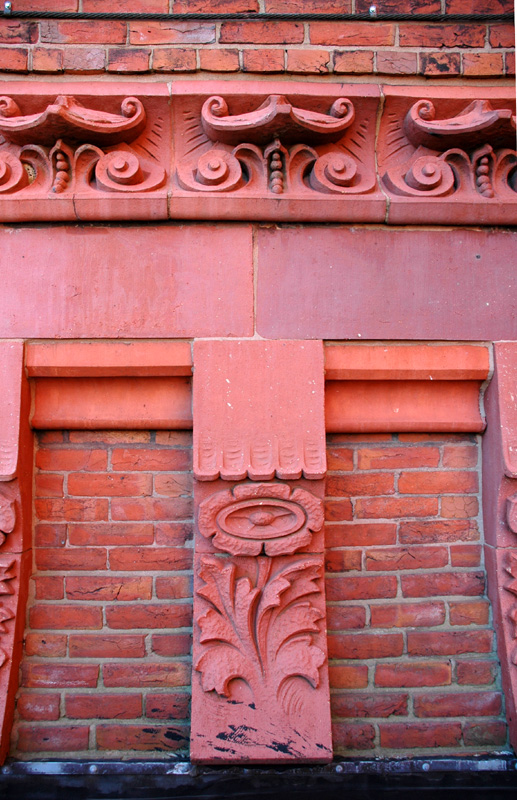
Foto Friday: Paintings and National Historic Landmarks
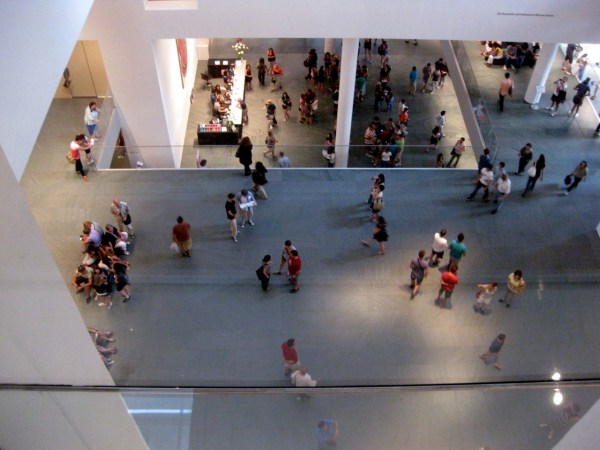
Free Target night. Thank you, Target.
I went to New York City not long ago. I visited lots of museums, including MoMA.
It was packed with people. It was hard to see the paintings.

See the guy thinking "I know this painting. What painting is this?" He's trying to read the info card on the left to find out the story.
Sometimes you can have a historic preservation moment even in the middle of a museum of modern art.
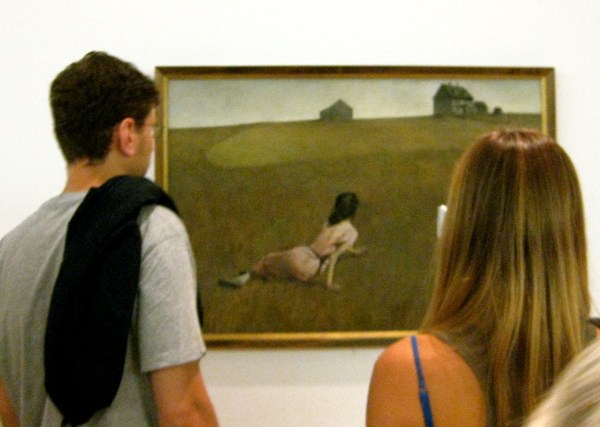
The painting (since you can't read the card from here) is "Christina's World" painted by Andrew Wyeth in 1949
That house in the distance that we’re all staring at (including Christina there in the painting) is the Olson House. Wyeth frequently drew and painted the house and its residents between 1939 – 1968.
Today the house is owned by the Farnsworth Art Museum and welcomes visitors who want to know more about its interesting history.

The house was once described as "looming up like a weathered ship stranded on a hilltop." Originally built in the late 18th century, the house was significantly altered in 1871.
Already listed on the National Register, in November the house will be considered for National Historic Landmark status. (That is the highest landmark designation that exists. NHLs “bring the American Experience to life” and are recognized for their “exceptional value or quality in illustrating and interpreting the heritage of the United States.”)
UPDATE On June 30, 2011, Department of the Interior Secretary Salazar announced designation of 14 National Historic Landmarks, including the Olson House.
Callowhill looks askance at Phila Historical Commission demo decision
More on Church of the Assumption, the 1849 church on Spring Garden Street. Last week the Philadelphia Historical Commission voted to grant the financial hardship application of Siloam Ministries, which seeks to demolish the structure (protected by its listing on the local register of historic places).
Plan Philly reports that the Callowhill Neighborhood Association (CNA) disagrees with the decision, and may file an appeal by the September 25 deadline.
The full story is here.
CNA believes that Siloam has financial options, they could sell or repurpose the other real estate they own (parking lots or convent) to supplement their funding needs and resolve their financial hardship,” [CNA president Amy] Hooper said.
Inga Saffron on Church of the Assumption

Photo by A. Palewski
Philly.com, September 11, 2010
Historic Philadelphia church to be torn down
By Inga Saffron, Inquirer Architecture Critic
The Philadelphia Historical Commission cleared the way Friday for the demolition of a landmark Spring Garden Street church whose 15-story twin spires are visible across much of North Philadelphia, and whose sanctuary nurtured the city’s two most notable Roman Catholic saints, John Neumann and Katharine Drexel.
The commission, which placed the ochre-colored Church of the Assumption on its historic register only last year, agreed to allow the demolition after its nonprofit owner testified that it was financially incapable of making crucial repairs to the green copper steeples. The 6-5 vote marked the latest defeat in Philadelphia’s struggle to retain its stock of spectacular, but underused, 19th-century religious buildings.
The decision came after hours of testimony, and after neighborhood residents and preservationists – including several city officials – pleaded with the commission to spare the historic sanctuary. Built by the noted church architect Patrick Charles Keely, the Church of the Assumption was consecrated by Bishop Neumann in 1848. Drexel was baptized there a decade later.
“Are we really ready to destroy a building that has such a profound history?” Commissioner David Schaff wondered aloud just before the vote.
Schaff, who represents the Planning Department on the commission, noted that the church was the oldest surviving building on Spring Garden, a once-grand boulevard that has been severely battered on its eastern flank. With the real estate market in the doldrums, many predict the large site, just east of 12th Street, could linger as an empty lot for years.
Despite those concerns, the building’s owner, the nonprofit Siloam, which provides free services to people with HIV/AIDS, argued that its own survival could be in jeopardy if it were forced to preserve the church and make costly repairs that could require more than $1.5 million.
Demolition of historically certified properties is generally forbidden in Philadelphia unless the owner can prove financial hardship.
Siloam director Joseph Lukach testified that his group spent months trying to find a new use for the church or a buyer to take it off its hands. When those efforts failed, he said, the board concluded that demolition was its only option.
The irony is that Siloam is now in such bad financial straits that it may have trouble finding money to raze the soaring church, Lukach said. Although Siloam said that demolition would cost $164,000, several commissioners familiar with construction prices predicted the bill would be triple that. Siloam said it would request state money to cover the expense, just as it sought state money to buy the property.
Lukach conceded in his testimony that it had never been Siloam’s intention to take on the responsibility of being a property owner. The group had been renting space in the rectory in 2006 when the Catholic archdiocese announced plans to dispose of the church compound.
“The church said, ‘Take it or leave,’ ” Lukach testified.
Initially, the group was optimistic that it could incorporate the ornate Gothic Revival sanctuary into its programs. But it soon discovered that the roof and two steeples would first need extensive repairs.
Siloam sought help from two volunteer design consultants, Community Design Collaborative and Partners for Sacred Places, but was unable to carry out their recommendations.
Andrew Palewski, the preservationist who nominated the church for landmark status, contended that the nonprofit never had the wherewithal to make use of the church’s sprawling compound, which includes a convent, school, rectory, and two empty lots. “They let the convent sit idle when it was ripe for redevelopment,” he complained Friday.
Kevin Boyle, a lawyer who handles the archdiocese’s real estate matters, countered that Siloam was seen as the last, best hope for saving the church. Boyle also represented Siloam at Friday’s hardship hearing.
“The church puts tremendous resources into saving historic properties,” Boyle said in defense of the archdiocese. “But at the end of the day, you can’t save every building.”
Not all the commission members agreed that the church’s fate was hopeless. Noting the poor state of the real estate market, Commissioner Joan Schlotterbeck, who runs the city’s public property division, urged her fellow members to postpone the demolition vote for six months.
When the commission deadlocked, 5-5, on the issue, Chairman Sam Sherman, who normally does not vote, cast the deciding ballot in support of demolition. Sherman, a developer, recently completed a hugely successful market-rate rowhouse project just two blocks north of the church.
“I thought it might come to this, and I was up all night thinking about it,” Sherman said ruefully. “The demolition of this church is not in my mind a good thing. But I do feel hardship has been demonstrated.”
The Church of the Assumption is unlikely to be the last great religious building Philadelphia loses.
According to testimony yesterday from Siloam’s Realtor, James J. Scott of Collier International, there are at least 20 religious buildings for sale in Philadelphia. “It can take two or three years to find a buyer,” he said, that is, “assuming they’re in move-in condition.”
Church of the Assumption: Update
The Philadelphia Historical Commission granted Siloam Ministries its hardship application for demolition.
The final vote was 6 to 5.
DO OR DIE TIME: Church of the Assumption
You can’t see it yet, but there’s a wrecking ball hovering near the twin spires of the 1849 Church of the Assumption, a landmark on Spring Garden Street between 11th & 12th.
The final Historical Commission hearing will be held on Friday, September 10, at 9:00 am at 1515 Arch Street, Room 18-029. It is open to the public and anyone interested in seeing this building survive for another 160 years should attend. This meeting will determine the ultimate fate of the landmark.
Siloam wants “hardship” relief from the Commission because they can’t afford to maintain or repair the structure, and claims that no one wants to buy it.
Neighbors have information that several people have tried to buy the church over the last year. (In July 2009, Siloam deflected a potential buyer by destroying many of the interior architectural features of the building.)
Additional Plan Philly coverage here.
Brownstoner Philadelphia (interesting comments)
Previous Time Machine posts here and here
It’s sad when a building’s story ends up with “… and then it was purchased by someone who never had the resources to manage [insert appropriate resource here] such a complex of fine historic buildings and was torn down at great expense.”
$1 for Chicago-area Queen Anne with Burnham pedigree
North Shore House for Sale for $1.

Photo credit: Glenview Historical Commission. Click image to read National Trust for Historic Preservation article
Smiting buildings that offend thy plans
At least the church that doesn’t want this building seems to be making good “faith” efforts to find a new owner for the structure (unlike Siloam Ministries and this Philadelphia preservation controversy). But I don’t understand them saying the building “is past its useful lifespan.” Houses were built to last in 1894 — and this house was built by the nephew of the man who designed some of this country’s most iconic buildings (I haven’t heard anyone say the Marshall Fields building is past its lifespan). That statement sounds like the owners are just quoting a real estate appraiser who has no experience with historic buildings.
Chimneys and Turrets and Glenview, oh my!
The building they want to demolish is a Queen Anne style residential building that sits 17 miles north of Chicago. It was designed and built by Hugh Burnham, nephew of game-changing Chicago architect Daniel Burnham. Here’s hoping someone will decide to live by Uncle Burnham’s motto — “make no little plans” — and take on this house before it’s torn down.
The Burnham Legacy
Want to know more about Daniel Burnham’s impact on Chicago and architecture worldwide? Check out the PBS documentary Make No Little Plans: Daniel Burnham & the American City. (PBS description below; premiere Sept 6; see local listings)
“Make no little plans; they have no magic to stir men’s blood and probably themselves will not be realized. Make big plans; aim high in hope and work.” — Daniel Hudson Burnham (1846-1912)
Few individuals have had more impact on the American city than architect and planner Daniel Hudson Burnham. In the midst of late 19th century urban disorder, Burnham offered a powerful vision of what a civilized American city could look like. He built some of the first skyscrapers in the world; directed construction of the 1893 World’s Columbian Exposition that inspired the City Beautiful Movement; and created urban plans for Washington DC, Chicago, Cleveland, San Francisco and Manila—all before the profession of urban planning existed. In fact, some say that he invented it.
His work sought to reconcile things often thought opposite: the practical and the ideal, business and art, and capitalism and democracy. At the center of it all was the idea of a vibrant urban community. A timely, intriguing story in the American experience, Make No Little Plans: Daniel Burnham and the American City explores Burnham’s fascinating career and complex legacy as public debate continues today about how and for whom cities are planned.
As Director of Works for the 1893 World’s Columbian Exposition in Chicago, Burnham not only envisioned a “beautiful city” but also constructed it in record time despite enormous obstacles. The Fair itself, which recorded over 27 million visits, represents a pivotal shared cultural moment in 19th century America that exposed people to scores of foreign countries and cultures from around the world and to the idea that a city could be beautiful.
Burnham’s other architectural achievements include over constructing over 500 structures, including architectural icons such as the Reliance, Rookery, Marshall Fields and Monadnock Buildings in Chicago; the Flatiron Building in New York; the Merchants Exchange Building in San Francisco; and Union Station in Washington, DC. He seemed to have been willing to tackle any commission—from the Mount Wilson Observatory in California to Selfridges department store in London.
As an international figure, Burnham believed that an ideal city could be both beautiful and commercially efficient. His ideas had enormous influence on towns and cities across America and even abroad. He was an early advocate for parks and open space who understood their importance in fostering a deep sense of community in a democracy. Although his urban plans are criticized for their monumentality and absence of social concerns such as better housing, they have an identifiable coherence. As a man, Burnham was a paradox: politically progressive but conservative in taste; a tough businessman and a Swedenborgian mystic; a pragmatist and a dreamer; and a complex man both efficient and indulgent.


 Nostalgic for the original Wayback Machine?
 My Own Time Machine: Buildings, Places, People & Things