Voice your opinion! Last chance for 1849 Philadelphia church building
If you missed the previous post about the Church of the Assumption (with historical background of the 1849 edifice), let me remind you that the Financial Hardship Committee of the Philadelphia Historical Commission will hear the owner’s case tomorrow (Wednesday) at 1:00 pm at City Hall, Room 578.
Attend and see if Siloam Ministries makes the case for demolition, that they’ve made every effort to find a new owner and that no other solution exists for the building or for their organization. If you can’t attend, but have an opinion, let the Historical Commission know.
Philadelphia Historical Commission City Hall, Room 576 Philadelphia, PA 19107
Telephone: 215.686.7660 Fax: 215.686.7674
Email: Jon dot Farnham at phila dot gov
To see what possibilities exist for a former church complex, see the Community Design Collaborative’s design work for St. Boniface in Norris Square.
Below is some visual perspective on Church of the Assumption and its landmark spires, as well as some historical perspective, drawn from 19th century accounts of the building’s opening, its restoration, its rebirth. Will the church be renewed again or will it become a ghost on the landscape?
From the Philadelphia Inquirer, November 11, 1849
A Dedication.—The Church of the Assumption will be dedicated tomorrow, at ten o’clock. The Right Rev. Dr. Reynolds, Bishop of Charleston, South Carolina, will preach the Sermon of the Dedication, and a collection will be taken up in aid of the Church. Tickets of Admission, Fifty Cents, to be had at the Assumption, the Sexton of St. Mary’s Church, the Orphan Store, Chestnut above Twelfth street, and Jas. Fullerton’s Bookstore, No. 57 south Fourth street.

Photo by A. Palewski
From the Philadelphia Inquirer, July 9, 1874, “Church of the Assumption”
The Roman Catholic church of the Assumption of which Father Carter is pastor, situated on Spring Garden street, below Twelfth, has recently been undergoing extensive repairs and improvements, and has been thoroughly renovated.
The steeples have been scoped down and all the defects removed. In the interior of the church the ceiling is in neutral tints and gold,, and the columns have been marbleized in imitation of Tennessee marble, presenting a beautiful appearance.
The walls of the sanctuary have been elegantly frescoed, the work being done by Messrs. C. Bremer & G. Gallaschik in person.
On the left are figures of St. Mark, St. John and St. Charles Borromeo, and on the right St. Patrick, St. Luke and St. Matthew, all six feet in height. In the centre are the Annunciation, the Immaculate Conception, the Madonna and the Ascension, and behind the tabernacle the remonstrance, the figures being four feet in height. The work is very artistically executed. And the figures stand out, presenting a remarkably lifelike appearance. The drapery is correct, and hangs naturally, and the characters are well modeled. The figures are in old Indian costic, and above each of the side altars are two angels.
The principal altar will be gold and white, and the pews will be grained. All the high points in the mar of the sanctuary have been dipped with eighteen-karat gold and filled in with neutral tints, and the columns of the same have gold leaves on a white ground. Messrs. Bremer & Gallaschik have executed well the work assigned them, and the church will hardly be recognized by those who saw it before the improvements, the cost of which when completed will be from twelve to fifteen thousand dollars.
There will be a grand opening on the second Sunday in September, the anniversary of the consecration of the church.
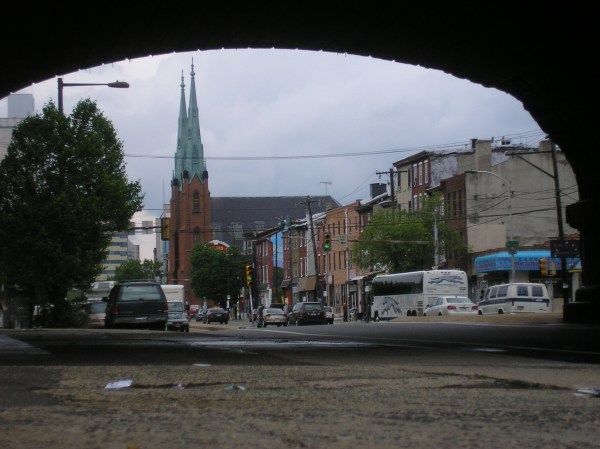
Photo by A. Palewski
From the Philadelphia Inquirer, June 20, 1889, “A Perilous Position.”
Gilding the Cross on a Lofty church Spire.
Crowds gathered yesterday afternoon at the street corners in the vicinity of the Roman Catholic Church of the Assumption, on the north side of Spring Garden street below Twelfth, and all eyes were turned to the top of the lofty eastern spire of the church, where a workman was seen in a position calculated to make the spectators’ flesh creep with a feeling of intense anxiety.
For some time past the work of repainting the two spires of the church has been going. Last Thursday afternoon Moses Coster, a painter, slipped from a scaffolding near the top of the spire and was terribly injured. But for coming in contact with telegraph wires he would have been instantly killed. That accident did not deter a painter and gilder yesterday from ascending to the very top of the spire and to go through with the work of gilding the cross and globe that surmounts it. He performed the task with as much equanimity as though he was on terra firma.
From the Philadelphia Inquirer, October 3, 1899, “Assumption’s Fiftieth Year”
Arrangements for Celebrating the Church’s Golden Anniversary
Elaborate preparations are now being made for the celebration of the golden anniversary of the dedication of the Church of the Assumption, at Twelfth and Spring Garden streets. In honor of the event special services will be held in the church on Sunday, November 12.
…Work upon the foundation of the church was begun in July, 1847, by Rev. Charles I. H. Carter, who was then pastor of St. John’s Church, and it was wholly due to his own individual efforts in raising and collecting funds that on May 21, 1848, the corner-stone of the new structure was laid with impressive ceremonies by Bishop Smith, of Glasgow, Scotland., The address was delivered by Bishop Kenrick, of St. Louis, Mo. The church was completed early in November, 1849, and on the 11th of the month was dedicated by Very Rev. R. X. Gartland, the sermon being preached by Bishop Reynolds, of Charleston, S.C.
Back to School time, kiddies!
Know a kid who’s still catching up on the reading they were supposed to do over the summer?
 Here are a couple of historic preservation-themed books available from my beloved Books of Wonder store in NYC. (And speaking of historic preservation — place a order from them so in some future time we won’t be saying “remember when there were actual bookstores where you could browse books all day?” We all know that in the Meg Ryan/Tom Hanks movie “You’ve Got Mail” the darling little Shop Around the Corner is put out of business by the big bad Fox Bookstore (think Barnes & Noble). In the real world of Kindles and Nooks and New York bookstores, did you read last week that Barnes & Noble at Lincoln Center will be shutting its doors?)
Anyway, where was I?
Oh! Books to pass along to the young preservationist in your midst.
BENJAMIN PRATT & THE KEEPER’S SCHOOL (We the Children), by Andrew Clements, illustrated by Adam Stower. Books of Wonder’s terrific catalogue describes the book like so:
With his parents recently separated and new living arrangements — one week at home with mom, the next week on dad’s sailboat — sixth grader Benjamin Pratt has had enough change; the last thing he wants is to see his harbor-side school — the oldest building in his small Massachusetts town — bulldozed to make way for a thirty million dollar real estate deal.
As Ben and his friend Jill begin digging for answers about how this ever got approved, they learn things that the people with money and power don’t want them to know. Could the history hidden deep within the old school building stop the developers? And just how far will these people go to get their way? Ben and Jill are about to discover just how dangerous a little knowledge can be!
Your young readers (ages 7-11) won’t be able to put down this fast-paced, thrilling mystery as they follow Ben and Jill every step of the way to pursue the truth. The exciting first book in a brilliant new series from the author of the modern classic, Frindle.
My two youngsters will relate to the challenge of change, since their parents’ divorce is why their mom went back to school to study historic preservation. By now, they’ve been to enough classes and tagged along on so many of my projects that they could advise Ben Pratt about how to save the school!
Another fun book to toss on the nightstand of your junior preservationist is THE WRIGHT 3 by Blue Balliett, in which three Chicago children must unlock a mystery to prevent demolition of Frank Lloyd Wright’s Robie House.
From Books of Wonder:
Young sleuths Petra and Calder are back again for another mystery, and this time they are joined by Calder’s old friend Tommy. [The previous book: Chasing Vermeer] Their new adventures begin with a class discussion about the Robie House, a Frank Lloyd Wright architectural masterpiece, which is threatened with demolition.
Opposed to the destruction of the house, the school kids begin a class project to save the building. Meanwhile, Petra, Calder, and Tommy each have discovered clues that lead them to believe there’s more going on at the Robie House than meets the eye! Calder wants them all to work together, but Petra and Tommy distrust each other. Can they put aside their differences long enough to solve the mystery and find the secret – left by Wright himself – that can save the house? Or will greed trump art?
In the midst of this tangled web where life and art intermingle with death and danger, Petra, Tommy, and Calder must match wits with some dastardly villains and the genius of Frank Lloyd Wright. Your young sleuths (ages 9-12) will be thrilled by this tale of adventure, where the fine line between logical events and odd chances of fate blend together into a chilling mystery that can only be solved with a little teamwork and a whole lot of trust.
And, since it seems all good preservation tomes need a single mom in the plot, there’s one in this book too! High five!
Did I mention that signed copies of both books are available from Books of Wonder? If it’s too late for Back-to-School, it’s never too early to get a jump on your Christmas shopping!
Foto Friday
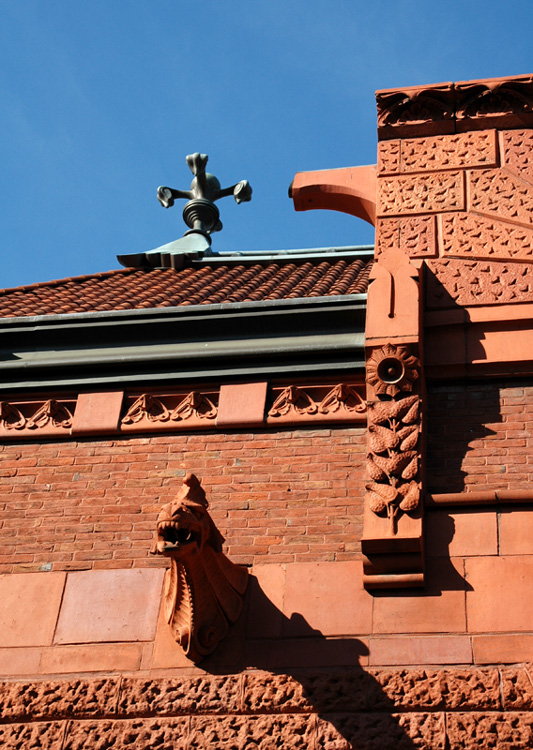
We feel like winners!
Here we are on the eve of September — where did the summer go?
In July (seems like just yesterday) I did a post on New York’s Metropolitan Museum of Art and the “It’s Time We Met” photo contest. The kids and I didn’t know about the contest while we were romping through the exhibits but a few of our photos expressed the fun we’d had exploring, so we entered.
I’m delighted to announce that out of hundreds of entries, one of our photographs was selected as a runner up! (There was one winner chosen, and two runners up, but we feel like winners.)
Congrats to my youngest, who came up with the idea for this picture and who is pictured in it!
When bad business management leads to demolition of a neighborhood icon — can it still be saved?

Photo by A. Palewski
Church of the Assumption of the Blessed Virgin Mary
1123 Spring Garden Street
The distinctive, twin-spired gothic church you see at right has graced the skyline of Philadelphia since 1849. A nonprofit agency purchased it, leaky roof and all, and proceeded to salvage the interior in preparation for demolition.
Demolition plans were halted when the church was added to the Philadelphia Register of Historic Places in 2009.
Pursuing demolition by neglect, property owner Siloam has made no effort to stabilize or maintain the church since then, and now claims it is a safety hazard.
Siloam has turned down several offers to buy the church (the most recent from a successful Philadelphia restaurateur) and will now plead an economic hardship case to the Philadelphia Historical Commission in order to finally pull the structure down. The group’s lawyer claims the organization is “struggling for survival” and claims the issue of the church could put them out of business.
The issue has been referred to the Philadelphia Historical Commission’s Committee on Financial Hardship which will meet to make a decision regarding demolition on Wednesday, September 8 at City Hall, Room 578 at 1:00 pm.
Interested in buying a church? Siloam is using Colliers International as its agent (though I was unable to find the property using their search feature on their several websites – Is it any wonder the UK-based company says it hasn’t received much interest in the Spring Garden property?) Took me half an hour, but here’s the link for their local office partner. Put in a bid and see what happens.
Interested in saving a church? You can:
Write a letter/Make a call
Philadelphia Historical Commission City Hall, Room 576 Philadelphia, PA 19107
Telephone: 215.686.7660 Fax: 215.686.7674
Email: Jon dot Farnham at phila dot gov
Attend the Wednesday, September 8 meeting @ 1:00 pm
Philadelphia City Hall, Room 578 (allow time to get through security line in the lobby)
Wondering about the bad management decisions that led to purchase of a site that so obviously required a significant investment whether they tore the building down or not (demolition is an expensive proposition itself)? So am I. With that kind of leadership running the place, it’s no wonder the lawyer says Siloam may have to go out of business. And wouldn’t it be a shame if they tore down the church and then failed as an organization anyway?
Lend expertise
Siloam will present its case to the Committee on Financial Hardship — involving claims it can’t sell the property, estimates for demolition versus estimates for stabilization all pinned to an overview of how much money they have and their stated mission of providing social services. When the Architectural Committee voted to refer the matter to the Hardship group, the sole dissenting vote (3-1) pointed to the need for an independent estimate for the costs involved for demolition or stabilization. Are you an expert who could weigh in on the costs involved? Leave a comment or contact me at the address in the sidebar (see the envelope?).
Most recent Article at PlanPhilly here.
2008 IRS form 990 for Siloam Ministries (check their financials and see if you’d make the same choices they did)
Nomination document here (Francis Drexel and his family worshipped at this church, and Katherine Drexel (St. Katharine Drexel) was baptized here on December 28, 1858)
For another slice of Spring Garden history long gone — 1104 Spring Garden Street during the Civil War

Photo by A. Palewski
BACKGROUND
The Church of the Assumption was added to the Philadelphia Register of Historic Places in May 2009.
Andrew Palewski, a neighborhood resident and preservationist who nominated the 1849 church for designation, presented a petition with more than 400 signatures from neighbors. Residents of the Callowhill and West Poplar neighborhoods testified about the church’s importance as a neighborhood landmark and its great potential as an icon for neighborhood revitalization. Architectural historian Michael Lewis, professor at Williams College, highlighted the church’s historic importance in the context of Irish immigration and anti-Catholic sentiment during the mid-19th century. Designed by Patrick Charles Keely, a prominent 19th-century church architect, the Church of the Assumption is the oldest of his churches to survive, and was the first of his designs to feature twin spires, an effort to differentiate Catholic ecclesiastical architecture from Protestant.
The nomination was contested by its owner, the nonprofit Siloam, which provides mind/body/spirit services to people living with HIV/AIDs. Siloam bought the deconsecrated church in 2006 and, after exploring options, had intended to demolish it. A designated building cannot be demolished without permission from the Historical Commission. Now, in 2010 Siloam has applied for permission to demolish the building under economic hardship.
HISTORY
This Gothic Revival church was built from 1848-1849 which makes it one of the early civic structures in the developing Spring Garden area of the city which was established as a neighborhood in the 1850s when developers began to build speculative housing for merchants and professionals. By 1877, the neighborhood became a fashionable address for Philadelphia’s nouveau riches. The Church of the Assumption was established at the inception of this neighborhood’s development and has lasted through a significant transition which has left it as one of the only original buildings on the 1100 block of Spring Garden Street.
Additionally, the Church of the Assumption holds great significance as the earliest extant example of the work of Irish-immigrant Patrick Charles Keely (1816-1896), who rose to prominence in the architectural field designing ecclesiastical buildings for the Catholic Church, primarily throughout the Northeastern United States.
At its essence historic preservation is about retaining the significant features that create and define a neighborhood. With its towering spires, gothic buttresses and tracery windows, the Church of the Assumption is a tangible link to the area’s history and represents a well-recognized landmark within the community.
Foto Friday
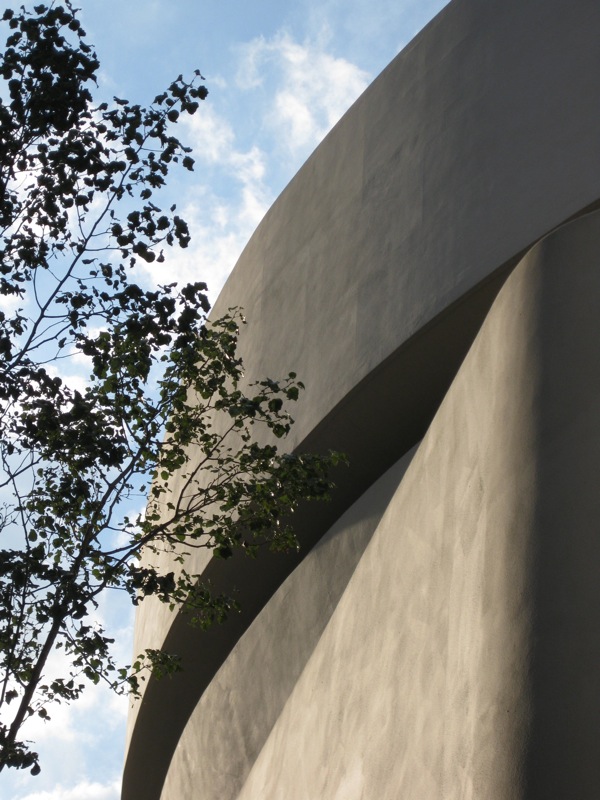 The Guggenheim shrugs.
Power in Numbers

One Fish
For years I’ve watched two house museums in the ‘burbs struggle for attention and identity. They are a couple of miles apart, a mere bicycle jaunt along a busy road. Both tell a colonial to colonial revival story. One does a car show, the other a craft fair. Both are set amid a remnant pastoral landscape in what is a rapidly developing, formerly agricultural area losing more context each day with a road widening here or a high-end manor house development there.
I’d drive by and look at the empty parking lots and think — Wouldn’t it make sense to join forces, share resources, and market themselves in tandem? Turn the remaining land to work for a Community Sponsored Agricultural Coop and take turns hosting a “Farm to Table” market on alternating weekends, maybe with local chefs teaching classes on what you actually do with a rutabaga. Hold a fireside camp out (Revolutionary reenactors optional) at one site with a child-friendly “Hunt Breakfast” at the other the next morning.
Surely promoting a locale with two places to visit would be easier than motivating a family to drive out to a single one that lacks any obvious nearby attractions to fill the rest of the day? [Bicyclists roam the scenic roadways in packs; why not tap that special interest group with cyclist-friendly resources and events?]

(Photo from Seacology.org)
Indulge my flight of fancy
The power in numbers idea makes me think of silvery clusters of schooling fish. They are swift, collectively look bigger than they really are and thus scare off potential predators, and are a wonder to behold. Theirs is a successful survival strategy and one that translates well to the real world.
Power in Numbers at Work: Ordering off the Venue Menu
In Philadelphia, the fledgling Baltimore Avenue Coalition is “a collaborative group of congregations and organizations, which was convened by Partners for Sacred Places, [that] seeks to spark a conversation about joint efforts, initiatives and projects that congregations and organizations can enact along Baltimore Avenue.” Power in numbers, in action!
The group recently produced a “Venue Menu” (click for pdf) — a brochure promoting “sacred spaces for community use” that includes five area churches built between 1870 and 1906: Spruce Hill Christian School (c. 1879), Woodland Presbyterian Church (c. 1870), Calvary Center for Culture and Community at Calvary United Methodist Church (c. 1906), St. Francis De Sales Parish (church c. 1890/school c. 1904) and Hickman Temple (c. 1904).
The brochure includes a rave review from a local theatre company, offers pictures of the building exteriors, contact information and icons signifying room capacity and special features.
Explaining its purpose, the brochure notes:
The historic houses of worship along Baltimore Avenue are anchors of their broader community, reflecting the diversity of the neighborhood’s people, histories, and architecture. Our congregations have strong legacies of positive involvement in every aspect of West Philadelphia’s life. These neighborhood landmarks — sacred to people of many faiths — are vital participants in the worship, culture and daily life of Baltimore Avenue.
The goal of the Baltimore Avenue Coalition’s Venue Menu is to preserve the character of our neighborhood, to maintain the architecture that is foundational in its identity, and to encourage the growth and true prosperity of the community. By opening our sacred spaces for community use, we seek to build an appreciation for the places where we live, work, and worship. In preserving the historical, cultural, and architectural diversity of Baltimore Avenue, we will preseve our Avenue’s sense of self.
Churches have always had connection to the community as a primary goal, but as churches across the country see their congregations shrink, this Venue Menu formalizes that offering and makes the partnership a kind of a contract with the neighborhood, a partnership and service to people looking to meet for a purpose that might not be spiritual, but serves the community in another sense (like sew a pillowcase for a cause).
(If you want more info on the Philadelphia pillowcase challenge, click here.)
But will there be enough ice cream for all the reenactors?

I'll have cherry ice cream please.
Marcus Hook Preservation Society Presents
The Second Annual Washington Rochambeau Revolutionary Route National Historic Trail Celebration & Ice Cream Social
Saturday, September 4
1:00–3:00 p.m.
Free — No reservations required
More info available at http://www.w3r-us.org or email mhps1 at hotmail dot com
Living biographer Carl Closs will portray General George Washington circa 1781 and lecture on the significance of Marcus Hook during the Revolutionary War. Enjoy the pageantry of The Encampment of the 6th Maryland Revolutionary War Regiment in period uniforms (on site from 10am-3pm). General Washington will greet his audience at the Historic Marcus Hook Plank House located at 221 Market Street in Marcus Hook before leading the troops to historic St. Martin’s Cemetery to honor all Revolutionary War Soldiers (with specific mention of Amor Grubb).
General Washington’s lecture will follow at the Marcus Hook Community Center (7 West Delaware Ave, Marcus Hook, PA). The event concludes with an Ice Cream Social.
♦♦♦
The Washington Rochambeau Revolutionary Route was designated as a National Historic Trail in March 2009. The route covers more than 650 miles from Newport, Rhode Island to Yorktown, Virginia. Visitors can follow in the footsteps of Revolutionary forces — the French (under Jean Baptiste Donatien de Vimeur, comte de Rochambeau) and American (under George Washington) — as they marched to Yorktown to defeat the British led by Cornwallis and mark victory in the American Revolution.

Foto Friday

And I’ll share this bickerfest from 2006 about preservation vs. replacement of the building’s facade tiles. You’ve seen it all before, complete with nothing but “anonymous” signed to the comments. (And no, as of this moment I don’t know how Tilegate was resolved.)
Historic sites through the viewfinder
Now, when I say “historic sites through the viewfinder” I don’t mean the viewfinder you had as a kid, that plastic update of the old stereoscope concept with those circular image disks you clicked through. Not that one.
I mean the one in your camera. (Or am I dating myself because you have a screen on the back of your fantastic pocket digital Elph/Coolpix/PoGo?)
It’s time to get out your camera and get snapping. It’s National Historic Landmark Photo Contest time! The National Park Service has made it easier than ever to enter — just visit the 2010 National Historic Landmark Photo Contest page at Flickr or, for more information, visit the contest webpage at NPS (you’ll see a slideshow of last year’s winners in the header). Register with Flickr, join the pool and upload up to ten photographs you think capture the essence of your favorite National Historic Landmarks — one image per NHL. (If you’re a professional photographer with inquiries about rights issues, email nhl_photo at nps dot gov for alternative permissions standards.) Be sure to tag your photos 2010nhlphotocontest
The contest ends September 10, 2010. Winners will be notified by September 24. Now go take pictures!
If you are an NHL or local historical society, consider using the contest as a way of engaging local residents and potential visitors or members. Host your own local contest and then enter the top three images in the contest. In your local contest, have categories for kids, amateurs, pros. Make up your own categories that resonate for your local organization and community history. Providing a list of NHLs nearby helps raise awareness of the significant places in your own locale. Have fun with it!
What are National Historic Landmarks?
I’m glad you asked!
The designation is the gold standard for historic sites. It is often confused with “National Register” status. The National Register is a listing of thousands of special places across the country with important national, state or local significance.
A National Historic Landmark is one of fewer than 2,500 places selected for their extraordinary importance in telling the story of our nation. They include presidents’ houses and exceptional architectural examples, but also battlefields, archaeological sites, vessels, neighborhoods and town centers (National Historic Landmark Districts). They tell stories about women’s history, slavery, invention, art, innovation, generosity, derring-do and more.
Some states have more than others. In cities like Philadelphia, Boston and New York, you don’t have to walk too many blocks to find one. In states like Wyoming and Colorado, they are farther afield.
To see if a historic site you love is an NHL or to find one near you, check the National Historic Landmark database (beware its finicky search engine). FYI: The slide show above features National Historic Landmark sites but all the images are from my own little shoebox file of pictures and have nothing to do with the contest.


 Nostalgic for the original Wayback Machine?
 My Own Time Machine: Buildings, Places, People & Things