Prefab Modernism and Preservation

Photo by Jack Boucher, Historic American Building Survey (HABS), National Park Service, taken 1994. Click to visit NPS website on the house
Dwell magazine’s April 2010 issue focused on prefab construction, and included a brief feature highlighting efforts to preserve a prefab example from the 1933 World’s Fair in Chicago.
One of 11 “Homes of Tomorrow” featured at the fair, the Armco-Ferro Enamel House was one of five buildings trucked from the fairgrounds to the Indiana Dunes to enjoy a useful residential life.
Now located within the boundaries of the Indiana Dunes National Lakeshore, the National Park Service manages the land and long term leases for the structures are offered through a partnership with the Historic Landmarks Foundation of Indiana (HLFI). Long-neglected, the buildings were featured on the HLFI’s Endangered List in 1993.
My personal favorite is the House of Tomorrow, designed by Chicago architect George Fred Keck to include a garage and airplane hanger on the ground floor. Apparently, in his vision of Tomorrow, every family would own an airplane.

One of the measured drawings from the HABS file for the Armco-Ferro House, click image to visit HABS file at Library of Congress
All the houses were built using innovative materials and techniques and the Dwell article notes the challenges faced by the new residents of the Armco-Ferro House when trying to restore the building to its former glory.
Since their “Preservation” heading doesn’t seem to rate a place on the online digital archive, let me recap what you won’t find in the online edition of Dwell’s April 2010 issue.
Chicago couple Christoph and Char Lichtenfeld envisioned the Armco-Ferro House as an ideal holiday home on Lake Michigan. Their idea of a holiday might not be the same as yours or mine. Christoph, a recently retired manufacturing engineer, felt up to the challenge of the renovation and started work in 2005.
The 2,400 square foot Armco-Ferro Enamel House (Robert Smith Jr., architect) has two stories and an atrium. When assembled in 1933 the factory-made sections of roll-formed steel and sides of baked-porcelain enamel went up in just 11 days. Renovating the house 77 years later would not be as quick or simple. When it comes to restoration, the period use of innovative materials in often untested applications calls for creative modern solutions. There are lots of folks who can tell you how to repair an 18th century wooden window frame. Those with experience rehabbing a modern era prefab are harder to come by.
Dwell writes
In the 77 years since it was erected, ‘ the structure had been completely compromised,’ Christoph says. Ultimately, saving the house meant building a new foundation; replacing the siding which was too badly corroded to save; and supplanting significant portions of the walls with new sections of corrugated 22-gauge steel. Christoph also replaced all floors with a system of interlocking steel Z-panels. Fabricated on press brakes and bolted together to create sturdy, hollow ‘pans,’ the panels mimic the original floor, which was spot-welded together at the factory.
The World’s Fair prefab homes were futuristic in concept but not built for the ages. The Lichtenfelds hope to have the home in full working order this year. ‘The problem with steelwork is that it is just so time-consuming,’ Christoph says. But time has had its benefits, too. ‘With all its flaws, we slowly learned to love this house,’ Char says.
— Tomorrow Never Knows, Jay Pridmore, Dwell, April 2010
Learn more about the Century of Progress Homes from the National Park Service Park Cultural Landscapes program.
Wagner Free Institute of Science is a time machine
This just in from the Wagner Free Institute of Science — a Victorian science museum frozen in time, but savvy about being relevant in the 21st century.

An appreciative audience enjoys "Science on Tap"
Monday, May 10 at 6pm don’t miss their “Science on Tap” program at National Mechanics (22 S. Third Street) where you can sip a favorite brew and hear Derek Pitts talk about “The Search for the Other Earth,” then debate your friends about whether alien women could ever really look anything like they do in those old “Star Trek” episodes.
↔
Not to be missed on Thursday, May 20 @ 5:30 (1700 W. Montgomery Avenue @ N. 17th Street near Temple) is the engaging Michael Lewis exploring the creative mind that designed Philadelphia’s wedding cake of a City Hall structure. For more details, see below from the Wagner website or click the image of City Hall under construction to be taken to Wagner directly.

City Hall, Philadelphia, PA. Southeast Pavillion Under Construction, 1881. Historic American Buildings Survey (HABS)
It is difficult to believe that two of Philadelphia’s most beloved buildings – City Hall and the Wagner Free Institute of Science – are the work of the same architect.
The one is a swaggering Baroque essay in civic pride, groaning with sculpture, while the other is a subdued and stately temple of science. Yet together they suggest the enormous range of John McArthur, Jr., one of Philadelphia’s most influential and yet least known architects. This lecture will look at the life and work of McArthur, his birth in Scotland, and his early training at the Carpenter’s Company, and show images of the houses, banks, hospitals, and hotels that sustained his career.
It will reveal the architect to be a far more complex and enigmatic figure than is commonly thought, and hint at why the poet Walt Whitman would call McArthur’s City Hall “silent, weird, beautiful.”
Michael J. Lewis is the Faison-Pierson-Stoddard Professor of Art at Williams College. The recent recipient of a Guggenheim Fellowship, he is the author of numerous scholarly articles and books, including Frank Furness: Architecture and the Violent Mind (W. W. Norton) and The Gothic Revival (Thames & Hudson). He writes widely on art and culture, and his essays have appeared in the New York Times, the Wall Street Journal, and the Atlantic Monthly.
↔
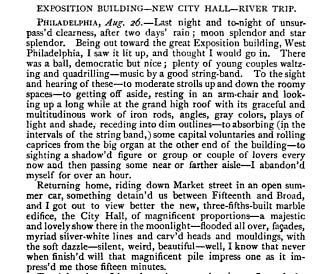
From Specimen Days, by Walt Whitman
Before you start reading, I really must insist you have the music link below playing to set the right atmosphere.
I came this close to being born in Hawaii, land of swaying palm trees and the scent of plumeria in the air.
Instead I was born on a Navy shipyard in Maine during a blizzard.
A few months later we moved to Hawaii. There I was winging over the Pacific on a military plane, the slope of the jump seats apparently allowing me to roll off onto the floor with a quiet little infantile thud. Back in my mother’s day, they didn’t have all these modern fancy baby carriers and we liked it that way. Built character, and made for funny stories to tell your kids years later.
In Navy Housing, I’d escape both from my mother’s view and the constraints of my kiddie-wear to go play naked in the red soil or toddle to the swing set and chill with the other neighborhood toddlers. I learned to swim in Hawaii, frolicked on beaches and learned how the waves roll. Palm trees sound like rain at night. Sleep, baby, sleep.
We moved away and moved back many years later. We lived for a time in Pearl Harbor. Waiting for a bus early in the morning on December 7 I looked west toward the pass in the mountains and imagined the tiny blots of Japanese planes in the sky. We moved to a house in Hawaii Kai, with a koi pond dug into the soil on the side of an extinct volcano. I’d meet friends at Waikiki Beach on the weekends and we’d pose with tourists, then laugh at them. We were young and impossibly full of life. We baked in the sun, surrounded by international icons of exotica — Diamond Head (another extinct volcano), the pink stucco Royal Hawaiian Hotel, the International Marketplace and the thatch of Trader Vic’s (or was it Don the Beachcomber’s).
My parents took me there for dinner once. I still remember studying the Pupu platter menu and marveling at the assortment of drinks, served up in themed glassware shaped like tiki gods or coconuts or painted with murals of island fantasies. Enchanting. Even without actually imbibing.
While we lived on the Mainland, my parents gave Hawaiian-themed parties. In Maine, the same steps where my dad hypnotized lobsters before they met a boiling death were now flanked by tiki torches and trod upon by adults holding tiki cups with fruit garnish and paper umbrellas. Guests wore leis and those who’d had a tour in Hawaii arrived in their muu muus and aloha shirts. Martin Denny played on the reel-to-reel and my father bested the jungle bird calls on the party sound track. Mixing metaphors, there was also a limbo pole and a steel drum. The laughter would get louder as the punch bowl got emptier.
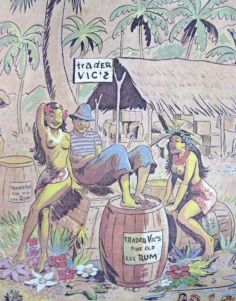
Cover of a vintage Trader Vic’s menu
As a young adult, I lived in New York and Trader Vic’s was the obvious go-to for a wild and crazy night on the town. Sometimes it was a small group, sharing a Scorpion Bowl with ridiculously long straws. Occasionally we’d have to push tables together to accommodate a bevvy of investment bankers and their dates (I was one of the dates, earning next to nothing in the notoriously underpaid publishing field).
We consumed round after round of beverages with those crazy names: Molokai Mike, Zombie, Suffering Bastard, Doctor Funk of Tahiti, Maui Fizz, Tiki Puka Puka, Trader’s Stinker, Menehune Juice, The Colonel’s Big Opu, Kamaaina, or the Potted Parrot. My tonic of choice was generally the Samoan Fogcutter which the menu warned was “a potent vaseful of Rums, fruits and Liqueurs…let the drinker beware.” You’d feel your face go fuzzy after the second one. By the third, if you could still walk you were definitely wobbly. I blame the liquor on my attempt to steal the vessel it was served in, because I was so giddily enchanted by the buxom nearly-naked native featured in relief on the side.
Trader Vic’s was in the basement of the Plaza Hotel. The downstairs location seemed to give it extra cache, as if you were entering a speakeasy and might be asked for a password. I once sat next to Rod Stewart at the bar there (the fur coat he was wearing matched his shaggy hair-do) and enjoyed many a happy birthday gathering before a night on the town. It’s gone now. The thatch, the comfy seats, the wonderfully cheesy tropicalitastic decor. All of it. Gone.
Why the stroll down memory lane?

The Tonga Room today. Click to visit their Facebook page (and find out when Happy Hour starts!).
Because these bastions of rum-fueled amusement have been falling by the wayside faster than you can order a plate of Yang Chow Fried Rice Country Style with a Pogo Stick to wash it down.
The latest threatened landmark of faux-Polynesia is the Tonga Room in San Francisco’s Fairmont Hotel (woefully underutilized as a backdrop to the recent finale of CBS-TV’s “Amazing Race”). I still recall my mother’s fond memory of her visit there and the magical indoor rainfall that was part of the experience. Perhaps I can convince her to share the story in the comments section.
↔
THREATENED: TONGA ROOM Opened in 1945… the Tonga Room survives as a rare example of the Polynesian Pop decor popular after World War II. The “High Tiki” bar — originally designed by MGM Studios set designer Mel Melvin and surrounded by a lagoon — features thatched overhangs and a floating “Band Boat,” and is the site of staged thundershowers on the half hour. But the bar might be demolished or dismantled as part of a condo conversion project proposed by hotel owner Maritz, Wolff & Co. Local residents have rallied to save the room, hosting happy hours to raise awareness. — Preservation Magazine, May/June 2010
Click here for the pdf of the State of California historic resource report.

Tonga Room, vintage postcard, as seen in 1953. Click to visit National Trust for Historic Preservation blog post.
148 North Second Street, Philadelphia

The ad above comes from The City of Philadelphia as it appears in 1894
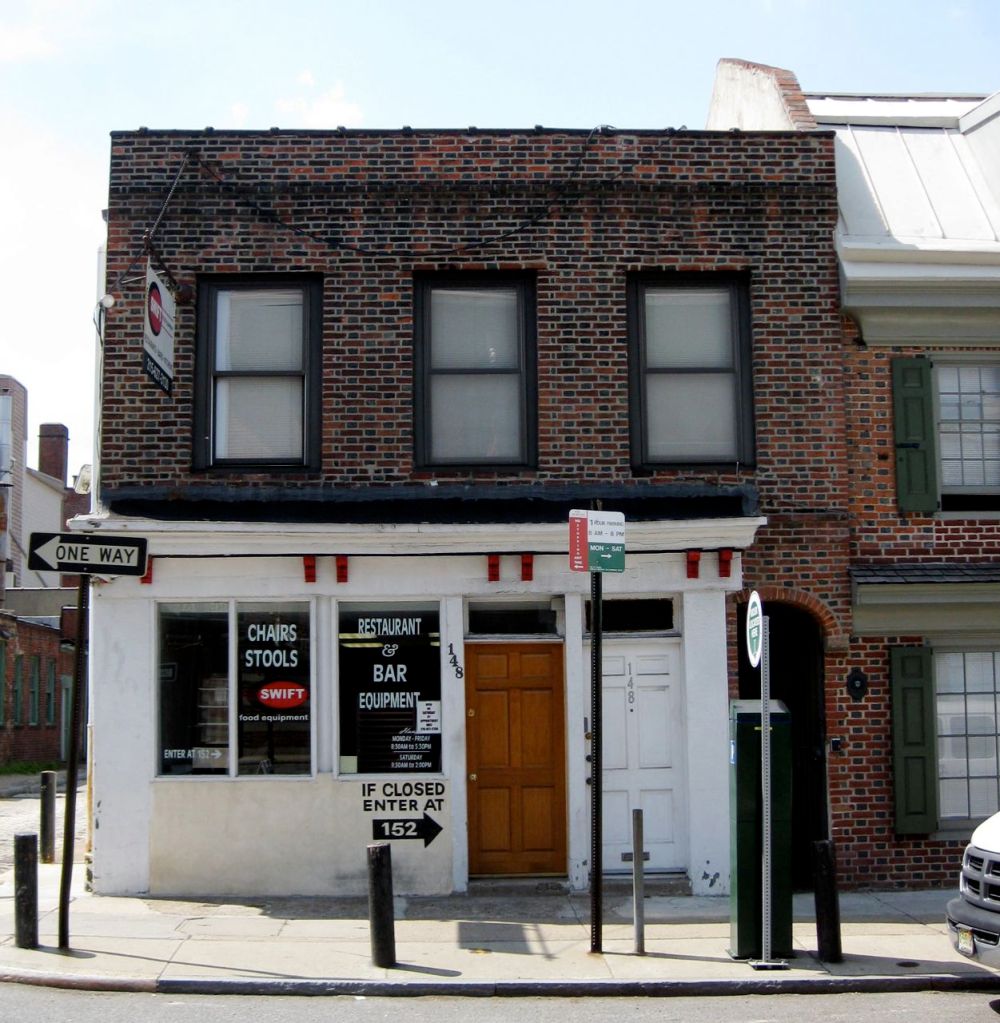
Along with wondering what was so special about Aunt Becky’s Coffee Pots, I was curious about what now stood at the 148 North Second Street address. The Philadelphia Scoop Company is long gone (along with Aunt Becky’s Coffee Pots), but the site has carried on the theme as home to the Swift Food Equipment Company. As I walked to the spot today, a car out front was being loaded with party supply materials. And I’ll bet you can still buy scoops there!
Steve Carell, actor, comedian,….preservationist?
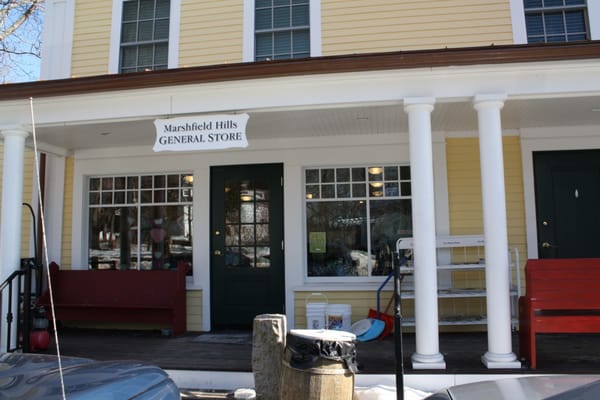
Chatting with David Letterman on “Late Night” last pm, Steve Carell took a break from plugging his new movie with Tina Fey, “Date Night,” to reveal that he owns a General Store.
You can go there and buy penny candy or a muffin, he said, or mail a letter at the little post office inside. That is, if you are one of the few people in the world who still writes letters. He admitted he has no expectations the venture will ever make money.
 The Boston Globe quoted Carell in January, right after he purchased the store: “I saw an opportunity to help to preserve a little piece of history,” Carell said in an e-mail. “I also felt that places like the Marshfield Hills General Store represent a gathering place, and give people a sense of community. These spots are growing more and more scarce. I hope to keep this particular one alive and well.”
Carell’s sister-in-law will run the store, built in 1858, and his brother will be the supervising architect for the building’s restoration.
Well done, Mr. Carell. Yes, yes you are adorable. We adore people who love special places and make efforts to preserve and protect them! Carell plans to work at the store this summer, so stop in for your penny candy supply and say hello.
Check out the Letterman chat here.
A less charming version of Mr. Carell talking about the general store with Dave in a later interview (plugging that penny candy) can be seen here.
↔
Harrisville, New Hampshire, has a General Store preservation story (but without a humorous celebrity). To preserve the idyllic 19th-century textile mill town (a National Historic Landmark district), local residents and preservationists formed Historic Harrisville, Inc. with the goal of preserving the town as a working community.
Their preservation efforts emphasized adaptive reuse of the buildings, a system of legal preservation covenants, historic district legislation, and revolving loan funds for restoration.
 The 1838 Harrisville General Store is leased to a mother and daughter who make delicious food emphasizing local, in season produce. You can sip coffee, read the paper, eat a great meal, surf the web on free wi-fi, pick up groceries, or shop the shelves of merchandise for an ideal gift. Their verve and spirit continue to make the General Store a community asset in the 21st century.
Do you know a General Store preservation story?
Foto Friday

Happy Easter from America’s oldest candy store, Shane Candies, founded 1876
Now that clapping erasers has gone out of style, what to do with old school buildings?
Here in the ‘burbs, my neighborhood has several former school buildings (Fort Washington School) facing possible demolition. With their high ceilings, large windows, and wonderful interior spaces, they desperately need some creative and savvy developer to come along and fulfill an unmet need for the kind of vintage, loft-like housing that is so easy to find in the city but impossible to locate here in the land of the strip mall.
(A downsizing friend has recently relocated to the Lenthal School and I am green with envy. I also admire the Champlain School Apartments in Vermont, another great example of a school-to-home repurpose.)
Today’s NYT features a wonderful story on a section of Brooklyn whose school buildings provide a timeline of academic architecture. Two of the now unused school buildings are looking for new life. Don’t miss the wonderful comments section with insights from readers with personal connections to the historic Erasmus Hall Academy (1786) and the 1878 primary school.

The National Trust for Historic Preservation recently featured a profile of a former high school school that was transformed into a new library for the community. It’s a tremendous example of people with vision making something happen, despite the poor condition of the building and the apparent financial issues connected with the project. After he had walked past antiquated systems and crumbling concrete windowsills, Birrer asked him if such a project was possible. “I told her, ‘Absolutely,'” Montalbano recalls. “And I drove back to Denver asking myself, ‘Why did I say that?’ If you had seen the building that day, the shape it was in, knowing how little money they had—that was an insane thing to say.” Read more here.
Oh, and how could I forget this magnificent example of how to transform a school into a place you never want to leave (in fact, their ad copy says just that…also that this time it’s okay to fall asleep in school) — I give you the McMenamins’ abra-ca-dabra do-over of two old schools transformed into fun and funky, award-winning hotels: Kennedy School (1915) and St. Francis School (1936) in Oregon. Want to meet me for a pint in the lobby before we hit the movie theatre? (In the right sort of neighborhood, that’s the ideal use for the challenging auditorium/theatre spaces Nick mentions in his comment.)

From their website:
Since its 1915 opening, [the Kennedy Elementary School] has been a beloved fixture of its Northeast Portland neighborhood. McMenamins renovated the once-abandoned scholastic gem and turned it into Portland’s most unique hotel. Here you’ll find 35 comfy guestrooms fashioned from former classrooms (complete with original chalkboards and cloakrooms, private baths and telephones), a restaurant, multiple small bars, a movie theater, soaking pool, gift shop and a brewery (just wait until the principal hears about this!). Extensive original artwork and historical photographs cover the walls, ceilings, doorways and hallways.

What a cozy bedroom and what great windows (check out the chalkboard, perfect for those latenight inspirations you need to jot down so you can go back to sleep!)
FOOTNOTE: I recently noticed a search result landing here; the query was “what does clapping erasers mean?” Obviously, this is one of those lost traditions, the knowledge of which will vanish forever unless someone writes it down. An eraser was a device about the size of a scrub brush, made up of thick slices of felt. Classrooms had large chalkboards, usually green, sometimes black, upon which teachers would write out lessons for students to see using chalk. When the board was filled with writing, the teacher would use the eraser to wipe away the writing so s/he could continue to use the board for the lesson. The felt in the erasers would collect the chalk dust and lose their effectiveness over time. “Clapping erasers” meant taking two erasers outside and smacking them together to produce a cloud of dust and clean out the felt. This was a task generally assigned to a student.
Foto Friday
 From our trip to New York City.
Sense & Sensibility, indeed
This just in from a friend, who thought I ought to know about the woman in whose honor March 24th has (apparently) been named the International Day of Blogging (a strange honor, to be sure).
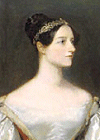
Ada Gordon aka Lady Lovelace, mathematician and inventor of the “Difference Engine”
Raised by her mother to shun the poetry and passions that consumed her father, Lord Byron (and really, if you read the fellow’s life story, you can understand why), her artistic gifts nonetheless combined with her rigorous educational training to produce, in one biographer’s words, “an enchantress of numbers.”
Here’s the “did you know” sent by my friend (but do also click on the links above for more information about her fascinating life):
Many people consider the first computer program to have been written by Ada Byron Lovelace. Ada — a high-level Pascal-based programming language is named for her. The first scientific programming languages were written in the 1950s; IBM’s FORTRAN was the first major scientific computer language, and is still used in some programs today. Ada Lovelace, daughter of the poet Lord Byron, loved mathematics. Her translation of and accompanying notations to an article about Charles Babbage’s analytical engine have been called the first computer program. Lovelace broke ground as a woman in a mostly man’s world of math and science. In her honor, March 24 is known as Ada Lovelace Day, an international day of blogging.
Lower Dublin Academy
Meeting of the Friends of Pennypack Park
Thursday, March 18th, 7:30 P.M.
Lafayette-Holy Redeemer Center
8580 Verree Road (north of Rhawn Street)
 Fred Moore will discuss “A History of Lower Dublin Academy, A Biographical & Historical Sketch of Thomas Holme and His Times and Other Historical Matters Pertaining to the School & Neighborhood” written by S. C. Willits in 1885.
Willits’ handwritten manuscript, available to the public in the Holmesburg Library for 125 years, has finally been transcribed and published in its unabridged entirety with illustrations drawn by the author. Willits’ work offers a unique view of the history of early Pennsylvania and particularly Northeast Philadelphia. Copies will be available for $25.00.
Ask about the Lower Dublin Academy, which still exists, but sits empty and fire damaged.
=======================
Friends of Pennypack Park (FOPP) history & Info.
In 1987, several individuals concerned about the decline in the condition of Pennypack Park had a vision to form an organization that would become an advocate for the park and actively improve its condition. It was determined that this would not be a discussion group, but a roll-up-your sleeves and get things done organization. Current activities of the FOPP include: conducting monthly history and nature walks, monthly park clean-ups, monthly meetings on matters concerning the park and environment, and monitoring the quality of the water in Pennypack Creek on a regular basis.
Web: http://www.balford.com/fopp/
FOPP telephone; (215) 934-PARK
FOPP E-Mail: FriendsPennypack@comcast.net


 Nostalgic for the original Wayback Machine?
 My Own Time Machine: Buildings, Places, People & Things