Epiphany — by Laura Kicey

Egads. No more Historical Commission?
Late this afternoon, a contact sent me the letter you see below announcing closure of the Philadelphia Historical Commission. While the document is named “Service Suspension” the letter makes the ending sound much more final than that. The hardworking staff had so much significant work going on — the new interiors bill, review (and hoped for approvals) of several new historic districts, in addition to their daily review of renovations and alterations to the city’s registered historic properties. To think they will have to turn out the lights and lock the door is simply astonishing.
Dear Interested Party:
We deeply regret to inform you that, owing to the ongoing delay by the Harrisburg State Legislature in approving our necessary budget measures, the City of Philadelphia no longer has the funds to provide a full range of critical services, severely impacting our residents, businesses, and visitors.
While we have been doing all we can to encourage swift action, without this State authorization to resolve our funding crisis, the City will be forced to discontinue operations and services at the Philadelphia Historical Commission. All Historical Commission activities, including all building permit application reviews and historic designation services, will cease.
Even as we remain hopeful that the State Legislature will act, we wanted to notify you of this very possible outcome so that you can plan accordingly. Please understand that only immediate action by the State would prevent some, if not full, disruption of services on October 2nd.
If you have additional questions about changes to any city service, or want to keep informed about this situation, please contact Philly311 by dialing “3-1-1” from your phone between the hours of 8 am and 8 pm Monday through Friday, email us at philly311@phila.gov, or visit the City of Philadelphia website at http://www.phila.gov.
These are extraordinarily difficult times and we thank you for your cooperation and understanding.
A similar letter went out from the City Planning Commission. Read it (and a wide array of opinion on the move) here.
I’d read about the Mayor’s threatened cuts in the paper (farewell libraries, rec centers, budget cuts, etc) but I’d assumed much of it was grandstanding to get the State to wave its magic wand.
Hello, State? What’s with the magic wand?
Update (September 17): Crisis averted. And not a moment too soon; the pink slips were in hand and waiting to be passed out. After the sort of silly game-playing one generally sees between teenagers in love, the state approved the city’s budget.
Hello sales tax increase, and hurray for the rescue of the Historical Commission and city libraries, etc. This is an example of one of the major challenges historic preservation often faces — arguing its value in the face of day to day needs like salaries for police, firemen, teachers, sanitation workers, and so on. Those daily needs take precedence in people’s minds over the more ephemeral notion of “place” or “historical value.”
What Does “Walkability” Say About Your Neighborhood?
PreservationNation » Blog Archive » What Does “Walkability” Say About Your Neighborhood?.
Preservationists continually try to link “preservation” (older buildings, neighborhoods with character, the sense of stability, etc.) with some sort of proof that preservation can equal money (because our world really comes down to money most of the time, can we all agree on that, even if we don’t agree with it?). It’s a challenge because it’s hard to quantify what it is about preservation that adds value to a neighborhood. So much is subjective, or hard to quantify.
Which is why I read with interest the attached post from the National Trust for Historic Preservation that studies “walkability” and links it to increased property values. The author of the study Joseph Cortwright, for CEOs for Cities, create a “Walk Score” and studies 15 markets.
Older and historic neighborhoods tend to be very walkable and scored well. Yay!
Perhaps this is an example to be followed — we need to look at the very quantifiable features and benefits of historic buildings and neighborhoods and measure their value in those terms. Let’s see, other than “walkability” what else can we come up with? “Sustainability”? “Artistic quality” (there I am thinking of how the cost of a house often doesn’t capture the real value of the workmanship it contains — e.g. think of each individual piece of craftsmanship contained in a place like La Ronda — what’s the value to reproduce that intricately carved window or mantel in the current market — of course, a valuation like that could be a nightmare if you let the insurers see it…). What other benefits can you think of?
Check the Walk Score for your property and see how you do. (Walk Scores available for 40 U.S. cities). How does your place rank?
Not for the faint of heart — La Ronda, after
“I have long believed that preserving our historic heritage should be one of our top priorities. I am hopeful that this matter is resolved in a way that enables us to do that and allows everyone to enjoy the beauty of La Ronda for years to come.” — PA State Senator Daylin Leach

If you missed the link to this photoset in the comments section of the last post about La Ronda, here it is again. I’ve tried to get through it three times and have felt so sad, or ill, or discouraged… that I haven’t yet made it to the end. You’ll see the remarkable interiors of La Ronda, and then you will see trenches through brick walls where even the copper piping and wiring has been stripped for its salvage value.
Compare the photo below to the one above.
Update: A different sort of battle rages on. As reported in the Philadelphia Inquirer on Friday (9/4), the past owner and current owner are now squabbling over picking the bones:
The estate’s new owner, however, has already hauled some of those items out of the house – which was the last commission of famed architect Addison Mizner – in advance of a planned teardown.
Many of the unique Mizner-designed pieces of the house, “including over 70 doors [and] all plumbing and lighting fixtures . . . have been improperly removed from the premises in violation of my control rights,” Kania wrote in a letter Tuesday to Lower Merion commissioners….
The buyer’s attorney, Joseph C. Kuhls, declined again yesterday to identify his client and said Kania’s salvage rights do not include anything hauled out before the permit was handed over. The permit, Kuhls said, opened Kania’s 30-day opportunity to salvage what was left.


Wallpaper


I once went to a party at the boss’s fancy house. My date leaned over to me and said “You can tell this is a WASP house.” I looked at him wondering where he was going with this. “Just look at all the wallpaper,” he said, waving an arm to indicate all the walls of the first floor. “Jews never use wallpaper.”
Having learned he was a bad judge of a lot of things, I doubt there’s any veracity to his statement. (He seemed to overlook the fact that his own [Jewish] mother put up wallpaper in several rooms in her house.) I think wallpaper is an equal opportunity decorating option, without regard to race, creed, religion or wallet. There’s high end (ooh, dig that Scalamandre pattern!) and low end (think that contact paper will cover the crack in the wall?). I remember a pattern my mother once selected for her kitchen consisting of oversized orange swirls against a silver metallic background. Wallpaper is often a choice best left to the brave of decorating heart.
In one of my favorite classes in grad school we studied historic interiors, from what was on the wall or floor during what period to where that chair would go and what sort of window decor you’d peek through to see if that were your gentleman caller at the door.
I love looking at the prints and color themes once popular in carpets, fabrics and wallpapers. Artistry meets graphic design. Muted small details. Garish bold flourishes. Embossing. Metallic accents. Flocking! (The Adelphi designs above all date from the mid-18th century.)
The Society for the Preservation of New England Antiquities, now known by the much less cumbersome moniker Historic New England, has one of the best archives of historic wallpaper patterns in the country, spanning from 1750 to 1950 — two centuries of style! Better still, it is all in an online database, searchable by period, color, source, or other tags that allow you to truly hone in on whatever it is you are looking for. The collection was started in 1911 by SPNEA founder William Sumner Appleton. The website also includes information on care and conservation, the history of wallpaper in New England, and links to additional resources, including manufacturers, conservators, suppliers of historic reproductions and other historic wallpaper collections.
Unfortunately, the collection does not include any images from the remarkable hand-painted English wallpaper hanging in the 1768 Jeremiah Lee mansion (click here for images of the exterior), a National Historic Landmark in Marblehead, Massachusetts. After passing out of the Lee family, the building served as a bank for a century and was then acquired by the Marblehead Historical Society (celebrating 100 years of stewardship of this remarkble property, donations welcome). The rare surviving paper — the only such wall treatments surviving in place — received a $70,000 Save America’s Treasures grant for conservation.
That Dominatrix of Style, Ms. Martha Stewart, illustrated the painstaking process for hand-blocked wallpaper in her recent decorating issue. “Using woodblocks, artistic skill, and plenty of manual labor, Adelphi Paper Hangings, in Sharon Springs, New York, brings historical wallpaper patterns back to life.” (Click through to see the magazine’s image portfolio, showing the process and the wonderful patterns and colors.) (The Adelphi paper samples above may be found here in their terrific historical overview.)
My ancestral link to wallpaper is through my grandfather, who for many years ran the paint and wallpaper department at Sears. My family “legacy” (meaning one of many things stashed in the homestead attic) includes several old wallpaper rollers, their sides embellished with the shapes — metal outlines stuffed with felt — that would pick up the paint and set the pattern down on paper. My grandfather had one of these made into a lamp. I remember it sitting on a side table with its giant shade and the base that reminded me of birch bark, dark blotches against a white background. Anyone else want to make a lamp? I’ve got extra rollers!
(For wallpaper in contemporary decorating use, Erin at Elements of Style shared some of her recent design installations)
Who’ll toll the bell?
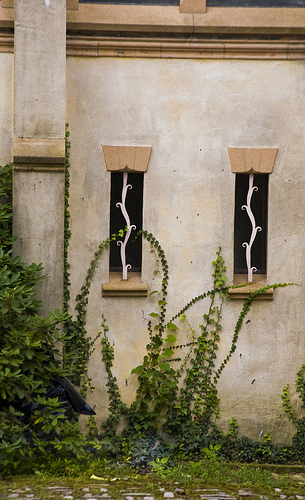
Photo by Laura Kicey
Hasta la vista, La Ronda.
It appears the only place you will be able to see Addison Mizner’s quirky Bryn Mawr mansion will be in pieces at the Philadelphia Museum of Art.
Local press reports that a demolition permit has been issued for the 1929 mansion, giving former owner Arthur J. Kania right to move in for salvage of the building’s extensive architectural features. Removing windows, stained glass, tilework, doorways, grills, stonework is tantamount to demolition, since it leaves only a shell of a building.
Following the 30-day salvage period, the anonymous current owner may raze the remaining structure.
Kania wrote, in a letter to Lower Merion officials, that he intends to donate the items to the Philadelphia Museum of Art — to preserve them. The Philadelphia Inquirer was unable to confirm whether the museum had been contacted about a donation.
Floridian Benjamin Wohl, who has stood outside the gates of the Mizner mansion for days attempting to purchase and then move the building, has been unable to work out a deal with Kania for the salvage rights and the owner for the building. The current owner was unwilling to negotiate until Wohl secured the rights from Kania.

Photo by Laura Kicey
So it appears that it is not the current owner who has brought about the building’s end, but the man who lived in it for decades and who profited $6m when he sold it. Thirty days and counting, til the walls come tumbling down. Unless….
Philadelphia Inquirer coverage here.
KYW News Radio here.
To view more images of La Ronda by photographer Laura Kicey, click here.
La Ronda protest – a set on Flickr
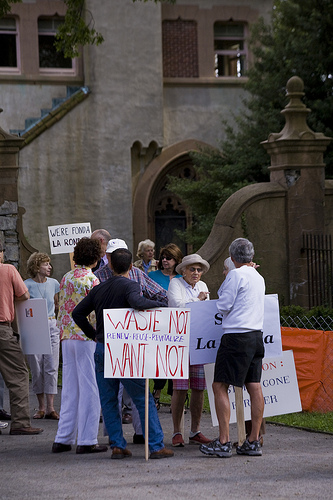
La Ronda Rally, Photo by Laura Kicey
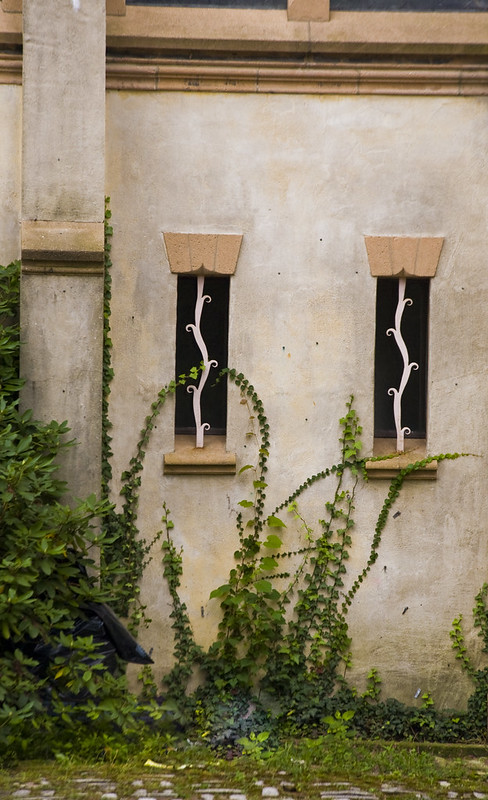
via la ronda – a set on Flickr.
If you couldn’t be at the rally today, have a look at these images from photographer Laura Kicey (and while you are there, look at her constructs and other amazing architectural photographs!).

La Ronda, Photo by Laura Kicey
Rally at the gates of La Ronda on Monday, August 31 at 4:00pm. You can make a difference.
See what all the fuss is about.
La Ronda, Here today — gone? or moved? tomorrow

La Ronda, rear facade
Preservationists get a bad rap for being obstructionist snobs who think they can tell other people what to do with their own property. The stereotype includes that “throw yourself in front of the bulldozers” zealotry that actually has a fairly reasonable explanation.
You see, a lot of historic preservation is actually about waiting, fundraising, patching, caring, nurturing — quiet stuff that takes place over years and even decades. But the stuff that gets attention is when a threat suddenly appears to some local landmark (of local or national importance, that part doesn’t really matter) because the preservationists — and other locals who have lived with the [now threatened] house or place or institution for all of their lifetime memory — assumed that if the place had lasted 100 years or more, it was going to be there for the foreseeable future. Then a bulldozer appears on the horizon and comes the shocking realization that a landmark everyone assumed was valued by the community is not valued by the person who now owns it. And so they (the preservationists and members of the community who may discover they are preservationists when they are moved to help save something they love), step in to try and protect the landmark.
This plays out every day all around the world. Out with the old, in with the new. And let me say this loud and clear — preservationists are not against the new. In fact, I’m getting tired of the default use of “McMansion” to describe whatever goes in place of what was there. New buildings that contribute something to our world are more than welcome. It’s just that when you take down one of the “they just don’t/can’t build ’em like that anymore” places and replace it with uninspired conglomerations of wallboard and faux whatever — that’s when you begin to get into McMansion territory (the dirogatory “Mc” label defining all that is bland and mass produced in our modern world).
 We’ve got one of these awful tales going on now, and whether or not the proposed new home is a “Mc” or not, I can’t say. I haven’t seen the designs. But I do know, for a fact, that the house coming down is a rare treasure, a 1929 Mediterranean-flavored mansion of the “they don’t make ’em like that anymore” variety. It’s a castle, it’s a vision, it’s the last of its kind built by architect Addison Mizner, well-regarded for his Florida-sited playgrounds for the rich (many of them famous Philadelphia family names who obviously like to spend their winters sipping cocktails poolside away from Philadelphia’s icy chill). (Think Katherine Hepburn/Cary Grant in “The Philadelphia Story but add palm trees.)
For a wonderful visual overview a la Mizner, check this post at Erin Gates’ delightful Elements of Style blog.
And its loss (if the preservationists don’t succeed in preserving it) will be a tragedy, as a fan of the architect’s work has stepped forward with an offer to move the building (and buy a nearby empty lot to put the house on and move his family here from another state to live in it). Unfortunately, as of this writing, the lawyer representing the owner has declined a first offer and not responded to a second (so say press reports).
The building has been stripped of much of the interior architectural detailing of value (fixtures, mantels, etc.) but even that doesn’t seem to matter to the hopeful new building owner who figures if he knows where it’s stored, he can buy it back and reinstall it all.
Doesn’t it seem obvious that this deal should go through? Doesn’t it seem like a win/win for everyone? Doesn’t it seem as though the owner has nothing to lose (but some time while the building is moved off the site) by selling the structure and delaying the start on building his own new house?
The clock is ticking.
La Ronda’s stay of execution is running out.
See what Adrian Scott Fine of the National Trust for Historic Preservation has to say here.
And here’s press coverage about the issue, from Philadelphia and beyond.
And if you’d like to be one of those people who are called preservationists, obstructionists, people who care about a beloved part of their neighborhood, people who can’t understand why the owner didn’t buy an empty lot in the first place, architect fans, lovers of quirky buildings, mediators, negotiators, people with hope…
you may want to attend a rally in support of the building’s rescue on August 31st at 4:00 pm
Stand up and be heard! Join local media and concerned citizens Monday evening August 31, 2009 at 4pm as we make a direct appeal to the owner of La Ronda to preserve this magnificent home. Come to La Ronda at 1030 Mount Pleasant Road in Bryn Mawr on the eve of the day that demolition may begin and stand united with others as we attach a name to the mysterious owner. Tell the owner that destroying La Ronda is totally unacceptable. Local media will be there to cover this event. Please sign up here (you can do so anonymously) to show your support and to commit to attending. Please tell your friends. We would love to have at least 100 people there to send the message that this community values La Ronda.
More info at Save La Ronda Now (also on Facebook!) And, to be clear, the “sign up here” link above is a petition, and you may want to read it and sign if you think the owner should give the house a chance to be moved, even if you can’t be at the rally in person.
Floridians — will you be sending a busload of supporters? (I’d love to see the front lawn of this place filled with those plastic pink flamingos. Please bring some with you. A great art installation to remember the place by, just in case….)
My downtown, your downtown
It’s wonderful to be back in Old City. This side of town thrives on quirky shops, galleries and restaurants, in addition to the tourist behemoth that is the Independence National Historical Park (INHP). One of my favorite spots is Foster’s Urban Homeware at Market & Fourth Streets. I stopped by to pick up a little something for my mom (but ended up with a little something for me instead) and noticed their window featured a decal promoting the 3/50 Project.

I was a fan of the concept even before I knew the official “Project” existed. With a goal of saving small, independent businesses operating on main streets, the project asks “which three independently-owned businesses would you miss if they disappeared?” They encourage you to “Stop in. Say hello. Pick up something that brings a smile. Your purchases are what keep those businesses alive.”
According to the Project, if half the employed population spent $50 in local, independent stores each month it would generate $42.6 billion in revenue. (Wow!) So, get that? 3 stores — $50 (that’s where they got 3/50) and $43 of that money, they note, stays in and benefits the community (which it doesn’t when you shop the big chain stores or — horrors! buy online)
I support the general notion, though it is redolent of the common wail “support your local newspaper because they are having trouble competing with the internet” or “support your favorite publisher and/or independent bookstore because they are having trouble competing with the chains and/or Amazon.” I think we need to support local stores and creative entrepreneurs. (As well as our newspapers and bookstores) I believe in supporting our Main Streets and their effort to define “community” and serve as a social center as well as a place of commerce. But I don’t think we can frame the argument in terms of “instead of the internet.”
Just go ask the old-time radio guy about what they thought would happen at the dawn of the Age of Television. We’re all part of the redefinition of the way the world works, moving faster than fios! This is a time of change and it remains to be seen just how different the future will be from “the good ol’ days when there were books and stuff printed on paper.”
Small shops and the downtowns they live in crashed for a variety of reasons and have been struggling back ever since. The National Trust for Historic Preservation established its wonderful Main Street program to provide expertise and guidance to help small independently-owned businesses revive their town centers and draw shoppers (and dollars) away from the mall and big box stores. In addition to the Main Street website, NTHP has also recently published Revitalizing Main Street: A Practitioner’s Guide to Commercial District Revitalization. For exclusive online content on everything from “Getting Started” and “Identifying Business Niches” to supporting entrepreneurs and balancing independent/chain stores click here.
One might argue that these brick and mortar stores are not competing with the internet (because they should all try to have a web retail presence as well) but competing with other brick and mortar stores (malls, big box) about the notion of what a preferred shopping experience ought to be.
Not long ago I was in the charming downtown of Chestertown, Maryland (which happens to be a National Historic Landmark District — the Gold Standard of historic sites in the U.S.; the town served as a major port from 1750-1790 and each year recreates its own historic “tea party” which took place as protest spread following Boston’s unceremonious dumping). It was a sidewalk sale day, complete with balloons fastened onto parking meters (free parking!) and merchandise ready to buy without even having to go into a store!
 The thing is, Chestertown is always an event for us and we always make a point of going there and we always make a point of spending money when we visit. We dine. We stroll. We soak in the atmosphere. We hang out at the coffee shop. We stop to ask complete strangers if we can pet their adorable dog. We finger the bindings of used books at either of the two! used bookstores across the street from each other. My kids insist on stopping in Twigs & Teacups to spend their allowance because it is the kind of store where anyone can find something that will delight them. We also have our annual fall tradition, when we head to the funny little shoe store to buy our back-to-school shoes. It’s a tradition that started when I bought my toddler-aged firstborn a pair of red keds which emerged from the stockroom in a box that must have dated from the mid-1970s (at the latest!).
We sit in the park with its delightfully sparkling Philadelphia-made Victorian fountain, where the children make wishes on pennies and point at the cast-iron ducks and lions spraying water and the maiden and her urn at the top. We delight in the farmer’s market on the square each Saturday and, if we stopped to think about it, are probably continuing a local market tradition as old as the square itself.
We go because we love it. We have an emotional connection with the place itself — the wide streets, the small-scale buildings, the memorial cannon, the clock tower, and on and on. We go to smile and meander and feel part of a community. We give, we get. Everyone’s happy.




 Nostalgic for the original Wayback Machine?
 My Own Time Machine: Buildings, Places, People & Things