Skip to content

Ford’s Theater Museum – Leading Visitors Through a Historical Journey to a National Heartache – Lincoln’s Assassination – NYTimes.com

July 16, 2009

Tickets to the fateful performance at Ford's Theater

One of my favorite past projects allowed me to think long and hard about museums (I was thinking specifically about historic sites) and how they do — or do not — connect with their visitors.  I nodded vigorously in agreement with Gaynor Kavanaugh’s (Dream Spaces:  Memory and the Museum) argument that artifacts should be presented as storytelling objects that evoke comparison with personal experience.  He emphasizes that basis for interpretive elements should be based on understanding the people using the museum, not the objects.  That’s basic customer service — what do people want and how best to deliver it?  It’s shocking how many history-oriented organizations come at it the other way around — and create a disconnect.

I once stood on a busy sidewalk in downtown Philadelphia asking passersby a question with the word “history” in it.  You should have seen how their faces glazed over.  “History” does not enter their daily lives in a conscious way, although they can’t avoid it on the streets of this city.  They hear the word history and are afraid that their ignorance is about to be revealed, that those questions they got wrong on their 5th grade history test are about to catch up with them.  That’s why historic sites must warp through time and tell a story people understand in terms of their own daily experiences.

The newly revamped museum at Ford’s Theater was recently reviewed in the New York Times (see link) and seems a great example of the “right” way to present history.

Museum Review – Ford’s Theater Museum – Leading Visitors Through a Historical Journey to a National Heartache – Lincoln’s Assassination – NYTimes.com.


Booths boot

Booth's boot, cut to treat the leg he wounded jumping from the presidential box

The previous exhibit “presumed an understanding, but did not create it,” says the review, perfectly summarizing the main problem with so many old house museums.  The new exhibits “lead the visitor through a historical journey” and create a context for the myriad objects on display related to the Lincoln assassination.  The objects are no longer numbered artifacts, but are vessels filled with meaning that bring an old event to life.  In fact, the “objects become creepier once you’ve seen the place where it all happened.”  That’s because they have context and context gives meaning.

For the visitor to bustling modern Washington, D.C., the museum employs “time machine” methods to show Washington the way it was:  “the malarial Potomac Flats, open sewer running along what became Constitution Avenue, the marble stump of the Washington Monument, abandoned for lack of funds.”  With those pictures in their heads, visitors feel transported through time.  

Lincoln's box at the Ford Theater. The upper right corner of the frame around Washington's portrait is nicked, where Booth's spur caught it leaping from the box

Another “time travel” experience the Ford museum creates sends visitors through a passageway where facing walls recount timelines of the two leading players — on one side Lincoln, the other Booth — and open into the theater itself at the point where the two stories intersect with tragic consequences.

Also significant is the museum’s partnership with the Petersen House across the street, where Lincoln’s body was carried after he was shot at the theater.  It seems obvious for the visitor to be able to complete the “journey” through history by finishing at the Petersen House, but it’s amazing how often struggling historic sites overlook the opportunity to create mutually beneficial relationships with thematically linked sites.  One look at the streetscape (below) clearly shows that the Petersen House is slowly being edged out of what is no longer a block of pristine historic buildings.  


Petersen House, second from right

Petersen House, second from right

It’s remarkably easy to imagine that central building with the green shutters refaced as a new Benneton.  Could the Petersen House attract enough visitors to survive alone?  Perhaps.  But the theater partnership is a wise marketing move.  A tourist will find it easier to buy a single ticket that tells the whole story, start (such as it is) to finish, than to make a choice about whether to cross the street and buy yet another ticket for the finale. 


The entire museum experience sounds creative and compelling.  It sounds emotional.  The interpretation at this historic theater sounds, dare I say it, theatrical.  Granted, Lincoln’s assassination still resonates with this country as a significant tragedy and one could argue that it would be hard to make the story boring.  Yet all over the country there are places with compelling stories that are told in a very boring, disconnected way.  Ford Theater offers important lessons for successful approaches to connecting the past to the present.  (Or perhaps Gaynor Kavanaugh would have it that we need to connect the present to the past…)

See what Anderson is up to? $10k!

July 15, 2009

The winner is the one who makes the most noise. Guess who’s going to win this round?  

(I’ll give you a hint…)

Vodpod videos no longer available.

more about “See what Anderson is up to? $10k!“, posted with vodpod

Altar Smoke — grace in the common things
July 12, 2009

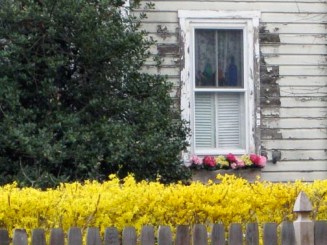
old house in springtimeI heard this poem on NPR and thought I would share.  (The author, Rosalie Grayer, was 17 when she wrote it, in 1946)

Altar Smoke

Somewhere inside me
There must have always been
A tenderness
For the little, lived-with things
A man crowds upon his worn fistful of earth.
Somewhere inside of me
There must have always been
A love
Made to fill the square aggressiveness of new-cut hedges,
And feed the pursed green mouths of baby leaves;
A love made to understand
The way grass cuddles up to porch steps leaned upon by time,
And why dandelions nudge the stones along the walk;
A love for garden hose curled sleeping in the noon hush,
Coolness trickling lazily from its open mouth,
For shingles starched and saucy in white paint,
And an old rake rusty with dreams of tangled grass and butterflies.
A love
For candle flames, like pointed blossoms on their ghostly stems,
And frost-forests breathing wonder on the parlor windows.
Somewhere inside of me
There must have always been
An altar of hewn stones
Upon which my love casts these —
Burnt offerings —
To make a sweet savor
Unto my soul.

Give me the strength my God,
To scatter my fires and tumble the altar stones in confusion;
Give me the strength to raise my eyes,
So that hard and sharp across my heart
Like shadow cut on mountain rock,
Will fall the agony of sunset —
So that I can see
The laughter of clouds spun into the blue web of infinity,
So that my soul can reach out
And melt in the sweep of forever
Above all these.

– Rosalie Grayer

Seeing eye to eye

July 3, 2009

I’m often stunned by how shortsighted people can be about the places and the buildings that create atmosphere — the sense of “special.”  Smart, creative use of unusual structures are the best way to make “place.”  Yet the world seems in danger of becoming one giant chain store experience.  Every day we lose they-don’t-make-them-like-that-anymore structures and they erect new fast food/big box/developer’s acres places that could be anywhere in America.  I get that people want to be able to buy cheap tvs and tube socks at Walmart but at what other cost?  

Threatened structures are often threatened because of money — or lack thereof.  Economic realities are tough to argue with, but I’ve seen too many examples where the real problem is short-sighted thinking and a misunderstanding of the value of evocative “age” in a sense of place.  (I am intentionally avoiding the use of “history” to avoid having to duke it out with the lobby that claims if George Washington didn’t do something important there, it doesn’t count). 
I want to cheer on the people who believe where-there’s-a-will-there’s-a-way, the matchmakers who can find creative people and money people and work to find a solution the benefits the owners and the community.  
The National Trust for Historic Preservation’s just issued their newest list of America’s 11 Most Endangered Historic Places.  Have a look and see if you don’t agree that the world just won’t be quite the same without them.
The Manhattan Project’s Enola Gay Hanger, Wendover Airfield, Utah
Dorchester Academy, Midway, Georgia
Century Plaza Hotel, Los Angeles
Unity Temple, Oak Park, Illinois (Frank Lloyd Wright, $ urgently needed before it collapses!)
Memorial Bridge, Portsmouth, New Hampshire/Kittery, Maine
Cast-Iron Architecture of Galveston, Texas
Miami Marine Stadium, Miami, Florida
Lana’i City, Hawaii
Ames Shovel Shops, Easton, Massachusetts
Human Services Center, Yankton, South Dakota
Mount Taylor, near Grants, New Mexico
When I read about Lana’i, I just shook my head and sighed.  Haven’t they learned anything? When you destroy the characteristics that define the place — erase the layers of its history expressed in built form — then you’ve got a place that could be anyplace. Not good if you derive major income from tourism.  Some parts of Hawaii might as well be Florida (which is a shorter, cheaper flight than Hawaii).  
Oahu used to be an island destination of choice but now simply serves as the waystation before one departs to another island.  People have little movies in their head about what they want their tropical destination to be — I used to live there and can still remember the charming little lei stands at the old airport, the 1920s movie theater on Kalakaua Avenue with full size palm trees and stars on the ceiling, the banyan treehouse in International Marketplace, the proud pink presence of the Royal Hawaiian Hotel.  Those “tropical touches” are gone or completely obscured now.   
Oahu has become so built up it ceased to resemble an island paradise.  The last time I visited I stood on a street corner in downtown Honolulu (the tourist area, not the business district) and I could have been anywhere — you couldn’t see sea or mountains.  I was in a narrow canyon of bland modern buildings and street, surrounded by traffic.  The island is built out and up.  And the same thing is happening on the other islands.  And the more it happens, the less appealing these places become as vacation destinations.  
On Lana’i, Castle & Cook have already built two high rise hotels and now seek to demo much of Lana’i City — “the last intact plantation community in Hawaii.”  I haven’t been there, but there has to be a creative solution that could utilize much, if not all, of the existing buildiings — as shops, getaway cottages, etc. — and preserve the character of the area.  The National Trust asks you to “make your memories part of the debate over the future of Lana’i City” — send them to 11Most@nthp.org
The item on the list that has personal meaning for me is the bridge that spans the Piscataqua River flowing between New Hampshire and Maine.  I was born on the Portsmouth Naval Shipyard in the middle of that river.  I have very early memories of crossing the bridge to go to Portsmouth where we’d stop at the bakery with the amazing cinnamon sticks or browse the counters at Woolworth’s to pick out the perfect Halloween costume (Caroline Kennedy and I both wore the same witch costume with the green-faced plastic mask.)  After seeing a movie in Portsmouth to celebrate my (sixth?) birthday my mother drove a station wagonful of rowdy kids over that bridge — and I remember how she startled them all into quiet by making the back window go down mid-span (keep in mind this is long before the era of car seats — we were all packed into the cargo area — so a rear window disappearing was dramatic).  I remember the hum of the tires on the bridge decking.
Built in 1923, Memorial Bridge was the longest vertical lift bridge in the country and is still considered an engineering landmark.  I remember waiting in a line of cars while the lift was up to allow ships to pass below.  And I remember construction underway of the high-arching new bridge that allows uninterrupted flow of traffic on I-95 heading to outlet shopping and vacation lands.
Today Portsmouth is a hip and happening town filled with buildings that reflect its history as  a thriving port town and shipbuilding center.  Kittery, across the river, is a quieter little village with charming homes (including the artist’s studio my parents rented when they first moved there in the 1950s) and popular outlet shopping on Route 1.  
Memorial Bridge provides pedestrian and bicycle access between the two towns but requires “immediate rehabilitation.”  NTHP reports “in 2008, estimates for repairs came in higher than expected, and both the Maine and New Hampshire departments of transportation (which co-own the structure) began a joint study that could result in the removal and replacement of the historic span within five years, a solution that could prove far more costly than repairs.”
I don’t know their rationale for wanting to demolish the existing bridge; perhaps it is a long-term maintenance cost issue.  But I think an explanation is owed before discarding this character-defining bridge, with its elaborate tracery metalwork and the two lift towers that are striking visual landmarks.  The NTHP article asks that letters be sent to Maine Governor John Baldacci to encourage rehabilitation of the bridge.  (That’s an unfortunate word — sounds like it should be sent to work camp to think over what it’s done wrong…)  I don’t know why they don’t also ask that letters be sent to New Hampshire Governor John Lynch….
Contact info (click links above for email page):

NH:  Office of the Governor 
State House
25 Capitol Street 
Concord, NH 03301

(603)271-2121
(603)271-7680 (fax)

Maine:  Office of the Governor
#1 State House Station
Augusta, ME 04333-0001
Phone:  207-287-3531
Fax:  207-287-1034 

History in Disguise

June 30, 2009

What?  Robots?  Isn’t she taking this whole time machine thing a little too far?  What do robots have to do with history?  Or old buildings?

Let me explain.

The robots are from the summer blockbuster, popcorn flick “Transformers: Revenge of the Fallen” which pulled in $200 million at the box office in just five days.   There is very little plot to speak of — it’s all action, explosions and running from here to there (so that newest “It” girl Megan Fox can stretch her legs).  In a movie where visuals are of primary importance,  you must have really, really good visuals.  Those backgrounds had better be as compelling as the robots.
So where did director Michael Bay choose to shoot?
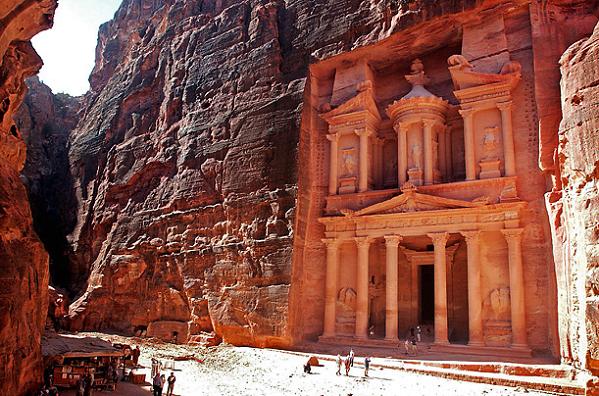
Well, there were the Egyptian pyramids. And the beautiful Temple of Petra — a breathtaking “structure” carved from a rock face (so distinctive you may remember it from the finale of “Indiana Jones and the Last Crusade” ).

Both the pyramids and the temple are ancient monuments weighted with history and revered around the world.  They are recognizable symbols of place.

Bay’s other chosen locations featured less-well-known but equally atmospheric, potentially-iconic places — and all of them are located in Philadelphia.  Since I doubt you will see the movie unless you also have two young boys, let me explain.


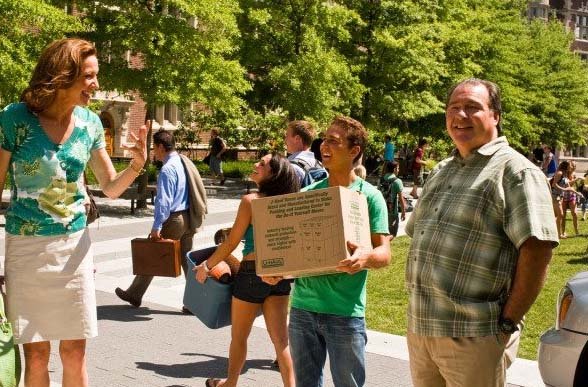
The hero leaves California for the Collegiate Gothic backdrop of the University of Pennsylvania campus where a robot disguised as a pretty girl attempts to suck out his brain.
laurThe clandestine meeting between the hero and a five-stories tall robot was set amid the highest marble monuments of Laurel Hill in Fairmount Park.
There was a hot rod Camaro (really a robot) parked in front of Drexel’s ornate Main Building (Wilson Brothers, 1891) followed by an adrenalin-fueled chase scene.  This went from (what I thought was Founder’s Hall at Girard College but IMDB tells me was) the Free Library Central Library building on to a smash n’ crash battle at the Windrim-designed Delaware Generating Station (deserving of historic designation and the protection that would bring).
Our heroes managed to escape the clutches of the giant bad guy robot (at right) to find temporary refuge within the thick walls of Eastern State Penitentiary.
Each of these locations are, in their own way for their own period, as remarkable as the Temple at Petra — and remarkably all are located within easy bicycling distance of one another — no robot transport required.

Long ago, historically speaking, young men of a certain class would take the Grand Tour to see the birthplace of civilization and culture. The journey’s intent was to enhance their education and inspire their view of the world for the remainder of their lives.  In our digitally-driven world, is it possible that a movie with exploding robots might subconsciously imprint a sense of value and appreciation for these unique historic places?  Am I the only one who noticed each and every location and thought to myself “this just wouldn’t have been the same if they filmed at the parking lot at King of Prussia mall….”? I left the theater listening to my sons prattle on (“watching a truck turn into a robot is just awesome!”) and contemplated what a treasure trove this area is for architecture.  Ergo potential movie sets.  Wouldn’t it be nice if a portion of the income from movie production (did I mention the production budget for “Transformers 2” was a reported $200million — and did you note above that it earned that back in just five days?) went into a fund to support maintenance of notable historic sites in the area?

Half empty, half full

June 29, 2009

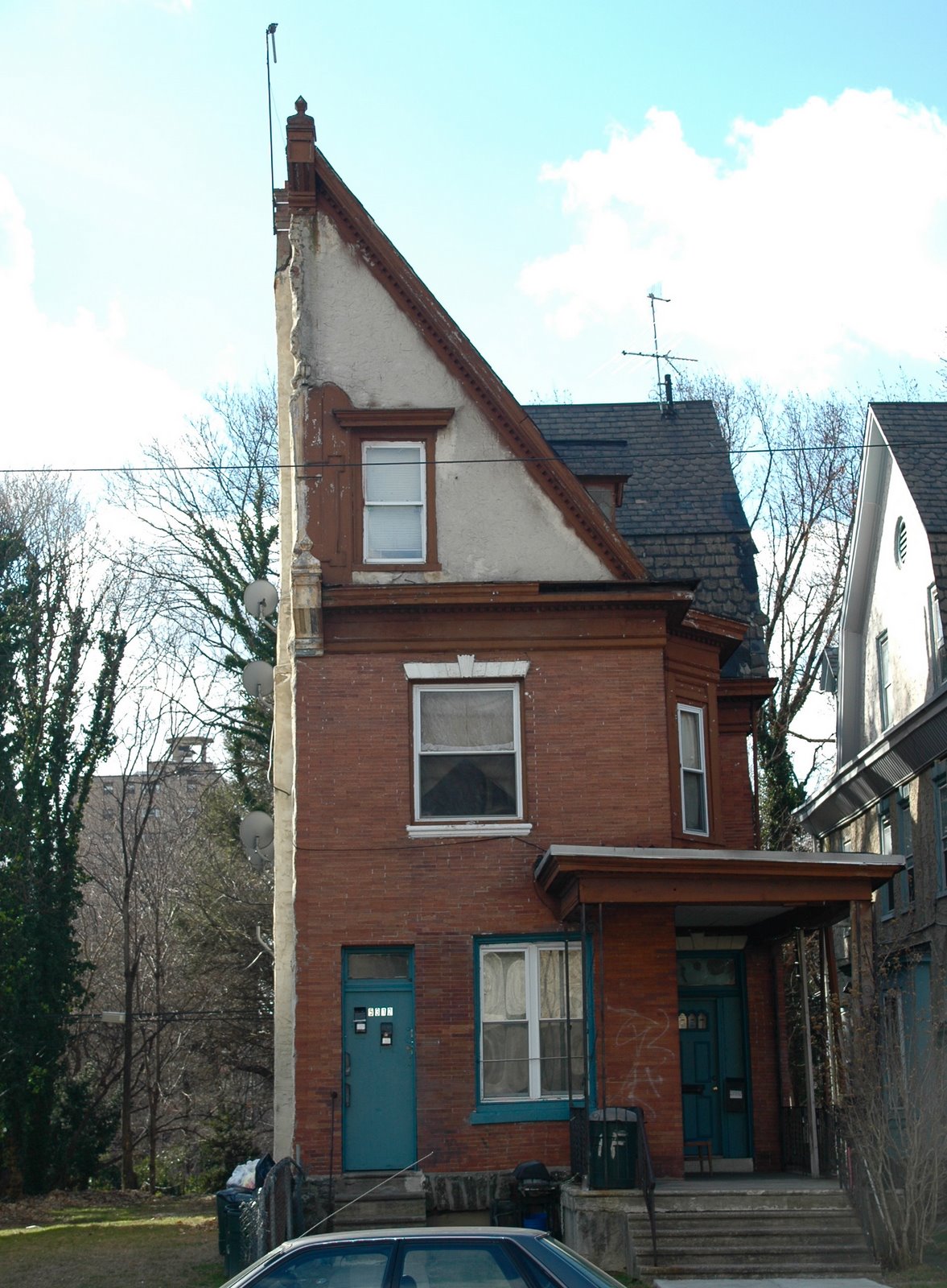
This house lost its twin.  A shame since it sits in the middle of a whole block of these identical twins.  (And the remaining half has been halved again — note the two entry doors.)

Fitzwatertown, Montgomery County
June 24, 2009

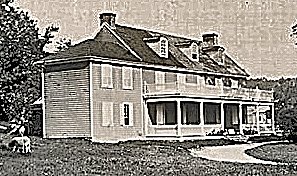
Since learning of its impending demolition, the Upper Dublin Historical Commission has been working to preserve a building connected with one of the founding families of the area.  The building, on Limekiln Pike, is currently owned by the Lulu Country Club.  Formerly used as a residence for the club groundskeeper the building is vacant and is suffering deterioration from deferred maintenance.

The Historical Commission encouraged the club and Upper Dublin Township to make efforts to correct some of the problematic conditions and now that the roof is sealed and other repairs are complete, the building is secure for the time being.
Much of the early history of the family has been lost, though it is known that Thomas Fitzwater sailed from England with William Penn,* who granted him a tract of 1,000 acres, which Fitzwater added to with later land purchases.  Fitzwater’s rich limestone deposits became one of the most important area sources for limestone (the others located in Lower Merion) and led to construction of the first road “into the wilderness” from Philadelphia.  Ordered by William Penn, the road began at the Port of Philadelphia and terminated at a Fitzwater limekiln.  This road, then and today, was known as Limekiln Pike.  According to Suzanne Hilton, author of Yesterday’s People:  The Upper Dublin Story (1975) some of the limestone from these quarries traveled along Limekiln Pike for use in building Independence Hall (built 1732-1753).  The inn along Limekiln Pike, she wrote, “served the needs of mule cart drivers carrying lime from Fitzwater’s kiln to Philadelphia for the  making of bricks eagerly sought by the Colonists for the building of dwellings.”
The photograph above (note the sheep visible to the left of the house) comes from Fort Washington and Upper Dublin (Fort Washington Historical Society, Arcadia Publishing, 2004).  The caption states that the picture was taken in 1896 and that the old Fitzwater Mill is located across Limekiln Pike from the property.  Charlotte, whose husband Robert Potter died in 1884, was the owner of the house at this time, which had once been owned by her grandfather, John Fitzwater.  Research has been unable to determine an exact date of construction.  The July 14, 1898 edition of the Ambler Gazette reported the following:
The Fitzwater Homestead
While it is somewhat difficult to say where was the original Fitzwater homestead, yet it is certain that Mrs. Robert E. Potter now lives at one of the old homes of the family.  This is where John Fitzwater lived [who ran the mill at Sandy Run], and on the west side of the turnpike, a short distance from the store _____.  Here is a large smooth _____ with a modern porch.  Though the house has a new appearance, it has only been modernized, the walls being of the olden time.  A large stone barn stands in the rear.  These buildings are on the south side of Sandy Run.  This is part of the very old grant of 1695, made to Matthew Perrin, of 500 acres, and the subsequent history of which is told in the account of the Stont farm.  It is part of these tracts which in 1768 Samuel Noble and Chas. West by deed of partition conveyed to Aquilla Jones and Elizabeth, his wife, parents of Isaac Cooper Jones.  In 1808 Isaac Cooper Jones sold 90 1/2 acres to Thomas Livezey and John Fitzwater.  The latter conveyed his right to Livezey who was a justice of the peace.  At a different time, Livezey conveyed the property to John Whitcomb.  The latter was landlord of the old hotel at Fitzwatertown, standing where the present one stands, and which was on this tract.  In 1832 Whitcomb sold to Robert McAdams, who held the tavern til his death, in 1846.  His daughters, Julia Ann and Jane, came into possesssion in 1852, who that year conveyed to Robert E. Potter, whose wife had been Charlotte, daughter of John Fitzwater.
In September 1898, the Ambler Gazette featured an item about the death of Charlotte (or “Lottie”) Potter’s brother, John Fitzwater of Philadelphia.  The funeral was held at Charlotte Potter’s home (“a large number of friends of the deceased attended the funeral”) and the burial followed in the nearby family plot on Twining Road. The digitized collection of the Ambler Gazette begins in 1886 and is a wonderful resource for those interested in local history.

Charlotte Fitzwater Potter was the youngest child of John Fitzwater. (She was the great-great-great-granddaughter of Thomas Fitzwater.*)  The 1870 census shows 28-year-old Lottie married to Robert Potter, who is listed as a druggist.  Living with them were five children, Charlotte’s mother, Mary, and Charlotte’s brother Jacob, listed as “innkeeper.”
In 1900 the census for Upper Dublin Township lists Charlotte F. Potter as age 64, a widow, who had given birth to 10 children, with seven living.
Based on a preliminary evaluation of architectural evidence, the smaller portion of the structure appears to date from the 18th century and the larger portion facing Limekiln Pike was probably built in two campaigns during the early or mid-19th century.   Since the historic photo was taken, the house has lost the front porch and the addition,  visible on the left portion of the house.
To view photographs taken during an early Historical Commission inspection of the site, please see below or visit the Fitzwater Potter House portfolio.   The Historical Commission, which is pursuing additional research into the history of the property, believes this building merits preservation and is working to develop a viable plan for adaptive reuse.
UPDATE:  Success!  The house will be preserved under an agreement with the Lulu Country Club and Upper Dublin Township.  The site has been separated from the county club parcel and the house offered for sale.  Here’s to the next owners, with hopes they will pursue a thoughtful rehabilitation of the building, earning the thanks of local residents for preserving this part of our local heritage.
*In 1682, Thomas Fitzwater of Hanworth in England sailed with sons Thomas and George and servants John and Henry, aboard the ship “Welcome” with William Penn.  Fitzwater’s wife Mary and two of his children, Josiah and Mary, died at sea.   According to “The History of Bucks County, Pennsylvania” by W.W.H. Davis (1876)  Fitzwater became a member of the first assembly, drafted and signed the first charter.  He died in 1699.
* Yours truly is the great-great-great-great-great-great-great-great granddaughter of Thomas Fitzwater.

My Time Machine — and welcome to it

June 20, 2009


There’s a story I have yet to write about how I grew up nowhere and somehow moved to my genealogical epicenter.  Though I bought a house because it was close to the train and had a pretty little arbor in the back, I later discovered that I was nearly surrounded by ancestral ghosts.

My relative Fitzwater White once lived around the corner and is buried in a churchyard up the road (with both his wives nearby).  I learned that the Fitzwater family founder arrived with William Penn and he and kin are buried in a family plot in the middle of a subdivision in nearby Fitzwatertown.  The Whites (the name my mother grew up with) may be found in the pretty meetinghouse yard up the road that-a-way.  In the opposite direction, a couple of my father’s Smith ancestors lie under a poem inscribed on a stone erected in a cemetery where only a few years later British troops chasing George Washington would camp.

It turned out my grandfather was born in a little town not far from here, at his father’s mill on a road that’s named after the family — White’s Mill Road.  The mill itself was torn down soon after I learned about it.  Losing it so soon after finding it was hard.  I wanted to know more. 
Confronted with this connection to history and people in a place that was new to me, I began to explore what it all meant.  Helping my father do geneaology research I learned about more and more connections to this place.  
A twist in my life journey found me back in school, pursuing a degree in historic preservation.  Perhaps I was hoping to learn the skills that would allow me to bring back to life the people and places I was distantly connected to.  This blog is an experiment in doing just that, a newfangled time machine that will allow me to share historic material with the intent of inspiring, informing, or intriguing others.
I’m also a strong believer that the past shouldn’t be unapproachable.  History doesn’t have to be a string of dates and a quiz with a pass or fail grade.  With the time machine, the person from 1897 (my great-grandfather) might simply be your neighbor, with many of the same passions and concerns you and I have.
So, yes, I have an agenda here.  But this will be a work in progress and I encourage you to share your own ideas with me.  One of my goals is to work with some of the many local archives and repositories  that are unable to digitize their collections to post a few alluring tidbits from their valuable collections (and urge you to visit them to see what else you may find).  
If you are on your own quest, do check out the links list for possible new leads.