Church of the Assumption: The next hurdle

Photo by A. Palewski
Update from Plan Philly here.
The story, by Alan Jaffe, recaps the May 10 meeting about the ongoing debate over the future of the Church of the Assumption. It says, in part:
The battle over the future of a Spring Garden church building moved into the Philadelphia Court of Common Pleas this morning, with the focus on the power of one city department versus another.
Does the Board of License and Inspection Review have the right to hold a full hearing on a preservation case already decided by the Philadelphia Historical Commission, and then reverse the Commission’s decision?
The Court of Common Pleas will hear the case on the demolition of the Church of the Assumption in two weeks. Oral arguments are scheduled to take place on Thursday, May 10 at 10:00 AM in Court Room 426 of City Hall. Please attend the hearing if you are available.
So far….
1. The church was added to the Philadelphia Register of Historic Places on May 8, 2009.
2. The owner of the church, Siloam, applied for financial hardship in order to pursue the demolition of the structure. The Philadelphia Historical Commission granted financial hardship on September 10, 2010, allowing demolition.
3. The Callowhill Neighborhood Association and several neighbors appealed the ruling and the case was heard by the Board of License and Inspection Review. The Board overturned the ruling on May 17, 2011, prohibiting demolition.
4. Siloam filed for appeal of the Board’s decision. The Philadelphia Court of Common Pleas heard the appeal on May 10, 2012.
Foto Friday: Tea with Gracie
It’s springtime and the blossoms are bursting forth.
My cherry tree is the first bit of color in my neighborhood. Then the dogwoods begin to wake. When the crocus begin to fade, the daffodils leap in to the color fray. The giant sycamore up the street has a blanket of Virginia bluebells spread out around its trunk. So pretty.
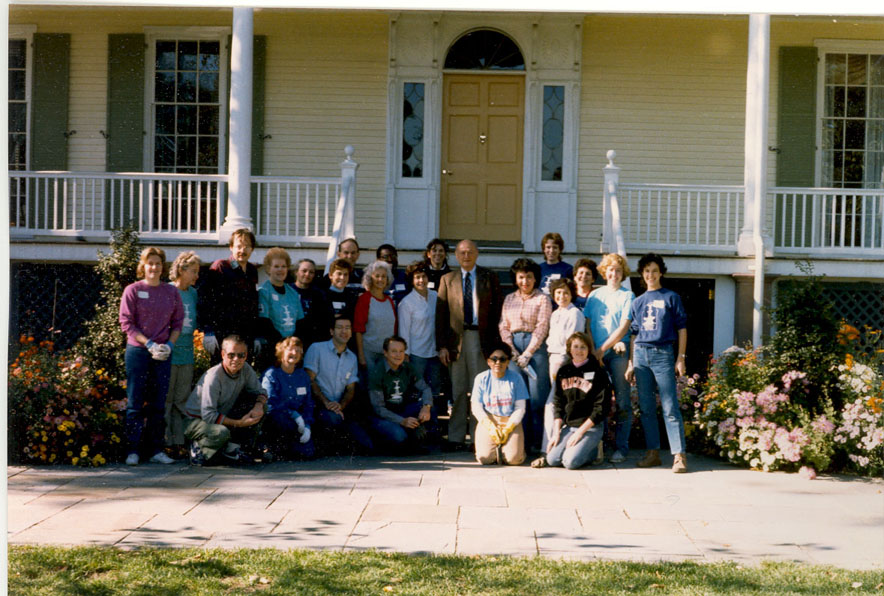
I haven’t been back to New York City to check, but I”m guessing that the bluebells, daffodill and tulip bulbs I helped plant as a volunteer with the Central Park Conservancy are probably busting out all over — including over at Gracie Mansion. (See if you can find me in the group above; I”m standing next to SaraLevine, the wonderfully inspiring manager of the L.I.V.E. — Learning/ Involvement for/Volunteers in the /Environment — program as part of the nascent Central Park Conservancy. And, yes, that’s the inimitable Ed Koch in the middle of the group. I have also hit him up for a donation when I was a Central Park gatekeeper during the annual park clean up/fundraiser day — he pulled his pockets inside out to show that he had no cash on him.)
You can check on my posies at this historic mansion by taking a tour — available most Wednesdays at 10 AM, 11 AM, 1 PM and 2 PM. (General admission is $7 for adults, $4 for seniors, and students are admitted free of charge. Tours last approximately forty-five minutes.)
A more special treat would be the Tea Time Tour, where you get to experience the residence and enjoy a delicious assortment of homemade tea sandwiches, teacakes, and scones, plus the House Tea — a blend with a twist of mandarin and safflower (for groups of 25-50 people on Tuesdays and Thursdays at $25 per person).
Haven’t ever heard of Gracie Mansion? Let the brief history below lure you to its location in Carl Shurz Park on the Upper East Side along the East River. For more information or to book a tour, contact the Gracie Mansion Conservancy.
In 1799, a prosperous New York merchant named Archibald Gracie built a country house overlooking a bend in the East River, five miles north of the City. Financial failure forced Gracie to sell his house to Joseph Foulke in 1823, and in 1857, the house came into the possession of Noah Wheaton. The City of New York appropriated the estate in 1896, incorporating its 11 acres of grounds into the newly-formed Carl Schurz Park.
After decades of use as a concession stand and restrooms for the park, Gracie Mansion was restored and became the first home of the Museum of the City of New York. When it moved to a larger building, Gracie Mansion became a historic house museum run by the Parks Department. Parks Commissioner Robert Moses convinced City authorities to designate it as the official residence of the Mayor, and in 1942, Fiorello H. La Guardia moved in.
The house was enlarged in 1966 with the addition of the Susan E. Wagner Wing, which includes a grand ballroom and two intimate reception rooms. The Gracie Mansion Conservancy was established in 1981, and under its guidance, the first major restoration was undertaken between 1981 and 1984.
In 2002, the interior and exterior were again restored, and the house was transformed into the “People’s House” with increased accessibility to the public and to City agencies. It has also been used to accommodate visiting officials and dignitaries, such as former guests First Lady Rosalynn Carter and President Nelson Mandela.
The Gracie Mansion Conservancy is a private not-for-profit corporation established in 1981 to preserve, maintain and enhance Gracie Mansion – one of the oldest surviving wood structures in Manhattan and a member of The Historic House Trust. The Conservancy’s mission is to raise funds to restore the historic structure and acquire furnishings that illustrate the rich history of New York; improve the surrounding landscape and gardens; and provide educational services, including publications and tours.
History

Foto Friday: Ruin Porn
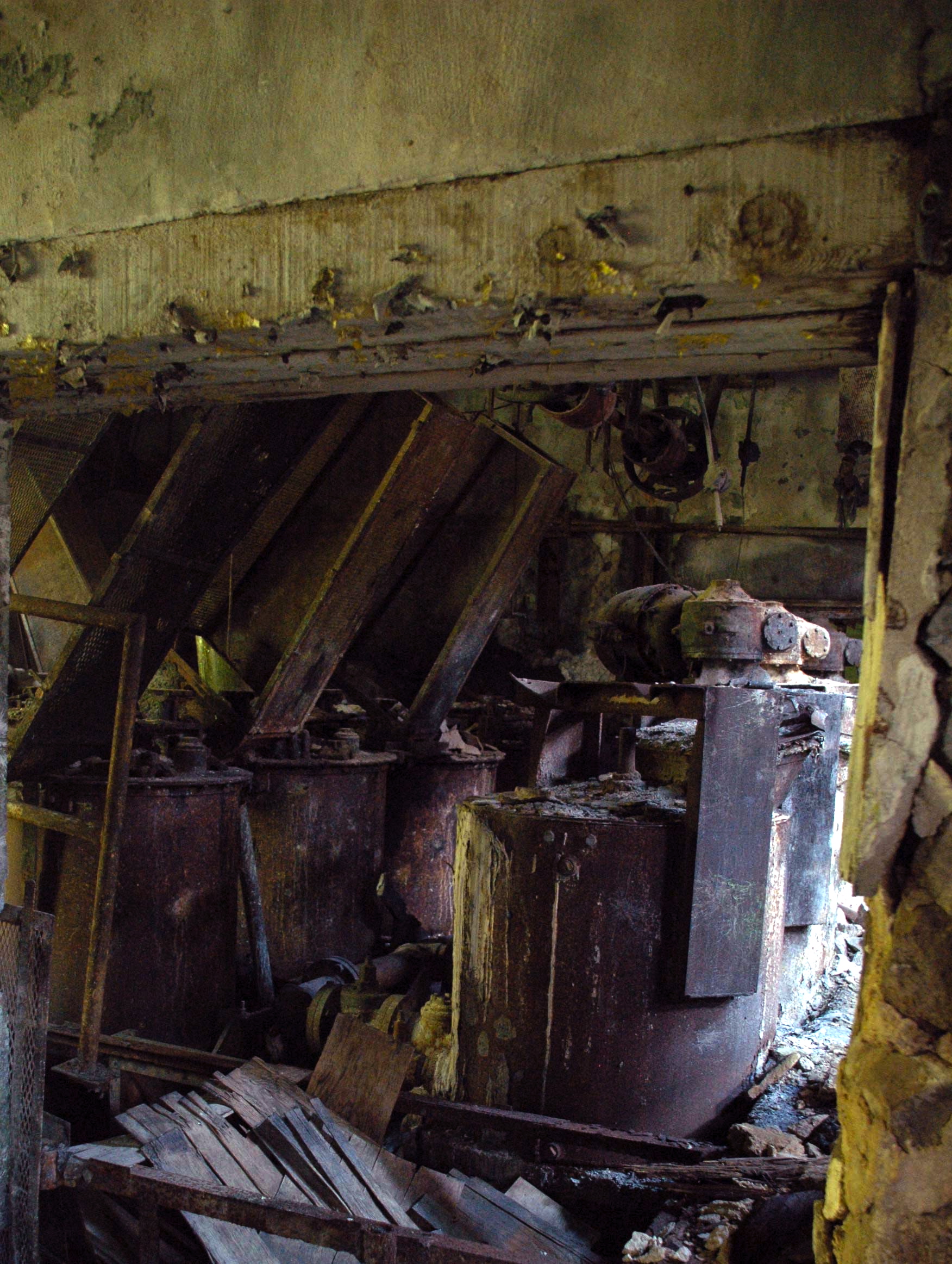
Photo by Sabra Smith, see Creative Commons License in sidebar
Once upon a time we thought asbestos was a marvel of a building material. Then we found out otherwise. The factories that manufactured asbestos-related materials shut down. Seen above is what’s become of a place that was once considered the world capitol of asbestos production.
Rambo House

Rambo House, Swede Street, Norristown, Pennsylvania
Here’s a sneak peek at an upcoming post (I’ve got a lot of work to do before I’m ready to share it with you).
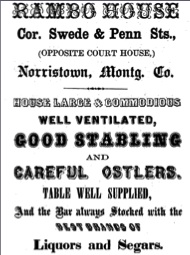 Above is Rambo House, a hotel once located on Swede Street in Norristown, Pennsylvania, across from the County Courthouse. Nathan Rambo, a onetime owner of the property, is a cousin (something removed) of mine. I pulled his will and the inventory of his belongings for a research project. In trying to build the context for his properties, his community, his life and times, I discovered a fire insurance survey for Rambo House.
Rambo House
Cor. Swede & Penn Sts.,
(Opposite Court House)
Norristown, Montg. Co.
House Large & Commodious
Well Ventilated,
Good Stabling
and
Careful Ostlers,
Table Well Supplied,
And the Bar always Stocked with the
Best Brands of
Liquor and Segars.
Fire insurance surveys are wonderful research tools, providing detailed descriptions of a building from top to bottom. To read the Rambo House survey, click here for a downloadable pdf file or simply scroll down. The image and this document is all that is left of Rambo House. It was demolished in the 1970s. (A bill for wallpaper discovered in my research, allowed me to suppose that Nathan Rambo’s residence, across the river in Bridgeport, probably also featured wallpaper in its public rooms.)
Franklin Fire Insurance 0/23260
Survey made and reported to the Franklin Fire Insurance Company of Philadelphia for Nathan Rambo of his three story brick dwelling & tavern house with back buildings on the northwest side of Swede Street on the Lot North corner of Penn and Swede Street, Norristown, Montgomery County, Pennsylvania
Building 51 feet front by 34 feet deep
Back building 22 feet wide by 30 feet deep
Cellar under front house divided by walls into three parts (A roadway in basement 10 feet wide for carriages to pass through into Tavern Yard not dug out under)
Ground floor, joists of Basement floor 3 by 8 inches, 18 inches apart
3 small windows 3 lights each. Steep stairs up to first floor. Basement story walled with stone.
Basement, divided into three rooms and Roadway. 8.6 feet high in the clear. Ceiled, plastered & painted. W. pine floor narrow. Washboard. SW office, 2 windows front, 12 lights: 8 by 16 inches and one window back 12 lights: 10 by 16 inches, all double hung on weights. Double paneled Shutters 1 1⁄2 inch thick. Iron strap hinges and bolts.
Out door front 2 inch thick knob lock. Two lights over in square head. Large closet with two doors. Board partitions across office with double doors in knob lock. Hatchway door over cellar stairs. Middle office same. NE office has no partitions, is otherwise alike.
4 in. Grecian moulding finish
First Story – One Room, 10.6 feet high in the Clear. Ceiled, plastered & painted. Yellow pine floor narrow, washboard. Five windows front and 4 back. 12 lights: 10 by 18 inches, double hung on weights. Double panel shutters 2 inches thick. Iron strap hinges and bolts. Middle window front with 2 small doors under to open (shutters down the whole length) onto a piazza 3 1⁄2 feet wide the length of house. Resting on cast iron brackets every 4 feet. Three wooden joists 3 by 4 inches with yellow pine floor. Iron Railing 36 inches front and sides. Heavy pattern. Two doors two inches thick, knob lock, to steps down to Bar Room.
Door to back part 2 inches thick. Knob lock. 4 inch Grecian moulding finish.
Second story – front part 9.4 feet high in the clear. Ceiled, plastered and painted. White pine floor narrow. Washboard. Divided by entry 5 1⁄2 feet wide through the middle of house the whole length. Five rooms front and four back with back entry, one window to each room, 12 lights: 10 by 16 inches double-hung with weights, double-paneled blinds 1 3⁄4 inch thick. Iron strap hinges and bolts. Door to each room and back entry 2 inches thick, knob lock, transom over, one light hung on pivots.
In Back Entry is Close Winding Stairs to Third Story. Stair door 1 1⁄2 thick, knob lock, large closet under stairs, large door, door from back part double, 2 inches thick, knob lock.
4 inch Grecian moulding finish to this story.
Third story front part 8.83 feet high. Ceiled, plastered & painted. White pine floor, narrow. Washboard. Divided as below into 2 entries and nine rooms. Eleven windows, 12 lights: 10 by 14 inches hung and Blinds as below. 10 doors 1 3⁄4 inch thick. Knob lock and pivot transom over. Close winding stairs in entry. Two stair doors. Knob lock 1 1⁄2 inch thick. Narrow closet.
3 1⁄2 inch Grecian moulding finish.
Garret beam nothing Peak 9 feet high. Double pitch.
Rafters 3 by 5 and 6 inches — 18 inches apart from center to center, Supported by Purluns[?] The whole length 8 by 6 inches resting on end walls and 5 truss. String piece 8 by 7 inches, Main braces 8 by 6 inches, 2 posts 8 by 6 inches cross brace 8 by 6 inchyes and back braces 4 by 6 inches Pinned together with iron bolts. Covered with slate 7 2/3 inches to the weather. Not floored. One window in end, 12 lights: 10 by 12 inches, with blinds as below. Walls of front and back are 1.3 inches thick in basement stories, through residence 9 inch walls. Walls in basement, between the offices and roadway 9 inches thick. All of good hardburned brick, the front pressed brick laid in white mortar. Marble facings to the basement front. Partitions in 2nd and 3rd Stories are lathed and plastered studding. Doors are all paneled in back part. Cellar 7 1⁄2 feet deep. Walled with stone. Ground floor, 3 windows, 3 lights. Winding stairs to basement above joists 3 by 10 inches, 16 inches apart from Center to Center.
Basement, kitchen, one room. Ceiled, plastered and painted. White pine floor, narrow. Washboard. Out door 1 3⁄4 inch thick, knob lock and lights over. Door from foot of stairs going up and at head of stairs door 1 1⁄2 inch thick, knob lock. Four windows, 12 lights: 10 by 14 inches, hung and shutters as front. Dresser closet, 4 doors large shelved closet with door, large dumb waiter box, and brick oven projecting into room, about 6 feet square.
3 inch Grecian moulding finish.
First story – 9.4 feet high in the clear. One room, 4 windows, 12 lights: 10 by 16 inches hung and shutters as front. Door from front, and out door 2 inches thick. Knob lock. Dumb waiter, range large, dresser closet 4 doors. Shelved closet, large door. Wooden mantle.
4 inch Grecian moulding finish.
Second story. 8 2/3 feet high in the clear. 2 rooms. Ceiled, plastered & painted white pine floor narrow. Washboard. Back room larger? 3 windows, 12 light: 10 by 14 inches hung and blinds as front. Door from small entry 1 1⁄2 inches thick. Knob lock. 4 wardrobe closets large doors, wooden mantle. Bath room small, one window and door as before. Bath tub hot and cold water pipes. One window in entry as others. Hatchway through ceiling to garret above.
Roof double pitch. Peak 6 feet high. Rafters and slate as front. Tin gutters to roofs and tin conductors down front and back. Partitions are lathed and plastered. Studding – Doors are all paneled. Walls are all of brick. Well-burned, 9 inches thick.
An old house adjoins this on South West side.
L.E. Corson
Happy Valentine’s Day — from the Time Machine
Of the many choices in the scrapbook of my grandfather’s postcards, I chose this one because those little flying valentines seemed like a 1910 foreshadowing of emails. You write your love, sign it with a kiss, and release it to fly through space and land in your lover’s lap.
Wishing each and every one of you a very happy Valentine’s Day! (If you are one of those unfortunate people who rejects the holiday based on commercial cynicism or traumatic experience, may I suggest you make it about someone else? Leave a secret admirer surprise for someone who doesn’t have a valentine of their own this year. Spread the love, so to speak.)
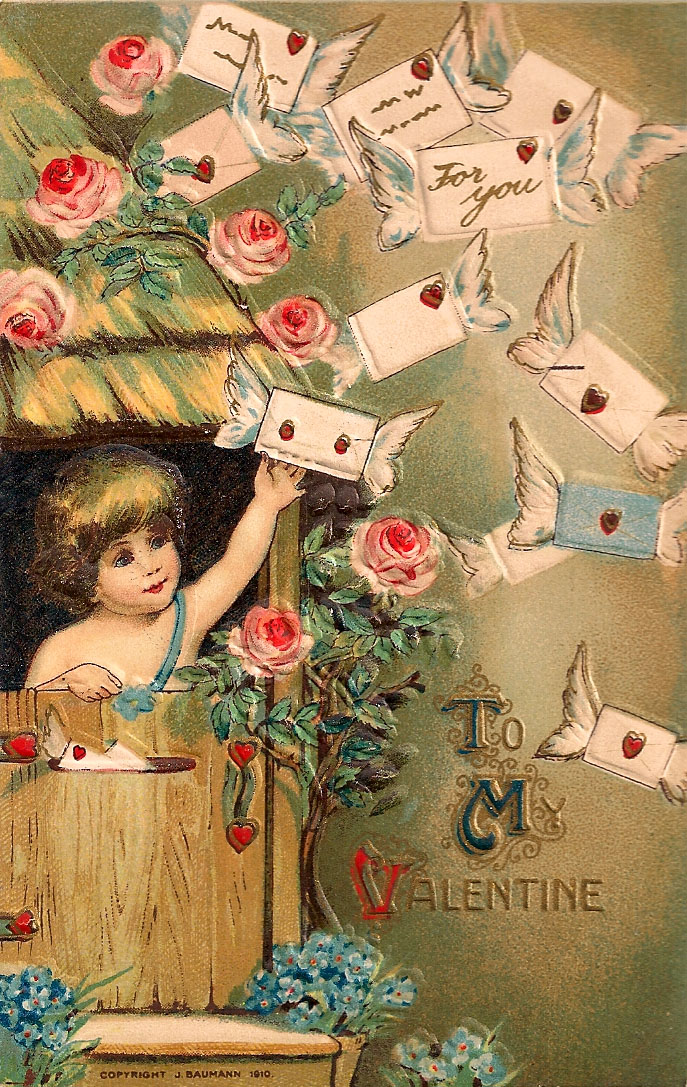
This card was never mailed, but is copyrighted J. Baumann, 1910, series 2282, and printed in Germany. The reverse indicates postage required: Domestic One Cent, Foreign Two Cents.
Foto Friday: Strolling the High Line
White’s Mill: The Dramatic Conclusion
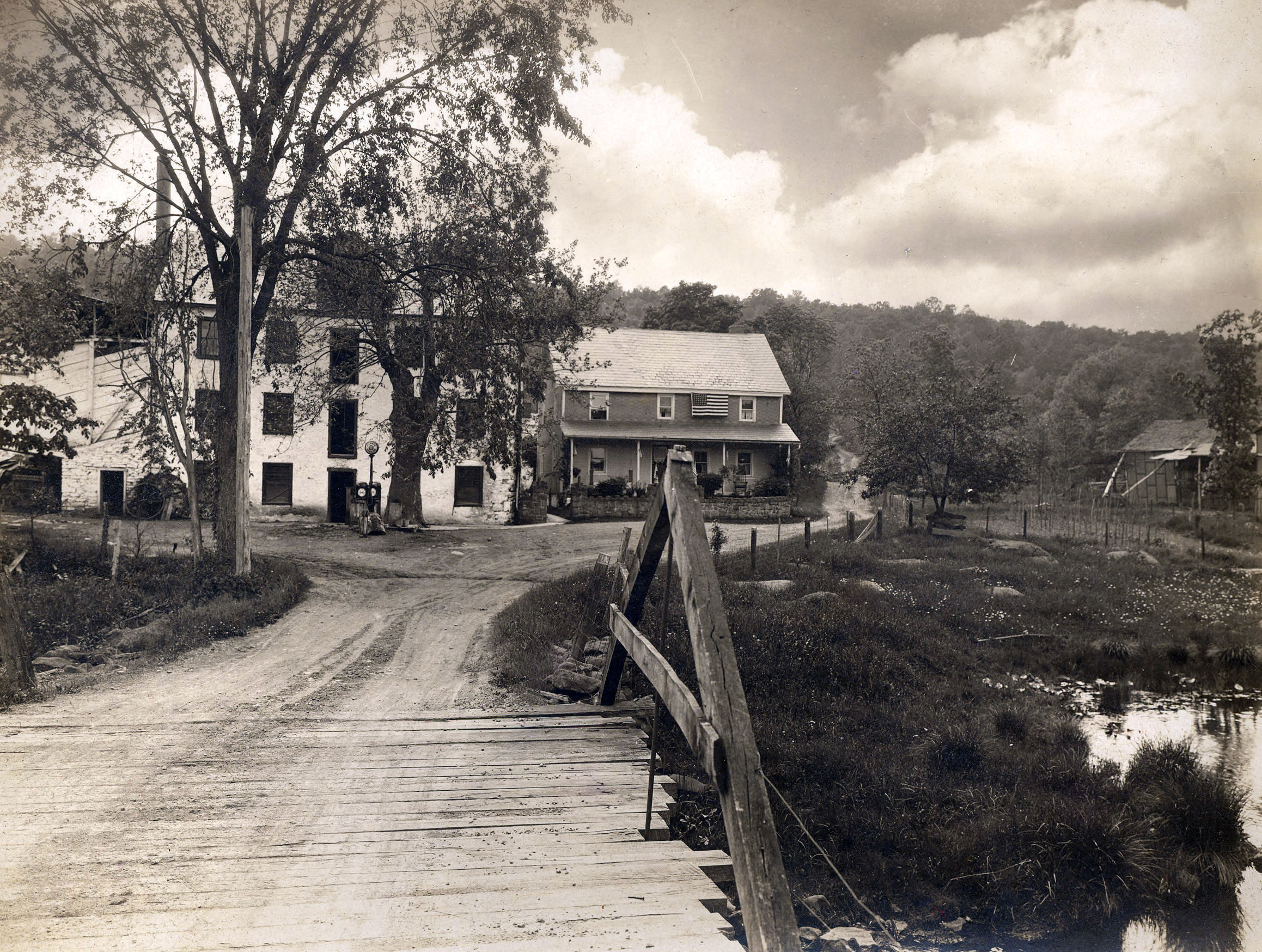
White's Mill: Photo by Thomas White. At right, one of the ice houses
Risk and Decline
Perhaps the fascination with the “romance” of rural life came from recognition of the strong ties people had to the land and to each other. Theirs was a “social economy” linking one neighbor to the next rather than today’s monetary-based consumer economy in which we seem more linked to our possessions than anything else. The hard work of agrarian life defined the rhythms and patterns of life in a small town and those interdependent relationships were vital to the town’s basic survival. Without the saddler, the blacksmith, the shopkeeper, or the miller, life would not have been possible. Today we often sentimentalize this picture of “community.” The reality, rather than the romance, showed that daily life was challenging.
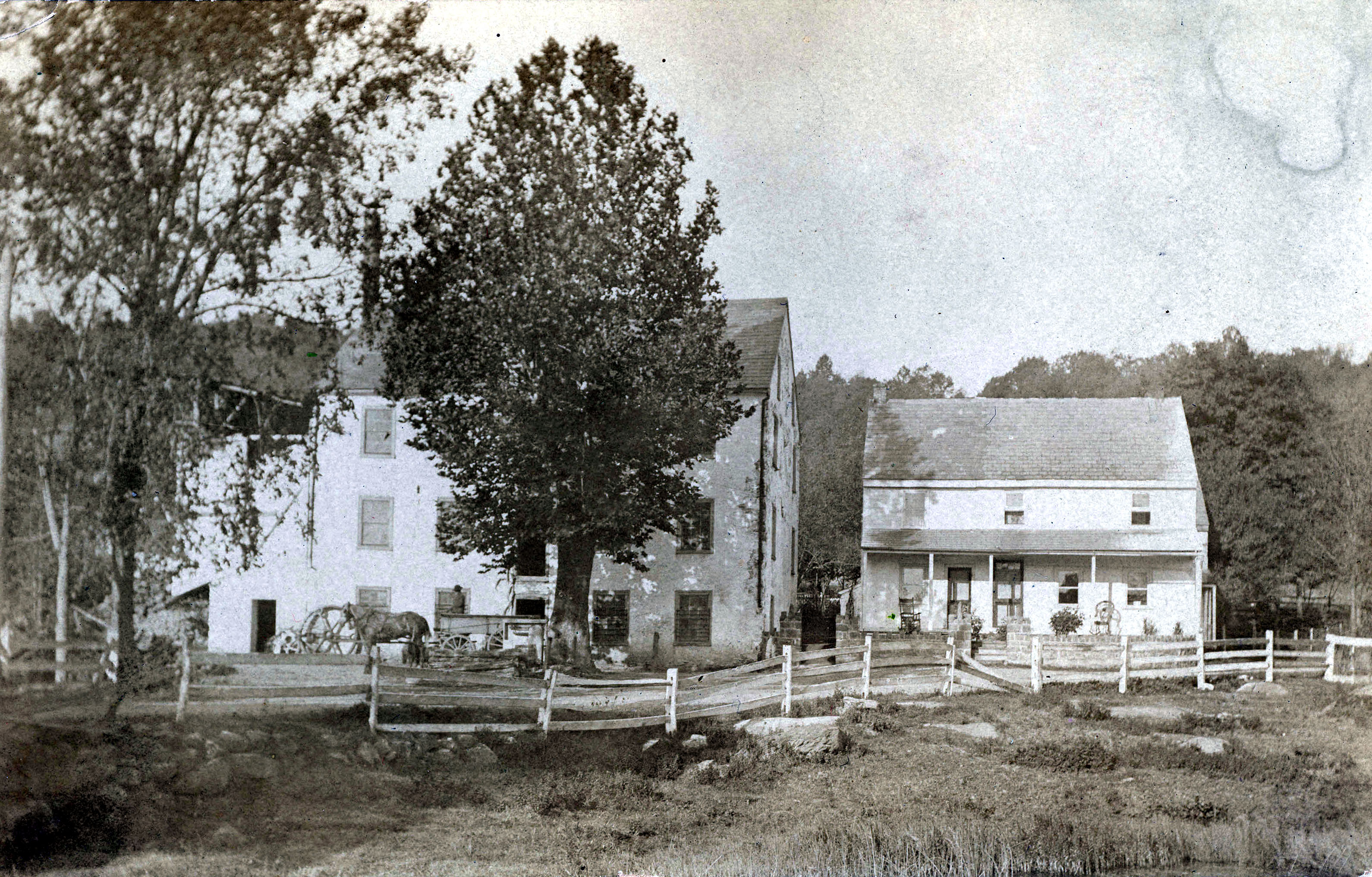
White's Mill: Photo by Thomas White
White’s Mill was notable as the last mill in Montgomery County to run on water power.[i] A business card from the later period of White’s Mill’s existence shows that in addition to the “flour, feed, grain, seeds, crushed stone, ice,” and sawmill output, Thomas White added goldfish and aquarium plants to the list of businesses he pursued trying to make ends meet. Journals and accounting books pay careful attention to every penny spent, orders delivered, services required.
Found among Paul White’s papers after his death in 2002 was an envelope marked “Careful: Notes from my Father to my Mother.” Inside the envelope were three letters, all variations on a theme, meant for Anna White in the event of a fatal accident. One in particular is so worn it is nearly falling apart, especially along the crease lines. The pencil writing is nearly rubbed away with wear. Holding the ragged scrap in hand, one wonders if he kept this particular paper on his person each day, knowing it would be found immediately if something were to happen to him.

White Family of Tylersport, PA, from l to r, Paul White (my grandfather), Thomas White, Esther (in driver's seat), Anna Mergner White and daughter Ruth, and Anna's cousin, Violet Belz. The mill building is behind them.
The written words bring him to life in a way nothing else could and offer a heartbreaking glimpse into the White family’s life and times. This is deepest heartfelt emotion; words from a man looking at his own demise and wanting to protect his family from beyond the grave. Although the letters date from between 1900 and 1935, the year he died quickly and unexpectedly from a heart attack just days after his 64th birthday, the feelings expressed are timeless. Here is the first, and apparently earliest, of the letters.
Anna,
Am starting this wondering if it will ever reach your eyes, and if so, will it help you any. I hope so. Years & years & years I have hoped to get free of this place to an advantage, but so far those hopes have not been realized and the hope grows less at times, then again is revived.
Surely has me blue and discouraged trying to keep ahead of the bills.
If you do see this I will not be here to help. And you will have to decide on what you want to do. As you know, you will have the direction of things, and if the following advice is any good this writing will be justified and I am glad.
I do not think it well for you to try to keep the place going as a business. [Illegible] you may be able to rent it for a small amount that it may be kept in repair, tho [sic] we should help accomplish this [in later letters, he advises her to be sure the renter has responsibility for repairs.]
As soon as possible, please settle all bills [illegible] is always paid promptly. [In a later letter he writes, “About the bills in the book, I would not lose much sleep over them.”]
Would suggest you arrange some of it to be paid monthly over a period of years. But please first thing possible send check for all bills in the drawer not paid.
The easy way, I suppose, would be to make sale, but you understand you do not need to sell anything you do not want to, all is yours to do with as you please and can.
I suppose: ‘even as I have had hopes for a home elsewhere in the future,’ you have had the same, I trust the where-with for that same may be realized when you clean up.
I will not make an estimate of what it might be, the insurance alone will make a goodly sum.
Perhaps you might be justified in retaining the place for the kids, if they feel so about it, but I assure you, the cost of keeping it in repair, taxes, etc. will be considerable.
Sometimes I feel how I would like to fix it up (this place) but the money did not come my way to blow in.
So, so who knows what the future may bring forth;
Hurrah for the Whites. And God bless you all.
In the journal volume Thomas White kept used to track weather, business and family and community doings in the years 1927 to 1935, the month of December 1935 seems typical with daily entries like the following:
December 5 Th – A cold windy day. Jim [the hired man] brot [sic] feed from Moyer. Killed & dressed 20 chickens 28¢
December 6 F – A nice day. AM at Esther in Allentown. Jim brot [sic] oats for Markley cash 47¢.December 7 S – Quite cold a.m. Sold heifer $20.00
December 10 Tw – [Thomas White’s 64th birthday] Clear. Load feed from [illegible] and oats from Stover.
December 11 W – Cloudy not so cold. Anna, Esther and myself at Sears, Phila.
December 16 M – Cloudy and some rain. A few jobs of insignificant [?] nature.
December 19 Th – Not so cold. Bank. Put 4 loads of firewood in cellar.
December 20 F – Cold and windy. Jim brot [sic] last of cob corn from Sellersville orders.
A longer entry on December 21 is in a different hand:
Tom passed away about 1:30 a.m. quite suddenly sick about one and a half hours. Dr. Nace came in only a short time after I called him, and stayed with Esther and I until almost three o’ clock. Esther sent for Jim, we could not get any one via telephone from Jeffersonville, so Jim went down, and Lydia came with him, stayed with us until Tuesday, day of funeral.
And then on Christmas Eve, December 24, 1935:
We layed Tom away today. We miss him so, but The Lord knows what is best for us. I feel that Tom is now at rest, will try my best not to worry. Am more than thankful to have Paul and Ruth with me, they are such a comfort and help to Esther and I.
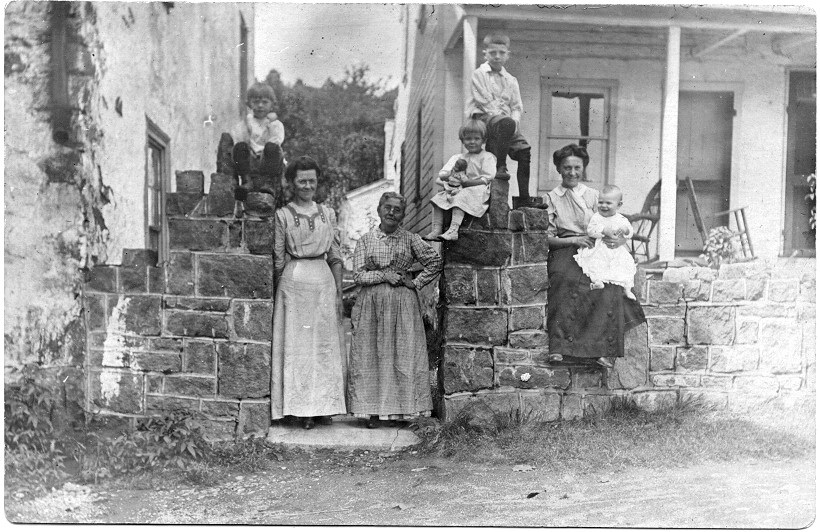
Anna Mergner White, second from left
The journal also has a list, in Anna White’s neat handwriting, of the family and friends who sent flowers, and next to their names she detailed the type of arrangement and flowers used. One imagines her writing thank you notes after the funeral, as she wondered what she would do after the loss of her husband.
In the end, she sold off the mill fittings and most of the household goods.[ii] The large broadside read
Public Sale of Personal Property!
There will be sold at Public Sale on Saturday, April 18th, 1936 at the late residence of Thomas H. White, deceased About One and One-Half Miles North West of TYLERSPORT, known as WHITE’S MILL the following personal property, to wit: 25 chickens, 10 tons hay, 200 bundles cornfodder, Ford runabout, hay wagon, two-horse wagon and body, 2 good mowing machines, grain drill, reaper, one-horse cart, 2 hay rakes, land roller, springtooth harrow, 2 bob sleds, 2 blowers, hay ladders, double ladder, 2 plows, manure carrier, two brooder stoves, chick feeders, coops, 12 new water pumps, safe, desk, lot of harness, 2 bag trucks, 50 gal. roof paint, oil tanks, lot of good forks, rakes, shovels, stone hammers, crowbars, drills, hammer mill, pipe wrenches, thread cutter, all kinds of wire, belting, lot of boards, scantling, chain hoist, lot of bags, etc.
Household Goods: Bureaus, 3 washstands, library table, bedstead, chiffonier, davenport, 2 extension tables, hall racks, lot of chairs, electric washer, waterless cooker, bread mixer, 3 rockers, 3 9×12 rugs, two Brussels and one Axminster, Eureka range, nearly new, parlor stove, lot of china and glassware, all kinds of cooking utensils, jars, etc. etc.
Sale commences at 12 o’clock noon, Conditions by Anna E. White, Executrix of Thomas H. White Estate., Raymond Hendricks, Auctioneer, Harvey J. Stoudt, Clerk.
Pages and pages of Mr. Stoudt’s tidy handwriting listed each item sold, the sum it sold for and to whom it was sold: a set of sleigh bells for 55¢ to Fargo, the porch swing for $2.30 to Fred Schultz, the hay wagon for $24 to Wm. Grauer, the Ford Roadster for $120 to Skarp, and a fishbowl and stand for 80¢ to James Constance. Jelly glasses, a buffalo robe, an oilcloth rug, a marbletop stand, two child-sized rocking chairs, a waffle iron and roller skates all came under the auctioneer’s hammer. Paul White purchased a spindle rocker for 80¢ and one wonders what sentimental attachment led him to select it out of all the things from the house in which he’d been born.[iii]
And now….
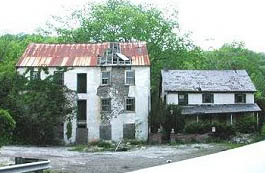
White's Mill in 1994, Photo by Sabra Smith
Tylersport remains relatively rural to this day, saved from overdevelopment by its distance from Philadelphia, its isolation from highly traveled roads and rails, and its distinctive geology and topography, although it is certainly changed from the time when the mill wheel turned.
Without a purpose to earn its keep, White’s Mill was torn down in 2002 in favor of “open space.” Surrounded by forested preserves, the township supervisors concluded that razing the building and clearing the land had more value than a historic site representing the milling heritage and the community history of the area. The sole remaining building is the original residence, unoccupied and subject to vandalism. Bullet holes let light into the attic.
An author writing in 1933, two years before Thomas White’s death silenced White’s Mill forever, bemoaned the passing of the old ways. The passage below serves as a eulogy to the hundreds of the old mills of our countryside that have vanished from the landscape without a trace.
One by one the old millers locked their doors and opened the waste gates of their races. Some, for lack of other occupation and because of advanced age, clung to their dwindling business until death released them. Then the ‘Old Mill Wheel,’ for lack of a master, ceased forevermore its splashing and dripping rotations. Time, the elements, decay, rust and fire have contributed their share toward obliterating the old mill structures…. ‘Tis with a feeling of emptiness and sadness that you return to the region of your childhood days and gaze upon the ruins of the ‘Old Mill,’ once the scene of bustling activity. And, so the march of time goes on, casting aside the old and replacing it with the new, which, in turn, shall suffer the fate of its predecessor.[iv]
(For Bibliography, click below for Page 2)
[i] Norristown Times-Herald, March 27, 1936 and Sellersville Herald, April 9, 1936 quoting the March 27 article: “”White’s mill near Tylersport, the last mill on Ridge Valley creek to be operated by power supplied by the creek and one of the last mills in Montgomery county using water power, has just been sold, together with 115 acres adjoining and the place is to be used for recreational purposes…. Ridge Valley creek, which flows into Unami creek near Summeytown, like numerous other streams of the county, was long of industrial importance because of the mill wheel which its current turned back in the 19th century. White’s Mill, a fourstory stone structure was built in 1825. Flour was made and there also was a saw mill alongside. Thomas White, who died recently, operated the mill for 40 years. The mill pond was well stocked with fish, especially pickerel.”
[ii] Anna White and her daughter, Esther, left Tylersport and moved to 6963 East Stenton Avenue, Philadelphia. Tucked inside the 1935 journal/accounting book is a creased sales brochure for “New Economy Homes” built by Joseph S. Lowery, on sale for $4,475. The brochure reads, in part, “These homes are built on a 70 feet wide main street on lots exceptionally deep, providing a splendid front terrace and setting back 55 feet from the curb and having a rear yard 40 feet long, with ample space for a play area. Only the best materials and nationally-known products have been used in the construction.”
[iii] Jim White recalls the rocker was placed in the living room of Anna White’s Stenton Avenue home. Following her death, daughter Esther kept it, and it passed on to her niece, Bertha.
[iv] Engart, p 112-113
White’s Mill, Tylersport, Pennsylvania Part 2
To read Part One, click here.
White’s Mill in context
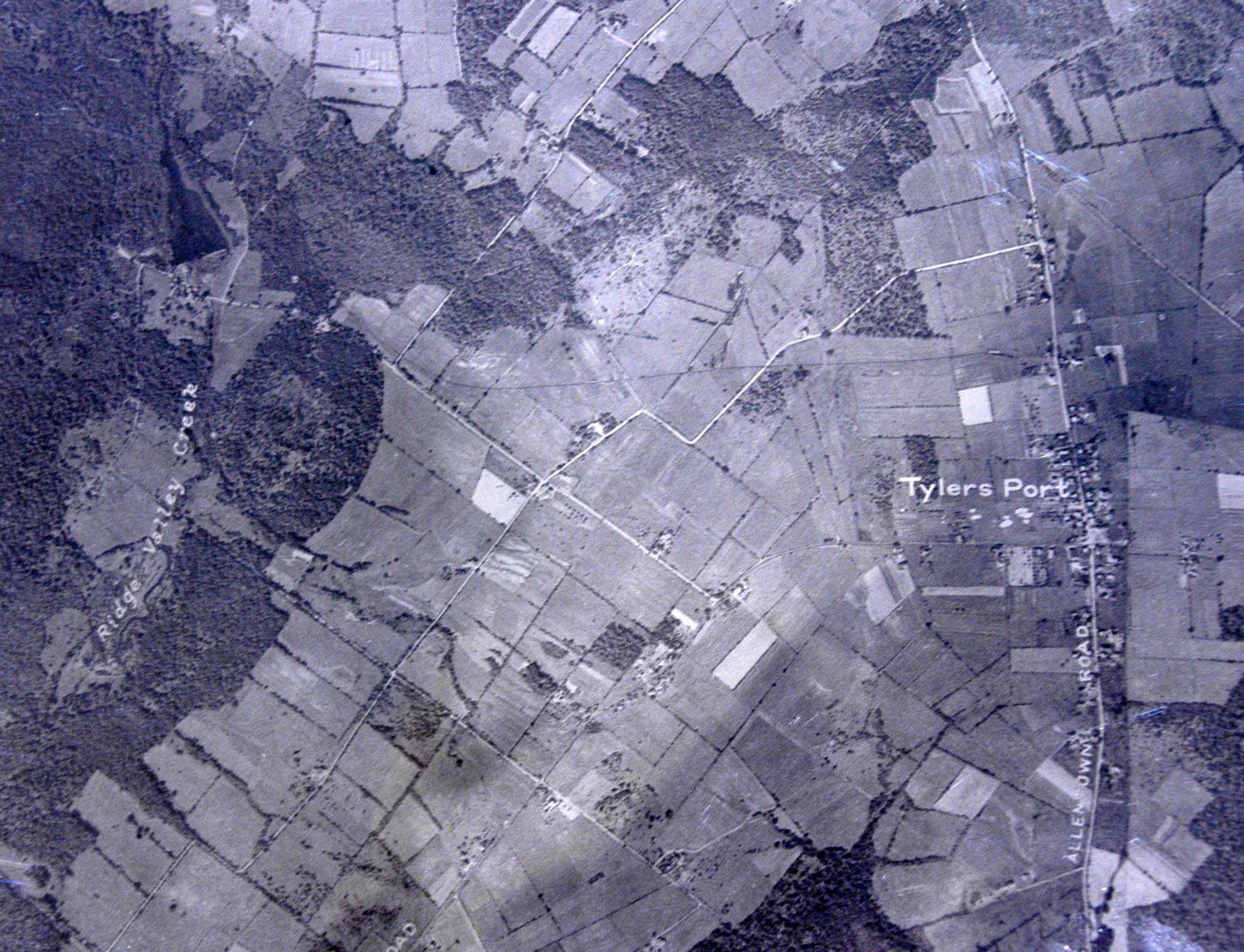
1928 aerial view of Tylersport, PA, Courtesy the Free Library of Philadelphia
The area around Tylersport, Pennsylvania, was settled in the early 18th century by southern Germans of mostly Reformed, Lutheran or Mennonite affiliation. The land in Upper Salford was less fertile and rockier than that in Lower Salford, though among the area’s more interesting geologic features are large fields of boulders, such as “The Devil’s Potato Patch” (a favorite place to take visitors from out of town).

Devil's Potato Patch
Tylersport was originally named “Cressmanville” [a name once seen on many of the cigar factories in the area] until a post office was established in 1842, at which time the postmaster renamed the village Tyler’s Port in honor of President John Tyler.[i]
An 1877 atlas of Montgomery County described the township of Upper Salford and indicated that Tylersport was the largest village in the township. In 1880, the village had 50 houses, a “segar” factory, a Belgian block factory, and 224 inhabitants.
The Montgomery County directory for 1900-1902 listed everything a thriving rural town might need: attorney, baker, blacksmith, brickmaker, carpenter, cigar makers (who worked at home or in the local factory[ii]), physician, farmer, foreman, hostler, hotel, laborer, machinist, merchant, organist, packer, painter, sawyer, stripper, saddler, shoemaker, surgeon, teacher, tinsmith, and wheelwright. Thos. H. White was listed as miller. Frank S. Shipe, from whom he bought the mill, was listed as farmer.
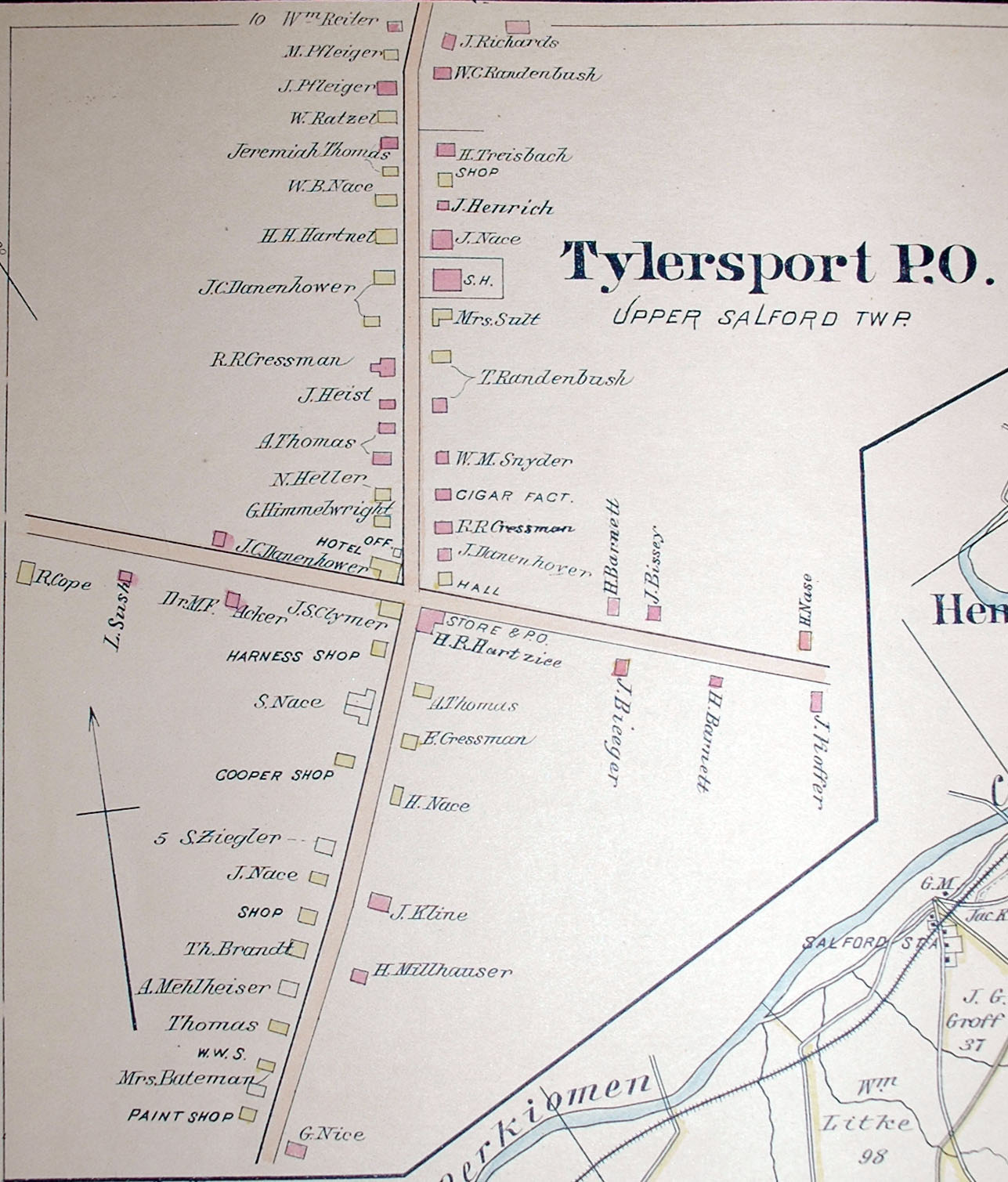 The number of farmers and laborers far outranked any of the other categories, underscoring the agrarian base of this economy and the importance of the miller. In keeping with his position in the community, Thomas White was an elder in the Presbyterian Church and a director of the Green Lane National Bank.
Thomas White, Miller
Thomas H. White was born in Norristown in December 1871 and grew up on a busy farm on Marshall Street in Jeffersonville, the town adjacent to Norristown. He attended the local schools and worked hard on the farm. He found time to work in local mills to learn the trade and to attend classes at a Philadelphia business college.
A journal from his 23rd year gives us an idea of the weather and general events of his life in 1894. He sold subscriptions to the Farm Journal, and took part in church activities. There were funerals to attend, lectures on the evils of drink, lambing season, dentist appointments, and a tunnel to be dug through the snow to get the cows out of the barn.
In a typical entry he wrote: “A little snow in morning, moderating. Sleighing still very good. Took Alice to station this morning. Norristown, Franklin Ave. 6:51 A.M. Went to Providence and was successful in securing a promise from Mr. B. to lecture at our social. Went to Norristown with 115 lbs hay for Neiman.”
In 1895 he began to look for a mill to buy. Wednesday, October 13, 1895 he wrote: “Went to Lansdale to look at mill, did not find it satisfactory.” Later in the month: “John Brooks offered me $18 per month and board as miller” — an offer he did not accept. In November and December of 1895 he looked at an unnamed Norristown mill, a mill on “Pickern’s Creek” which he noted had “good power but poor buildings,” and Brook’s Mill in Norristown, which was for sale for $8,000. Apparently frustrated by the lack of appropriate or affordable situations in the area, he wrote to offer himself as an apprentice to his uncle Harry M. Halloway in Larned, Kansas, who established the Keystone Mill there in 1884.

Thomas Halloway White
Thomas White departed Norristown for Larned on January 7, 1896 and returned home from his apprenticeship on December 17 of that same year.
Business owner
Shopping for a mill of his own, Thomas White visited Tylersport for the first time on February 17, 1897 to see a mill for sale for $3,500. He made his offer in April and the paperwork was completed on May 17.
Thursday, May 20, 1897 his journal entry reads: “clear and warm. Went to Norristown for stuff from Phila. Started for the mill Tylersport about 11:30 am with Duke and Dan [horses] in Haywagon and General in Dearborn. Bertie [his sister], Geo, [his brother] and I arrived about 7:30 pm. Lost lynchpin and box out of front wheel of wagon, so delayed.”
On Friday, May 21, he wrote: “Cloudy and sunny a.m., heavy shower at 2 p.m. Went to Sellersville for feed and shipment from Phila. Drove in shed at Maceville to escape shower. Took in first money at mill. .05”
The next day was a busy one: “clear and sunny. Worked in mill and hauled out manure a.m. Plowed gardens and worked it p.m. Sold first feed. Started for home at 4:40 p.m. Arrived home at 9:00 p.m.”
He worked long days getting things in order at his new place of business. It appears he moved in

Anna Mergner White
once and for all on May 24: “Rainy early and late, sunny and hot noon. Started for mill with big load of stuff. Bertie, Geo., and myself, at 1:30 pm arrived 6:20 pm.”
Thomas married Anna Mergner, niece of Mr. and Mrs. George Belz of Camden, on Tuesday evening, September 20, 1904 in Jeffersonville. They had three children: Paul (born 1905), Ruth (born 1909) and Esther (born 1915). Years later, Paul White would recount sitting outside the house while his mother was in labor in the bedroom upstairs. At last, he was told it was time for him to get the doctor to help with his sister Esther’s birth. He ran up the wooded hill behind the house, following an old Indian trail to reach the doctor’s home. The doctor hitched up his buggy, while Paul ran back through the woods to home.
[Author’s note: I despise it when women’s bios consist of “she married him and had children; thus began the daily drudgery of housework” with no flavor of the spirit of the woman. Unfortunately, I don’t have a lot to go on, though there’s a tale to be told. You’ll see. We’ll see a little more of Anna, my great grandmother, later on.]
White’s Mill
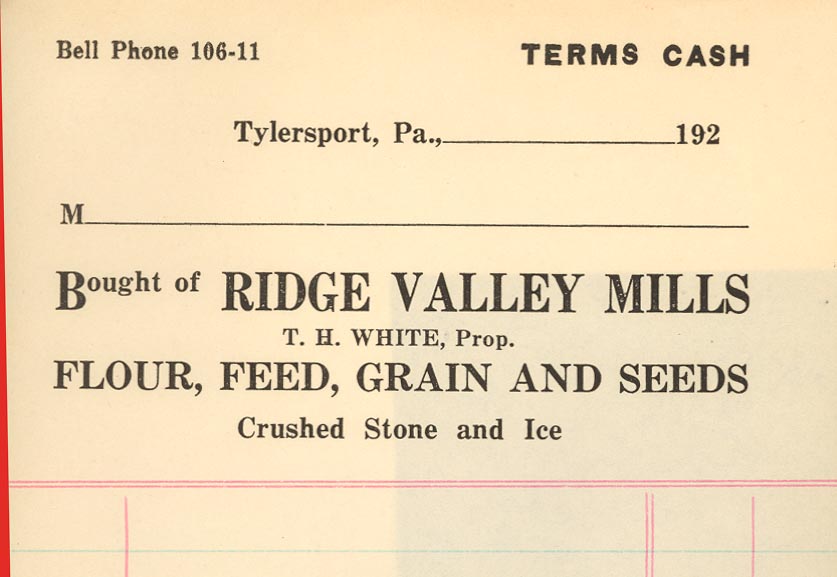 The mill site consisted of a house for the family and another house for the hired man and his family. There was a wagon house, a barn, a chicken coop, a pig shed, and two ice houses[iii]. At the center of it all stood the mill.
The mill became a major social gathering place as soon as the winter grain crops were harvested. Children were released from school in time to help with the harvest. They would arrive at the mill riding on the wagonloads of grain. As an adult, Paul White told his son about those times, and how, when he was done loading bags of grain into the chutes feeding the stones, he dashed off to play with the other children in the woods behind the house, land too steep and rocky to cultivate.
Sometimes the farmers’ wives came along with food. Everyone would picnic on the front porch of the house and Anna, Thomas’s wife, would provide drinks and fresh vegetables from her kitchen garden on the other side of the road.
The gathering must have been a welcome change of pace and an event both adults and children anticipated. One better understands author Henry Engart’s attempt to convey the wonder of a mill seen through the eyes of a young boy.
White's Mill, Image courtesy of Phil Ruth
When you drew up to the mill it was not unusual to be fourth or fifth in line, so great was the volume of business done by the local mills in the years gone by. While awaiting your turn you watched the unloading of the teams ahead, particularly the bags of grain as they were hoisted aloft and skillfully swung in through the open door by the miller, all white and dusty. How the gurgling and rushing of the water along the mill race tempted you to get down from your wagon and try your luck at sailing boats or fishing…. Another sore temptation, both hazardous and fascinating, was the desire to unlatch the lower half of the first floor mill door and go exploring into the very midst of all that rumbling and grinding machinery. The hand-hewn posts and timbers, the easy stairways, the flapping belts and grinding cog-wheels, the miller’s bag truck and the piles of filled sacks – a most interesting place to go and a temptation the average child could not resist.[iv]

Engart goes on to empathize with the adults who discovered a child missing and imagined the horrors of a mill-related accident. “These were not idle delusions either, for there was hardly a mill that did not have its tale of horror relating to some one having been killed, or of arms, legs, fingers or toes that were torn off.”
In fact, at White’s Mill, Maggie Hartley, wife of Theodore Hartley who worked at the mill in the early part of the century[v], had an accident that was recounted in the local Pennsburg Town & Country newspaper of 1901.
A peculiar incident occurred at White’s Mill one evening last week. While the family of Theodore Hartley was seated at supper, Mrs. Hartley walked over into the mill on some errand, while the machinery was running at full speed. A draught caused by an open door blew her clothing so that it was caught by an upright shaft, which was revolving rapidly. Before she had time to realize her position, it had torn every stitch of clothing from her body, which fact alone saved her life. Her cries brought her husband to the scene.
Drs. Acker, of Tylersport, and Blanck, of Green Lane, were hurriedly summoned. Her injuries were considered very slight, consisting of abrasions upon the left side of her body. That she escaped with her life is remarkable, as the clothing was wound around the shaft so tightly that it was necessary to cut it loose. It was later learned that Mrs. Hartley’s injuries were of a more serious nature and the unfortunate lady is now in a dangerous condition.
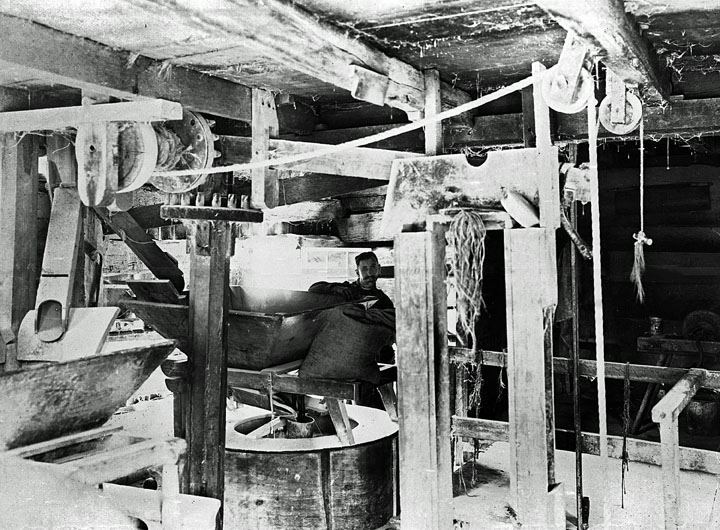
Interior view of White's Mill, Image courtesy Phil Ruth
It is assumed that she recovered her full health, since later photos show her posing outdoors with an addition to the family.[vi]
Milling the grain was a long and laborious process, particularly if the stones had to be adjusted from feed to flour grinding. Paul White remembers a great part of the expertise of a master miller was the skill it took to dress the stones that did the grinding.
“Hitting that stone and cutting it was very trying stuff. Jees, you’d be there all day and on into the night and he’d eat and say ‘I got to get back.’ Working away getting those damn stones sharpened. And his fingers all were blue with pieces of steel from hitting there on the rock and the steel would kind of… he wore gloves but they’d go right through the gloves. He always had this streak on his hands from that work on polishing the stone, cutting the stone. Really something.”[vii]
Many of the farmers would store the raw grain or corn cobs at their farms so there would be milling right up to the arrival of cold weather with a final rush just before water froze. Thomas White would then go down to the dam and close off the mill race gates so the water would build up behind the dam and provide more ice.
White’s Mill was a factory of sorts, which not only ground grain but provided ice from the mill pond for use in the summer months, cut lumber for building and firewood, and made gravel for many of the roads in the county.[viii]
Ice was the cash “crop”
Thomas White began a new journal on his December 10th birthday in 1921: “The finish of my half century and feeling good. Carrying on; tho lazy at times, especially Sunday mornings. Best year ‘financially’ I have ever experienced. Presume ‘ice” gets the credit for most of it.” The mill pond that powered the mill wheel also had value when frozen. Thomas White would sample the ice regularly to determine when to start filling the ice houses. The journals contain numerous entries about clearing off snow, lest it spoil the ice. Local laborers waited eagerly, as this was an important source of income in the off-season, since it “paid their taxes and so forth.”[ix] Cutting the ice was done with an ice plow, which held a five foot saw. Some expertise was required to determine the best places to cut in terms of thickness, and whether or not there was any plant matter that would ruin the ice.
“So once you decided on the area you ran a strike line. Put a nail in the ice and ran a line to where you wanted to stop the thing. Then you took the ice plow and the horse – this is all handwork – one man led the horse and the other one held the plow and they cut along this line to make this starting ridge. After you got the starting ridge you started really making the cut because you now moved the plow over and it had a guide on it and you swing the guide over into that line.”[x]
Plowing ice was not without its potential for harrowing accidents as Thomas White’s journal notes on Thursday, February 10, 1921: “Cloudy & warm. Hauled four loads of ice to Musselman’s Creamery with truck and five with teams. Geo. Horse broke in dam while plowing ice. Out O.K. but with considerable effort. Roads in very bad condition especially below the Branch Creek.” As Paul White recalled:
That was a very noteworthy thing because we weren’t sure whether we lost a horse for awhile. We finally got a board underneath so at least he could get a foot up. And after we got his shoulder up on the ice and with harness you had something to get on and get ahold of and we hitched another horse to him and he had to keep pulling while we kept pushing with boards, different areas that were kind of stuck and the, of all things, the ice started sinking with this weight on it! That would have been terrible because we’d have been right back where we started except that at that point we were getting closer to the edge.
For awhile, I think, Father was considering breaking all the ice away and just leading him out if we had to but he was thinking about the horse being in the water too long to do that.
We got him out and then we walked him around for a couple hours to get him back in to circulation. He didn’t have any ill affects at all. But boy, that was exciting! Because while the process was going on we had, I suppose, five people working in the ice house and then Father and I got the hired man and the guy running the engine plus a couple of other workers pushing ice around. And we were all there, you know? We could have all gotten ourselves a bath![xi]
The ice business provided employment in both winter, when it was cut and stowed, and in summer, when it needed to be delivered. Loading the ice house in the winter was cold, back-breaking work (and risky, as noted above). The summer work took place in the pre-dawn hours to beat the sweltering heat of summer that would reduce the valuable “crop” to nothing. Decades later, Paul White could still recall the experience in detail.
“We’d get in there at like two o’clock in the morning and get a load of ice ready and our man would come at four o’clock with the first truck backed up to the door and we’d load him in nothing flat with the ice and he’d drive around front and pull the covers over it and away he’d go. And then we’d go in and lay down for a few minutes in front of the front door of the house. We’d open that door and usually a draft would come in there and if we were lucky we’d get a little sleep until it was time to get the next load out because the truck was due back…. Saturday was a big push. Everybody wanted ice over the weekend and the beginning of the week and it was pressure time for the people in Perkasie that delivered the ice.”[xii]
Sawdust was used as insulation around the ice. White’s journal contains regular entries about hauling sawdust and enlisting even his youngest daughter’s help to fill up holes and protect the ice from the flow of warm air. Melted ice was lost income.
[i] Montgomery County Planning Commission
[ii] Baum, Two Hundred Years, the author was surprised that he found it necessary to detail the processes by which tobacco was harvested, cured, and made into cigars but realized that, along with many other things, this knowledge was falling away from the collective memory
[iii] The financial return from the ice “crop” led White to decide to build a second ice house. His journal on December 19, 1921 notes “Carpenter (4) came and started [to] erect new ice house. 30 x 42 x 21. Wages 75¢ per hr.”
[iv] Engart, p. 105-106
[v] Someone named “Dory” working at the mill appears in various of Thomas White’s journals, including 1903 and 1906. One assumes this is short for “Theodore” Hartley.
[vi] Census records for 1900 show the Hartleys with two children, Sadie, born June 1894 and George W., born February 1899. The 1910 census lists an addition to the family, Harry S., five years of age. The photographs of the Hartley family (and a rare interior image of White’s Mill) may be found on page 58 of Phil Ruth’s book, A North Penn Pictorial.
[vii] White, Paul, taped conversation
[viii] White, James, email regarding mill recollection
[ix] White, Paul
[x] White, Paul
[xi] White, Paul
[xii] White, Paul
White’s Mill, Tylersport, Pennsylvania, Part 1
On my “About” page, I talk a little about how I ended up here, doing what I do (it’s a much longer, stranger story than is told there, but you have the pertinent facts). One of the blips on the timeline has to do with my great-grandfather’s life. I never knew the man, he died in 1935, but his son was my grandfather. He was born at a mill in the Pennsylvania countryside and had a lasting attachment to the place until the day he died.
We didn’t tell him that they tore the mill down. His old home was still standing, but the tall mill building was gone forever — a place he remembered as a busy, wheezing site of industry, dusted with flour, the air filled with the buzz from the sawmill and rock crusher. There, in his mind’s eye, he could still see his family working and playing.
I wrote an article for the Bulletin of the Historical Society of Montgomery County, and now I’ve chopped it up to share here. Maybe those driving by that now-empty site will gain an appreciation for the phantom of what once was there.
“Experience once more that feeling of elation which seized you as you approached the rumbling old [mill] structure on a drowsy midsummer’s afternoon. How your childish curiosity was aroused by the vertical row of doorways, one for each floor and often numbering as high as five.”[i]
Prologue

Figure 1. White's Mill, painted by Walter Baum
Throughout the first half of the 20th century, Impressionist painter Walter E. Baum used both brush and pen to capture the landscape around his birthplace, Sellersville, Pennsylvania. In newspaper articles and a slim volume impressively titled Two Hundred Years he evoked an image of the mill setting:
…I never failed to visit a mill whenever I had an opportunity to do so. Naturally, also, I was attracted by the picturesque setting. The old structures were wooden. Later they were of stone, hardy and enduring.
When a miller chose a site, he took into consideration its accessibility for the neighboring farm people. But more often he was concerned about the power which a stream could generate. Quite naturally a place with a definite grade in the landscape was selected because it lent itself to the building of a dam. Often, therefore, the mill structure was erected at odd places.
Today one drives along some out-of-the-way rural road and, among curves along the hillsides, suddenly there looms up a quaint structure. Across the street or nearby is the miller’s house. In the ensemble are a barn, a wagon shed and other buildings, added as the mill business expanded.
The spot seems deserted except, perhaps for a dog seeking the shade of the inevitable buttonwoods of the millstream. The silence, as one approaches, is deceiving. The miller is a busy person. To see him one must go inside and, maybe, shout lustily. Otherwise ‘twould be hard to attract him from the numerous chores that call him here, there and elsewhere in the building. The tune of crunching mill stones, whirring, exciting shafting and pulleys with slap-slapping belts, the almost imperceptible drip-drip of a white or golden flow of flour or meal streaming from troughs to bins, the sonorous swish and groan of the mill wheel, the symbol of unfailing power, the click of cogs, the creak of timbers, protesting against the daily strain – these mystify the ear as if some strange symphony were heard for the first time.
As a figure in the ancient rural community the miller was a sage indeed. He was more than that; he was a man of influence and respect. The community depended upon him and, being of a type that required stability and character, he was one of the factors to promote its well being
To the alert miller these syncopations hold profound meanings. The undue stress of some note here or the absence of another there, are becks and calls. Perhaps some obstruction, escaping the screen in the mill stream, retards the wheel. Maybe a lace or rivet has given way in some ancient belt. Or, again, the stones, bolting their stock like some hurried child gulps its food in playtime, chokes and splutters. These are an open book to him and, peering thru the dust, that whitens his face, hand, hair and clothing, he hastens to rectify or put in order the project, for such it truly is.
When all is well he can stop to chat with a visitor. Indeed he is an interesting man – informed on what is new in his home community and eager to hear of what is going on outside. Thus he becomes at once a sage alike to stranger or patron from the neighboring acres.
As a figure in the ancient rural community the miller was a sage indeed. He was more than that; he was a man of influence and respect. The community depended upon him and, being of a type that required stability and character, he was one of the factors to promote its well being.[ii]
White’s Mill in Ridge Valley
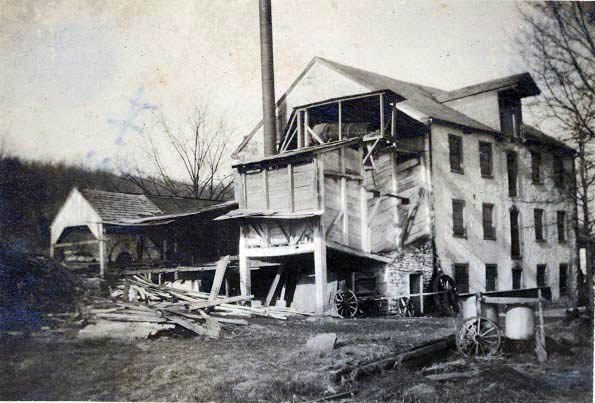
Figure 2. White's Mill, saw mill and rock crusher
Baum might easily have been describing a particular mill not far from his home in Sellersville. He spent days in the area, eventually setting down a view of a cluster of buildings on a large canvas, eliminating the smokestack from the scene because it detracted from his desired sense of the pastoral. [Figure 1. White’s Mill, Tylersport, by Walter E. Baum, and period photograph of White’s Mill by Thomas White, Figure 2., taken from the opposite side of the property, showing the grist mill, the saw mill, the rock crusher and the offending smokestack.]
The mill was White’s Mill, owned by Thomas Halloway White, master miller. Located in Tylersport, Pennsylvania, approximately forty miles from Philadelphia, the mill exemplified the kind of rural institution and regional icon that vainly attempted to bridge the shift from past to future, from rural to industrial.
the origin and history of only a very few spaces, very few structures are on record. Those for which we have plans and maps and legal documentation and official descriptions are being studied and written about. But an infinitely greater number of structures and spaces have no documentation at all….
John Brinckerhoff Jackson wrote, “[M]ost of landscape history deals with an infinitely small fraction of the landscape…. The reason for this is simple: the origin and history of only a very few spaces, very few structures are on record. Those for which we have plans and maps and legal documentation and official descriptions are being studied and written about. But an infinitely greater number of structures and spaces have no documentation at all.” [iii]
White’s Mill has been poorly documented over the decades. Now that all but the original homestead has been demolished it could easily slip into the oblivion of the ages, joining many other of our undocumented, early vernacular sites. Just as Brinkerhoff notes, this is one of those sites for which there is little or no public record. The property’s deeds were held by my family for decades, kept in a file box in the back of a closet. The earliest among them dated to 1747 and indicated the land was part of an original thousand-acre parcel sold by William Penn’s grandson.
White’s Mill was located in an area of Pennsylvania that remains rural to this day, and the nearby town of Tylersport has the air of a town that time passed by. This article is an effort to establish a record for White’s Mill that is more than some professional nostalgist’s vision.


 Nostalgic for the original Wayback Machine?
 My Own Time Machine: Buildings, Places, People & Things