Happy New Year
I share with you a postcard with a New Year’s greeting — a greeting for a year that was new 100 years ago. This colorful card was sent in 1909 to my grandfather from his cousin Violet Belz.

Below is a photograph of the White family of Tylersport, Pennsylvania, with Cousin Violet in 1913.

White Family of Tylersport, PA, from l to r, Paul White (my grandfather), Thomas White, Esther (in driver's seat), Anna White and daughter Ruth, Violet Belz
Calling Kris Kringle!
Did you finish your Christmas shopping yet?
Are there a few people on your Xmas list that just have you stumped?
Historic preservation offers lots of unique gifting opportunities.
Support your local historic site by shopping at their gift shop or Christmas Fair. Some even offer online stores so you can hit a button in the middle of the night and cross a name off your personal naughty-or-nice list.
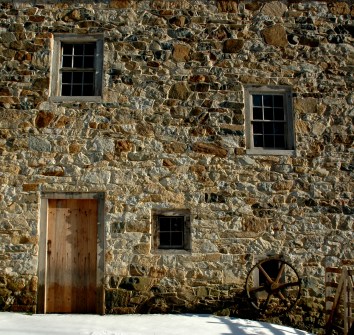
Mill at Anselma, Pennsylvania (Photo by Sabra Smith)
I’ve previously noted gift ideas from the National Historic Landmarks the Mill at Anselma (“The Gingerbread Man Gives This Gift Idea Five Stars) and Historic Harrisville [New Hampshire] Historic District (“Knit One – Gift Two”).
There are obvious classics like membership in the National Trust for Historic Preservation or Historic New England, which have the double benefit of giving the beneficiary free admissions and discounts while at the same time supporting important preservation, advocacy, and education work. Each of these organizations offers special interest possibilities, for instance….
Know a garden enthusiast? Historic New England‘s “Garden & Landscape” membership category includes discounts at the Lyman Estate Greenhouses [a National Historic Landmark site], Logee’s Greenhouses, exclusive horticultural programs and special preview plant sales.
Old house owner? What could be better than ‘Historic Homeowner” membership, which grants expert consultation on historically appropriate paint colors, evaluation of construction or design proposals, special events, topical e-newsletter, and members-only online resource center.

Engine room of the USS Olympia, like a giant jewelbox (Photo by Sabra Smith)
Know someone in the Navy? Or a fan of Steampunk? Consider making a donation in their name to the National Trust’s fund for the USS Olympia, the one-of-a-kind battleship, historically notable because it straddles the technological leap from the days of sail to the age of steam. This National Historic Landmark vessel is also noted as a National Mechanical Engineering Landmark for its state-of-the-art engines — a jaw-dropping, room-filling array of shining brass, dark wood, and powerful shafts that are a steampunk dream come true. Deferred maintenance has left this marvel in danger of sinking at its moorings in Philadelphia unless substantial sums are raised so new owners can get her into drydock for an overhaul. A donation to the National Trust for Historic Preservation’s USS Olympia Fund is a wonderful way to pay tribute to the history of the United States Navy and help preserve a beautiful old ship.
Check out the National Historic Landmark program Facebook page for other historic site information and marvelous gifting ideas and event inspiration.
And what suggestions do you have for preservation-minded gifting?
Foto Friday: Pillars of the community
The Maycomb County courthouse was faintly reminiscent of Arlington in one respect: the concrete pillars supporting its south roof were too heavy for their light burden. The pillars were all that remained standing when the original courthouse burned in 1856. Another courthouse was built around them. It is better to say, built in spite of them. But for the south porch, the Maycomb County courthouse was early Victorian, presenting an unoffensive vista when seen from the north. From the other side, however, Greek revival columns clashed with a big nineteenth-century clock tower housing a rusty unreliable instrument, a view indicating a people determined to preserve every physical scrap of the past.
— To Kill a Mockingbird, Harper Lee

Happy Halloween!
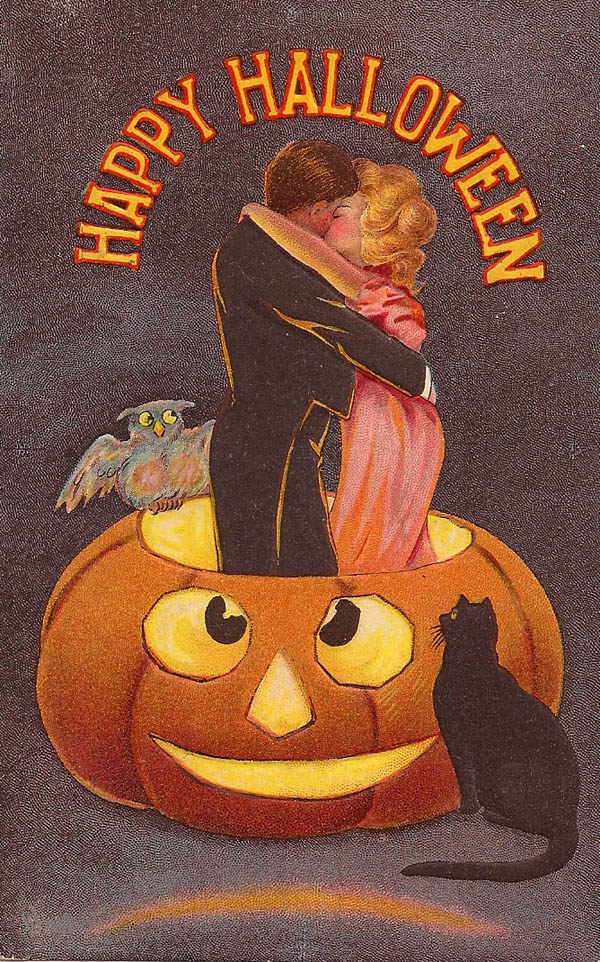 My grandfather has a remarkable postcard collection. It’s fun to think of him living out in the middle of the countryside, at his father’s old water-powered mill that was wheezing its way out of existence, waiting for the mailman to come and deliver each of these. Or, more likely, someone climbed on the same horse that he and his sister rode to school in the mornings (uphill) and went in to town to collect the mail and the latest gossip.
This card was mailed in 1908. I find the couple in a clinch a bit surprising as I don’t think of Halloween as a time for romance, but perhaps the blonde was so startled by a lurking shadow that she simply leapt into the fellow’s arms — and a kiss ensued. (Or perhaps she cleverly lured the fellow to the pumpkin patch and then invented a lurking shadow.)
The card traveled from Camden, New Jersey, to Tylersport, Pennsylvania. It was mailed by his Cousin Violet Belz (click here to see the family, including my young grandfather on the far left, and that’s Violet on the far right, in the snazzy hat). Turning the card over, one will find the following inscription:
Tell Papa to cut you a pumpkin into a Halloween head like this.
If you were here to-night you would see a fine lot of masqueraders.
Lovingly, Cousin Violet
Seeing Cousin Violet’s name there reminds me of a graveyard story.
It was a bright and sunny day…. I was riding on a University of Pennsylvania bus with other students on a very fine tour of Camden with Camilo Jose Vergara, whose brilliant work documenting urban neighborhoods for more than 30 years can be seen at Invincible Cities. Our tour began at Walt Whitman’s house in downtown Camden to evoke the bustling, industrial Camden of his era. Throughout the day, we experienced many places that are no doubt haunted by ghosts of the past — abandoned, derelict places that were sad, atmospheric, and inspiring because you knew there were stories those sites could tell.
Camilo ended the tour at the Harleigh cemetery where Walt Whitman is buried in a rustic-inspired tomb of his own design, cut into a hillside. The bus pulled through the gated entryway and wound among the curving rural cemetery style roadways. I was talking to the friend sitting next to me and occasionally glancing idly out the window at the vast expanse of gravestones scattered across the green acres. Something drew my eye — we were passing a tall granite monument topped by a funerary urn — I glanced at the name on it. “Belz” I couldn’t quite make out the other words. But after I paid homage to Mr. Whitman, I raced back up the road and discovered that out of all the stones, in all of this cemetery, I happened to notice my cousins’ above all. There were Violet and the rest of her family — and in fact, I discovered someone we did not know existed — a boy who must have died at a young age and faded from family memory. I said hello to the ghosts, and returned to the bus, having had a nice family visit as a bonus to an excellent day.
Boo! Have a fun, and safe, Halloween!
Children and history

 Anniversaries come and go. Some are fleetingly small. Others sparkle with silver or gold and mark milestones of time.
My children attend a school celebrating its 250th birthday this year. The party will go on all year. My son played the fiddle and the class danced to George Washington’s favorite party pastime, the Virginia Reel. How convenient to mark the study of colonial history with the anniversary of the school founding! (A previous post showed you the murals and portraits of early headmasters we made to be mounted on the wall for the day’s special presentations.)
How do you get children to engage with concept of the passage of time that leads to a sesquicentennial?
There are signs around school: “older than the country,” “older than television,” “older than ketchup” that attempt to place the school on a timeline.
 On display in the hallways is an exhibit of art by the first graders. I was awed. To make it personal, the children were asked to take an individual from a long ago yearbook and interpret that photograph as a painted portrait.
What a personal, colorful and delightful result!
I stood in the hall for ages, comparing the thumbnail black and white yearbook photo to the uninhibited creation on canvasboard.
There was the dapper cute boy. The basketball player from 1911. The girl who looked as though she’d like to be editor of the school newspaper, but it was probably too much before women’s lib for her to have a chance at the spot. I was so impressed that I’ve challenged my children to give my parents portraits of their parents as this year’s Christmas present. (My thinking being that once you enter those upper decades, it seems family history has more meaning than stuff from the mall).
 To see more of the first graders’ wonderful portraits, click on page 2 below left…
Foto Friday: Love among the ruins

Ruin of the Samuel Colt factory in Paterson, New Jersey, 2010 (Photo by Sabra Smith)
Foto Friday: 114 Osprey Drive, Groton, Connecticut
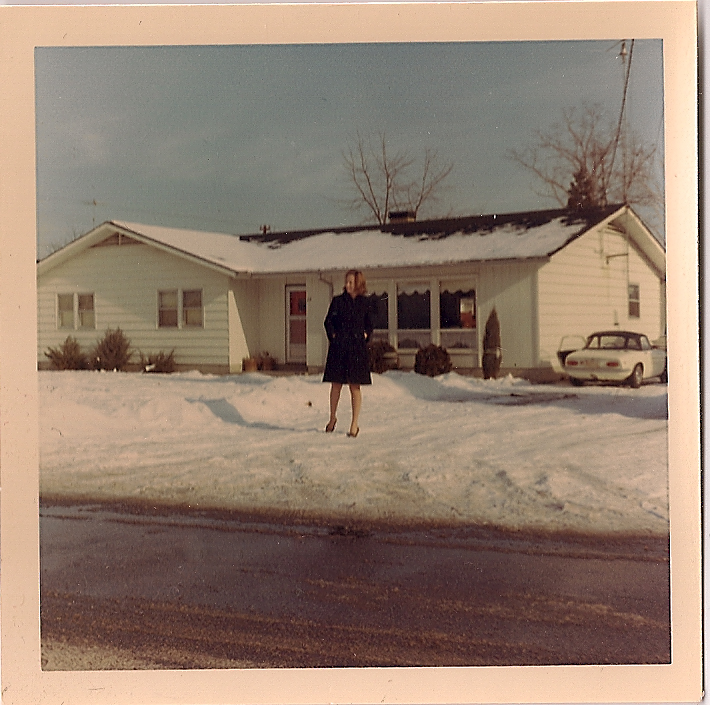
My mother in front of 114 Osprey Drive. That’s my dad’s little Lotus Elan there, parked in the driveway. Should I tell you about riding around in the trunk of that thing? Probably not.
A military family lives in a house, generally, for just couple of years (or just a year…). The longest we lived anywhere was four years (the shortest… a year). So look at the house below and think what that means to this one little house in the middle of Navy housing in Groton, Connecticut. A new family every three or four years. Anywhere between 2 – 7 families in a decade. How many coats of paint cover childrens’ height marked in pencil on the wall? How many pets might be buried in the backyard? (Our beloved guinea pig, Ian, lies behind this house, near the tree I’d climb, pretending it was my lighthouse; we moved here from Maine and a lighthouse.)
Imagine the stories that could be told by the children who roamed the neighborhood — I myself can tell you about the Great Crab Apple War, the igloo my father made after the big blizzard, the boycott I organized against the cheating Good Humor man, the sledding hill called the Big Dipper (it doesn’t seem so big now), the old stone wall where the neighborhood bad boys hid our stolen Christmas light bulbs (I found and retrieved them!), and the boy who used to ride his bike and vanish into the fog of DDT sprayed behind Smokey Joe’s truck as it drove through the neighborhood. (I often wonder if that boy is still alive.) Oh, yeah, no big deal, but there was also that time I caught fire reaching over the stove.
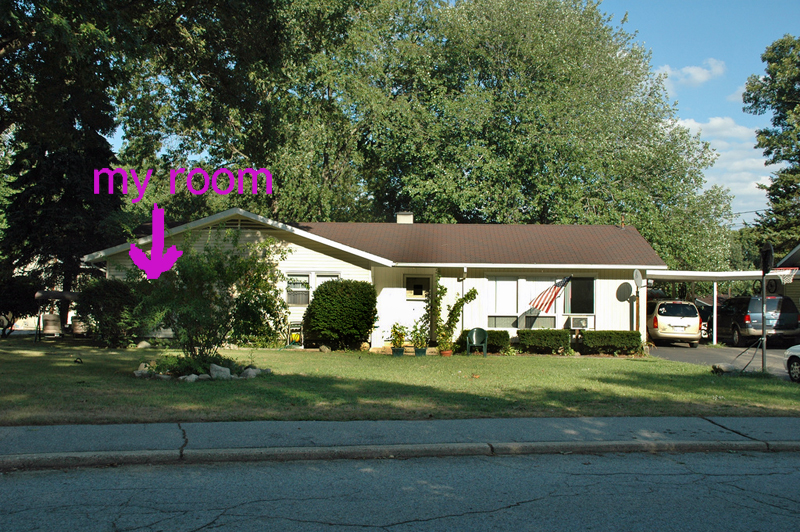
Not a vintage photo. This was taken when I dragged my kids along on a “Let’s Visit Mommy’s Childhood” Tour a few years ago. (Photo by Sabra Smith)
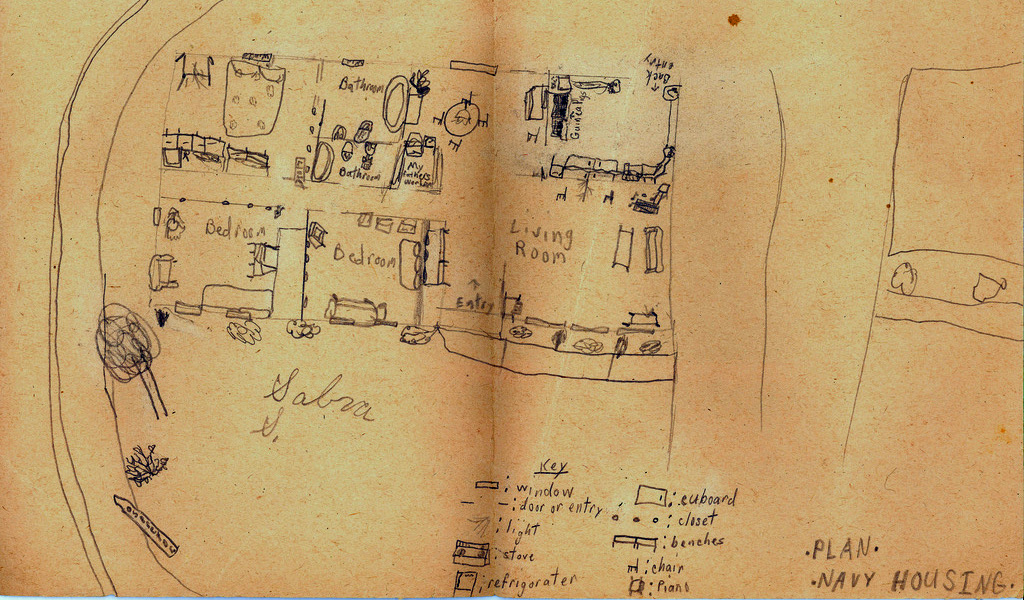
Moving so often, I attempted to find a way to organize my environment — I’d draw maps of the new neighborhood as I learned the local landmarks and secret shortcuts for a bike. I’d draw plans of our house (see below), or fantasize about what our next house might look like and draw imaginary decorating schemes.
A Red House
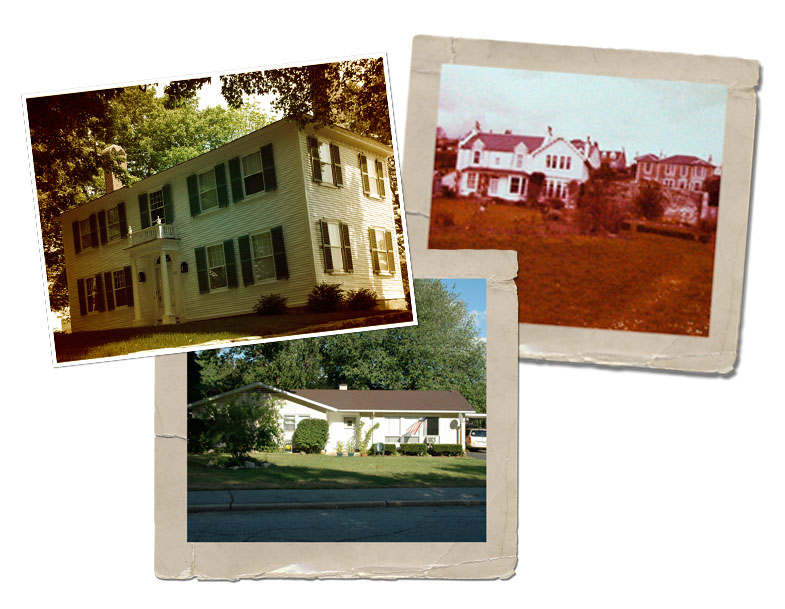 I’m trying to remember if I’ve ever lived in a red house. An 18th century Federal style white house with green shutters in Maine. White tract Navy housing in Connecticut (and Pearl Harbor, and Charleston). White Gothicky Revival stucco pile in Dunoon, Scotland (it’s for sale, if you’d like to live there too. I don’t know why they don’t show the ruined greenhouse; it’s quite compelling in the springtime when the foundation is filled with blooming yellow daffodils.) A little split level outside Saratoga. The crumbling hateful house I live in now. All white.
Though there was the sweet little grey shingle house in Maine that I came home to from the hospital where I was born. And our house in Hawaii Kai on the side of an extinct volcano — what was that? A kind of orange stained wood? Or lava rock? One exterior wall (leading to my bedroom and my sister’s bedroom) was sliding shoji screens. The wall next to the front door was all glass and my memory of the rest of it seems to be bougainvillea and other exotic greenery that grew around the koi pond. But definitely not red.
In case you can’t tell, we moved around a lot. I’m part of the lineage of a whole string of houses across the country (and beyond). Which is why I marvel when I read about houses that can lay claim to generations of the same family. It’s remarkable enough that the house itself survives, but to have stayed in the same family for hundreds of years? To have been inherited by a Jakob, or Isaiah and passed down to a Topher, or Thomas who wanted to stay put, and who had the wherewithal and bank account to pay taxes and put on a new roof? What a miracle!
I started a book this morning about a house (a red house) that belonged to descendants of the Hatch family for eight generations (that’s 300 years-worth of family history; to get a sense of this, repeat after me: “this was my great-great-great-great-great-great-great-grandfather’s house”). I was hooked after the opening.
Before the highway, the oil slick, the outflow pipe; before the blizzard, the sea monster, the Girl Scout camp; before the nudist colony and flower farm; before the tidal wave broke the river’s mouth, salting the cedar forest; before the ironworks, tack factory, and shoe-peg mill; before the landing where skinny-dipping white boys jumped through berry bushes; before hayfield, ferry, oyster bed; before Daniel Webster’s horses stood buried in their graves; before militiamen’s talk of separating; before Unitarians and Quakers, the shipyards and the mills, the nineteen barns burned in the Indian raid — even then the Hatches had already built the Red House.
….
In architectural terms, the house my father saw would be described as a five-bay, double-pile, center-chimney colonial. It had post-and-beam, vertical-board construction, a granite foundation, and small-paned windows. The windows were trimmed with chipped white paint, the body of the house was a deep red — Delicious Apple Red, Long Stem Rose Red, Evening Lipstick Red, Miss Scarlett Red, a red that neared maroon. Otherwise, the house was plain, and with its chimney in the middle of the roof against a backdrop of sky, appeared as simple as a child’s drawing of a house: big square and triangle, smaller square on top. The cornice seemed the only detail out of place: attached to the doorway as if to elevate the exterior from utilitarian farmhouse to Victorian estate, it hinted at Greek or Roman Revival, something lofty — like a hood ornament on a Dodge Dart.
The house was large and debauched. Four bushes grown shaggy with tendrils sat beneath the first-floor windows. Lilac trees tangled the farthest ell. The driveway wound around the house to the right, where it climbed a small hill. In the backyard, a man and woman sat in lawn chairs drinking old-fashioneds. It was 5 p.m.
Red House: Being a Mostly Accurate Account of New England’s Oldest Continuously Lived-in House, by Sarah Messer
I’ve been told by an architect that we no longer build to last, that the way most houses are constructed today, they won’t last much past the 30 year mortgages taken out on them. Is this the final sign of becoming a disposable society, that we build knowing we plan to tear down?
Foto Friday: Brick
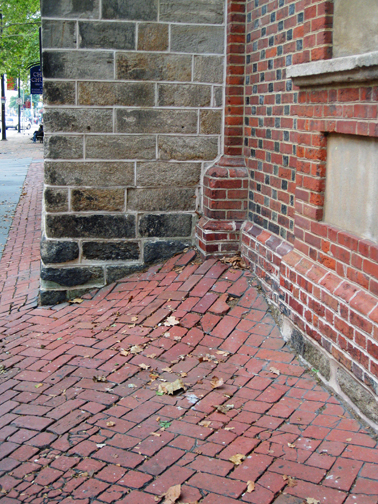 Christ Church, Philadelphia; built between 1727 and 1754. (Photo by Sabra Smith)
An open letter to Hugh Laurie, aka “Dr. House”
Mr. Laurie:
While I’m a fan of the curmudgeonly brilliant physician you play on television, I am also intrigued by your real-life polymathic tendencies. Congratulations, sir, on the unbounded success of your new blues album, “Let Them Talk.” (I will still always think of you belting out vintage tunes at a plinkety piano in “Jeeves & Wooster.”)
In the New York Times magazine interview (“Hugh Laurie Sings the Blues,” profile by Gavin Edwards, 9/4/11) you experienced while meandering through the Darwin exhibit at London’s Natural History Museum with your journalist buddy-of-the-day, you lamented the horrifyingly invasive aspects of interactive museum media and sought peace and quiet.
He headed past an array of interactive touch screens explaining evolution, then questioned a security guard about where he could find a less high-tech section of the museum. “Glass cases, mahogany cabinets, no people,” Laurie specified. Thus directed, we decamped for the mineral gallery and found a bench between the sulfides and the silicates.
Mr. Laurie, I’ve got the nexus of glass cases, mahogany cabinets and Charles Darwin to recommend to you if your publicity tour takes you through Philadelphia.

Hoffman's Two-toed Sloth, image courtesy of Wagner Free Institute of Science, Philadephia, click to view original
Don’t miss the Wagner Free Institute of Science, founded in the 19th century to provide free science education for the people of Philadelphia. Little has changed since its founding and you’ll find glass cases galore, filled with stuffed birds and mammals, skeletons, fossils, geologic specimens and more.
As the museum’s own website explains
The Institute is not a reflection of the past, but the past itself, visible and vital, as it continues to pursue the mission of its founder, William Wagner.
You don’t need a replica of Darwin’s ship, the H.M.S. Beagle, in order to indulge in exploration of Darwin’s theories. (Darwin, according to Laurie, is “a good contender for the single biggest idea anyone’s ever had.”) Wandering around the Wagner, one might think they just glimpsed Darwin himself disappearing around Case 71 with the hanging tree sloth.
You don’t need to thank me for the suggestion. Just enjoy yourself.


 Nostalgic for the original Wayback Machine?
 My Own Time Machine: Buildings, Places, People & Things