Foto Friday

A chipped china cup makes me think of Lost Things
I found this wonderful film, and it reminded me of beloved things, rescued things, things put away for the children of my children, found things, and lost things. (And how my need to save things to pass along sometimes feel like a bondage to the past, or a birdcage on my head… you know what I mean?)
Enjoy “Lost Things,” a film by Angela Kohler
We’re all links in a chain


If there’s one thing my father’s decades of genealogical research have shown me, it’s that communities (micro to macro) are connections of people who are related in twisty, bendy, branched ways — sort of a six degrees of separation concept as applied to a family tree. After moving from place to place all my life, it has been a strange experience to stand in a churchyard and know that I am somehow related to many of the people buried under the lichen-covered marble stones even though the names on those stones vary.
At this point, I can’t even imagine how many pages my father’s research would total if he were to print out the whole thing. One of his (and my own) great fears is that something will happen to his computer and it will eat all his data. Zipffft would go the image of my grandmother standing in front of a giant sequoia, of my other grandmother costumed on the General Wayne candy float in the parade, the image of my great grandfather surrounded by his family proudly standing alongside the new family car, the grainy copy of a newspaper wire photo of my dad the day he graduated from Annapolis hoisting a pretty blonde in some variation of that famous sailor meets cutie Times Square V-Day image.
My own sons mostly shrug. I’ve dragged them to enough churchyards and historic homes that they don’t really pay attention anymore. (Though I suspect that osmosis is taking place and they will be affected just as I was, toodling around the countryside with my parents and stopping in at historic sites and antique shops all over New England.)
The youngest boy brought home a memo from his third grade teacher asking parents to send in photographs of ancestors to be used in an upcoming class project. Dutifully, I pulled images from my treasure trove and burned a disk to send in. I printed out a contact sheet to review with the boy so he’d know who the people were and how they were related to him.
“These are your great-great-aunts who were in the circus,” I explained.
“uh-huh, uh-huh, uh-huh,” he said and shoved the disk in his bag. So much for exhibiting the slightest bit of interest.
But then an interesting thing happened.
He came home filled with questions. In the photo of the people dressed in tuxedos — who was that? In the photo where the people are dancing, where are they? In the photo that’s like the picture we saw visiting our friends, who is that? He got interested because other people were interested. They had questions and so now he was curious too. My answers sparked additional questions and so began a real dialogue about who he came from and what their stories are.
The lesson here is personal connection. There had to be some turning point where this information became about him. He made an emotional connection to the past and wanted to know more. (You’ve probably read something along those lines before on this blog, during one of my rants about how the failure to make history/architecture relevant to a modern audience makes it irrelevant and thus endangered.)
I love watching the celebrity guests (Meryl Streep, Dr. Oz, Stephen Colbert and more) on PBS Television’s “Faces of America” program turn the pages of the scrapbook given to them by Henry Louis Gates, Jr. Watching their rapt faces as he unravels their own personal story for them. I love being able to watch the connection take place as they learn about relatives they’ve often never heard of or have a jarring moment of confrontation with a document — real proof of a history that is theirs. It moves me to see them moved, to see them wipe a tear, or steady themselves, palms flat on the table, while they take in a whopper of an ancestral fact about persecution, triumph, tragedy or staggering coincidence. This series debuted the week of February 10 (check local listings); episodes are also available online.
With interest I noted that Lisa Kudrow is executive producer of a new project with Ancestry.com and NBC called “Who Do You Think You Are?” The seven part series sounds similar to Gates’ celebrity family tree journeys though perhaps with an additional DIY aspect that will also explain to the viewer how to discover their own roots. Featured are Sarah Jessica Parker, Emmitt Smith, Lisa Kudrow, Matthew Broderick, Brooke Shields, Susan Sarandon, and Spike Lee. The program launches Friday, March 5 at 8pm EST on NBC.
Foto Friday
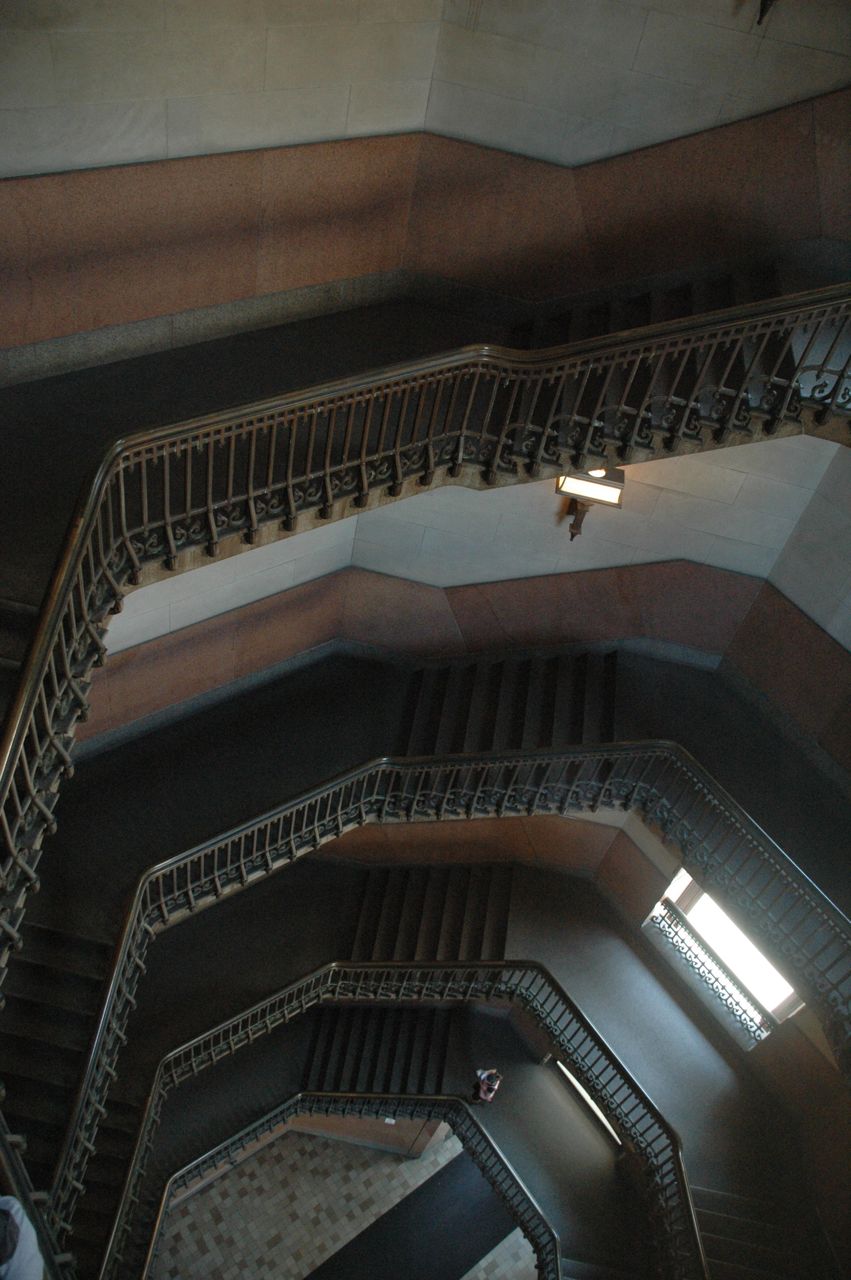
Foto Friday
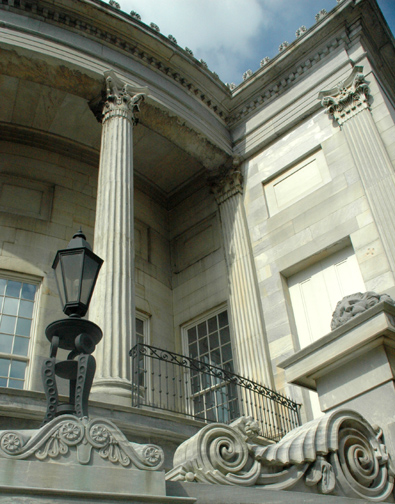
Can you spot the face?
Standing outside to peer in The Memory House
 I settled in to read a book called In The Memory House by Howard Mansfield last night, and ended up in a self-reflective funk, wondering why I’ve chosen a field that by its very nature is certain to bring loss and heartache. The nature of history is that things go into the past, and the nature of historic preservation is a selection process whereby some things are consigned to history — whether it is remembered or not is another matter — and some are allowed to slip from the landscape or our collective consciousness. Demolition. Loss. Ignorance. Forgetfulness. Perspective.
Mansfield touches on all these issues in the book — how we choose to honor or ignore the past, why we choose to remember what we do, the shift over time from who decided and how things were honored. It is thoughtful, inspiring, hopeful, and just a tad cynical.
It was the prologue that got me feeling that keen ache; a feeling I know well after years of moving and returning to find myself an outsider, childhood landmarks lost.
A Lost Spring
There was a man I loved to visit. He lived in the house he grew up in — a wonderful, warm, cluttered house that seemed larger inside than out. There were long hallways and rooms, and a barn lined with the things he had collected — antlers and bones, small animal skulls, wood of all sorts. He would carve animals on these or paint scenes of how it used to be. He carved my wife’s wedding ring.
I could have listened to him tell me stories for hours. He knew how many turtle eggs it took to make enough mayonnaise to last the summer. In his stories he could remake the land, clear away the woods and bring back the farms he knew in his youth, the trains, the factories making clothespins.
His house is two hundred years old, shaded by a maple tree probably as old — the tree is what you look at first. The house seems to be keeping the tree company. He told me once that it used to get so cold upstairs in his sisters’ bedrooms that the nail heads in the wall would frost over. And in summer it would be so hot up there. But they would run down to the swimming hole and come back and slip under the sheets — real cool. The swimming hole was a marvelous place. It was fed by a spring.
Some years back, the state widened the road and built a new bridge. They had to drop a cement slab on that spring. Pluggged it right up, he told me. It took quite a load of cement and a bit of engineering, but they stopped the spring and the bridge goes through straight. You wouldn’t even notice it.
When I pass his house and that great maple tree, I picture the spring, and the children swimming there in summer twilight.
And when I am away from this corner of New Hampshire, down among the landscape of haste — parking lot and highway, mall and condo — I look into the faces of my countrymen and I think of the plugged spring.
Howard Mansfield, In the Memory House
We bemoan the loss of a way of life we imagine once was (and maybe it was really that idyllic, in some ways) yet we pave over a new fast lane in our eagerness to get to a life of cheap convenience, as though tube socks from Walmart matter more than a stream where children can play and forge a lifetime of memory.
Foto Friday
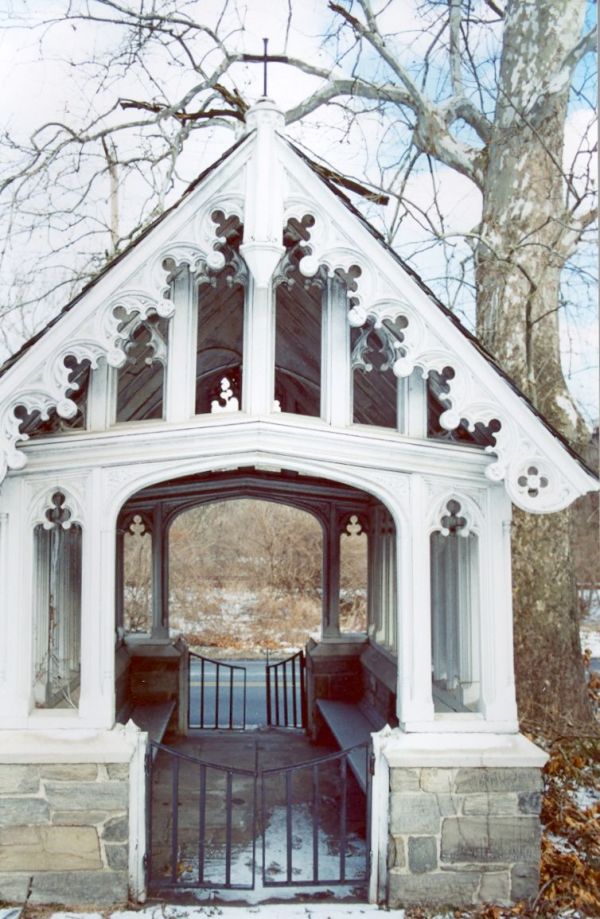
 This is a detail of a small Gothic Revival structure built on the grounds of Old Swedes or Christ Church, located in Bridgeport, Pennsylvania.
The main building, which still hosts an active congregation, was built 1760 (altered 1837) by descendants of the 17th century Swedish colonists in Delaware. The site was donated in 1758 by the Rambo family, many of whom are buried in the churchyard along with Holstein, DeHaven, Coates, Matson, and Cox ancestors.
A brief overview from a June 29, 2009 article on Old Swedes Church written by Walter Ault for The Times Herald. After reading it, this site sounds like it could use a workshop with Partners for Sacred Places before it’s too late.
According to Reverend William Morris Longstreth, a service at his church ordinarily draws eight to ten parishioners. However, it doesn’t lessen the importance of the church, being that it is about 250 years old, is well preserved and has played a big role in Montgomery County history. Furthermore, it is a lasting icon of one of the earliest groups of Europeans to settle in this part of the county: The Swedes.
The church in question is Christ Church (Old Swedes), Upper Merion, located at 740 River Road in Swedesburg. A book about the history of the church by Rev. William P.C. Loane reveals that the Swedes established one of the earliest colonies in the New World in 1638, in Wilmington, Delaware, with the settlers spreading out to Philadelphia in succeeding years. Between 1655 and 1675, the book reveals, the Swedes tired of intermittent Dutch and British rule, and consequently began moving westward up the Schuylkill River. This migration continued for many years and, as Rev Loane’s book points out, a man named Gunnar Rambo led a group of Swedes to this area around 1707.
According to the book, local Swedes originally met for religious services in the home of the son of Gunnar Rambo, also named Gunnar, with the first recorded service in 1733. The Swedes, the book says, were deeply devout Lutherans and therefore eventually insisted on having a separate church building. As a result “a simple log cabin was built in 1735 on Gunnar Rambo’s land,” which served as both a church and school until Christ Church was built.
The old church sits on approximately one acre of land a stone’s throw from the Schuylkill River; next to a churchyard and walled-in cemetery as old as the church, as Rev. Longstreth pointed out, with some grave markers so old that all inscriptions are worn away. Many notable people are buried in this cemetery, including Sarah Priest, a famous Civil War nurse.
The church is rather small and plain architecturally. It is a stone, plastered-over structure with a tower rather than a steeple. Christ Church was dedicated June 25, 1760, according to Rev. Loane’s book, and expanded in 1837. The book states that the “nave or body of the church, up to the line of the transepts or wing, is the portion which was built in 1760.”
Much of the original portion of the church is just as it was in 1760, except that the pews have been replaced, according to Rev. Longstreth, who commutes from Pottstown. While the church’s exterior is plain, the interior is beautiful despite chipped paint and plaster. “The outside doesn’t look like much, but the interior is beautiful,” Reverend Longstreth said. Inside the church are thick, heavy doors with iron hinges; stained glass windows that illustrate bible scenes; red carpeting; beige pews with brown trim; a marble baptismal font and a pipe organ, with the pipes taking up an entire wall.
Christ Church’s history is detailed on a wall at the rear of the church. It states that after crossing the Schuylkill River at Swedesford on Dec. 13, 1777, General George Washington and his troops visited Christ Church and encamped there before going on to Valley Forge. In 1876, the history says, Prince Oscar, son of King Oscar of Sweden, came to Christ Church for a visit.
It also says that in 1980 Christ Church was included in the list of historic places of Pennsylvania. The Swedish pioneers who settled here had a lasting impact on the surrounding area. Swedesburg, Swedeland, and Swede Street are in Norristown; two streets in Bridgeport, Rambo and Holstein streets, are named after Swedish families.
More photos at flickr
A Valentine to Frank Lloyd Wright
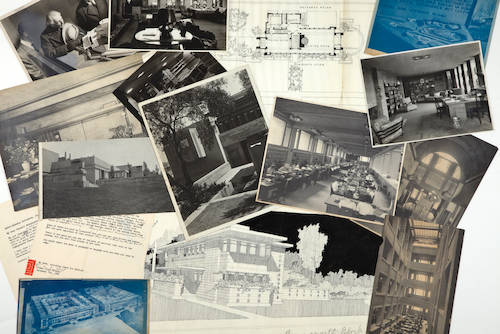 A treasure-trove of photographs, drawings, and correspondence related to publication of In the Nature of Materials, Henry Russell-Hitchcock’s 1942 magnum opus on the architect Frank Lloyd Wright (1867-1959), will go to auction in San Francisco on February 14, 2010. Auction house Bonham and Butterfield’s will offer the collection as the highlight of its Rare Book and Manuscript auction.
The archive, which was organized in folders and bequeathed by Russell-Hitchcock to the seller, includes:
- 600 photographs of Frank Lloyd Wright’s buildings and their interiors many of which are stamped “Property of F.L.L.Wright” or with a penciled notation “FLLW”
- 300 photographic reproductions of drawings and plans not used in In the Nature of Materials
- Building plans redrawn specifically for the book’s publication by members of the Taliesin Fellowship (this was a group of young architects who paid for the privilege of living and working with Wright)
- 7 plans and one perspective drawing in ink, pencil, and wash believed to be from Frank Lloyd Wright’s hand
- 3 typed letters signed “Frank Lloyd Wright” or “FLLW”
Art historian Henry Russell-Hitchcock (1903-1987) intended In the Nature of Materials (published 1942 by Duell, Sloan and Pearce) as a ex post facto catalogue of the 1940 Museum of Modern Art exhibit dedicated to Wright’s work. (Wright called the exhibit “the show to end all shows.”)
The purpose of both book and the exhibition, Russell-Hitchcock wrote in his preface, were one in the same: “to display as fully as may be the architectural work and projects of Wright, with particular emphasis on the expression of the ‘Nature of Materials,’ the characteristic phrase Wright has selected both for the title of the exhibition and of the book.”
Describing the material gathered for the book, he added “the rather complete collection of photographs and plans in whose selection Wright actively participated, together with the perspectives of many important projects, should make it widely useful. There is in existence no other book which pretends to cover the work of Wright with comparable thoroughness.”
The auction house estimates the archive will sell for $20-30,000. ♥UPDATE: Hammer price was $40,000 ($48,800 including buyer’s premium).
Sale 17782 – Fine Books and Manuscripts, 14 Feb 2010, 220 San Bruno Avenue, San Francisco
More information from Bonham’s & Butterfields, Catherine Williamson, (323) 436-5442
Foto Friday

Goodies alert!
This just in — and it falls under both the “Goodies” and “Free Stuff” category!
 THE LAST CHANCE FOR PHILADELPHIA COMMERCIAL MUSEUM OBJECTS
The City of Philadelphia is seeking to disperse the remaining unclaimed items from the Philadelphia Commercial Museum collection. Items are of no monetary value, but may be of interest for educational or production purposes and include textiles, raw material samples, vases, statues, baskets, clothing/costumes, toys, housewares, etc. in various conditions.

Interior, Commercial Museum
The Commercial Museum was built in 1899 and founded by William Wilson, a botany professor at the University of Pennsylvania. The Museum was inspired by the monumental Columbian World’s Fair in Chicago and was the official repository for artifacts from world’s fair of the era. Displaying objects from around the world, it functioned both as a tourist destination as well as an educational resource for business persons. The Museum stood on the site now occupied by the Perelman Center for Advanced Medicine at 34th Street and Civic Center Boulevard.
When the Museum was closed, the collection was dispersed among local universities and cultural organizations, as legally required by Philadelphia Orphan’s Court. Since then, the remainder of the collection, over a thousand objects, has been held in a City storage facility and the City intends to disperse these remaining objects.
The Office of Arts, Culture and the Creative Economy is coordinating the dispersal of these materials and invites you and your colleagues to take any items of interest. This is being facilitated on a first-come-first-serve basis; please call or email to arrange a time at the storage site.
Please call BY WEDNESDAY FEBRUARY 17th to arrange an appointment.
CONTACT INFO:
Margot Berg, Public Art Director
Office of Arts, Culture and the Creative Economy
701 City Hall
Philadelphia, PA 19107
v 215.686.4596
c 267.303.0507
www.phila.gov/publicart


 Nostalgic for the original Wayback Machine?
 My Own Time Machine: Buildings, Places, People & Things