Love and Joy Come to You

Postcard sent to my grandfather in 1906
The Tycoon and the T-Plan
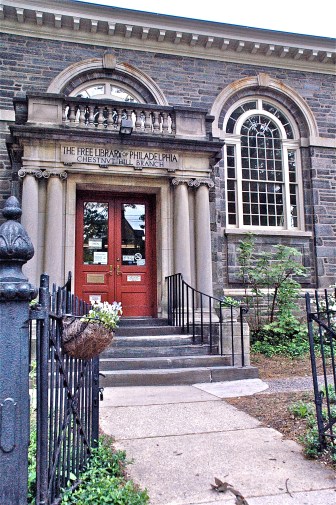
Chestnut Hill Branch of Philadelphia’s Free Library system is a Carnegie Library. (Photo by Sabra Smith, 2009)
I had the pleasure of working with Catherine Lavoie and Lisa Davidson of the Historic American Buildings Survey (HABS) who spent many hours researching Philadelphia’s remarkable collection of branch libraries, built in the early part of the 20th century with a grant from steel magnate Andrew Carnegie.
Using their reports, I was able to write nominations for four Carnegie branch libraries that were added to the Philadelphia Register of Historic Places in June 2009.
For more information, read this article I wrote for CRM: The Journal of Heritage Stewardship (live link here, or click link below for pdf) to learn about the Tycoon, the T-Plan, the Mayor and HABS. Have a look at the images and let me know if the words “quintessential library” don’t spring to mind.
Preserving Philadelphia’s Carnegie Branch Libraries_Sabra Smith (pdf)
 Browse the HABS/HAER archives at the Library of Congress and see if they’ve documented anything in your neighborhood. They do amazing work. Insightful, thorough research, detailed drawings, time-in-a-bottle photography. (You can order reasonably-priced prints from the archives — an inspired and unusual Christmas present idea for the history buff or architectural enthusiast on your list.)

T-Plan, click for article pdf
One of my other favorite repositories is Google Books. It found a 1916 article in the Architectural Record about the Haddington branch (Kelsey and Cret), including floor plans and drawings and photographs of architectural details, including a cartouche of the “triple-headed bird of wisdom” (I never knew there was such a thing). For pdf of the Haddington article, click link below or the t-plan thumbnail at right:
Haddington_Architectural Record July 1916
Here’s a quote from the article (by C. Matlack Price) that I think sums up my attitude about historic preservation in our day and age:
And in no type of public building have classic forms been more often called into service than in library buildings. This, in many ways, is fortunate, for we instinctively feel that, in all propriety, the repository for a valuable collection of books should be dignified.
In pursuit of the ideal of dignity many architects have overlooked the element of humor in architecture and have forgotten that with qualities of dignity in a library building it is desirable also to combine in as strong a degree as possible qualities of an inviting character.
Cozy corners and reading nooks are very good things indeed
I dream of buildings. I re-visit childhood homes and finally find the secret passage I had always sought. The north-facing apartment in Manhattan of my post-college era fills with light (and moves from a tenement to a lovely brownstone). Hallways in my college dorm shift, like something out of a Harry Potter movie. Not long ago I dreamt I’d moved back to Manhattan and scored a spacious place in a pre-war building with vast windows overlooking the Hudson River. I look forward to someday walking into that amazing apartment and saying “wow! I’m having deja vu!”
My imagination knows me well and so it designed the apartment [literally “of my dreams”] to include a cozy reading nook. A perfect place to settle in for a good, long read.
Since then I noticed this nifty space in Martha Stewart Living. While the feature wants you to follow directions and make that wreath, what I admired most was the nook. Vintage buildings are much-beloved for their nooks and other quirky architectural features.
With almost two feet of snow outside today, this would be the perfect hideaway to dream and look out at the white stuff. I’d like a nifty nook like this for Christmas, Santa. Can you dream one up for me?
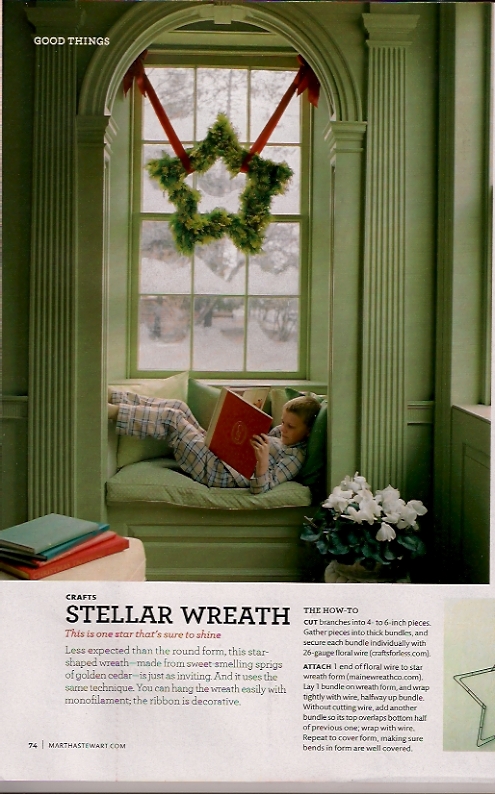
Nook. As seen in December 09 Martha Stewart Living. Can someone get me a mug of hot chocolate?
Foto Friday
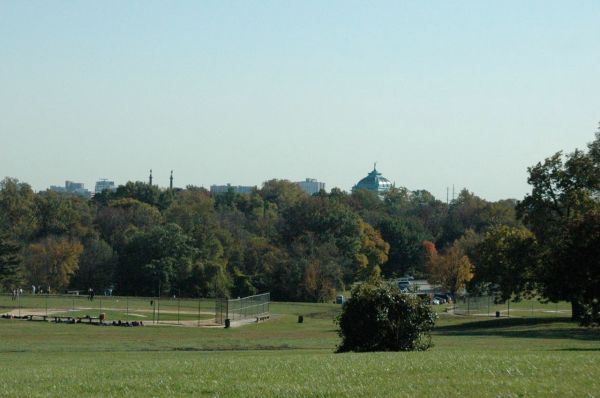
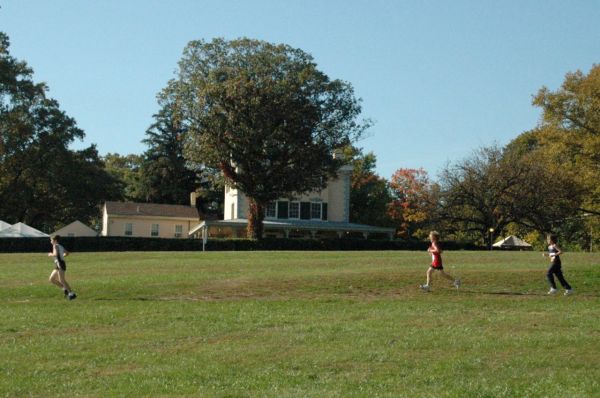 Kids in the Invitational Cross-Country meet were so busy puffing up the steep hill, they didn’t notice the remarkable views, including Belmont Mansion (seen above, now home to the Underground Railroad Museum) and vistas that included a gleaming Memorial Hall (a remnant of the 1876 Centennial Exposition beautifully restored by the Please Touch Museum) and the towers of the Smith Civil War Memorial, erected between 1897-1912 (no relation).
Philadelphia is so chockablock with history and remarkable buildings that tell fascinating stories that I guess they just don’t notice after awhile. So one of the challenges that we, as preservationists, face is working to make these marvels “pop” into awareness from time to time.
Pine needles, champagne corks, and large bulldozers

Click photo for post on 2009 Endangered List's Memorial Bridge connecting Portsmouth, NH and Kittery, ME
It’s that special time of year again. Soon the needles will have fallen off the tree and the New Year’s eve streamers will lie unfurled on the floor.
With all the flurry of activity (and snow), don’t forget that nominations for the National Trust for Historic Preservation’s 2010 Most Endangered Historic Places list are due on January 8.
While I would love a new year in which special, place-defining buildings, bridges and whatnot were safe from falling down or being knocked down, that simply isn’t the case. See the link below for full information on nominations. Then put “Nominate an at-risk site to NTHP” on your list of 2010 resolutions.
The key criteria are:
Significance: The architectural, artistic, and/or historic importance of a site whithin its cultural, social, or geographical context. The places on the 11 Most list need not be famous, but they must be significant whithin their own cultural context and illustrate important issues in preservation. Some previous listings are of undisputed national significance, while others have been included for their role in a unique cultural tradition, for their rare architectural design, or as the last surving example of a style, building type, or resource.
Urgency: The need for immediate action to stop or reverse serious threats. Potential 11 Most listings may represent stages of physical deterioration or unfavorable conditions including a natural disaster, intentional destruction, neglect, erosion, exposure to the elements, improper planning or preservation.
Solutions: The actions that can be taken by the National Trust for Historic Preservation, local organizations, and/or the public to help mitigate the threats facing an endangered place in the short or long term.
via 2010 America’s 11 Most Endangered Historic Places® Nomination Guidelines.
Celebrating the past with art
Art gives us a new way to see the thing that we’ve seen before.
Art is a wonderful tool to interpret or engage with history.
The artist, creating, can take invisible stories and give them presence. Thinking must go on about the place, the people, the meaning, and the collapse of time.
The viewer sees layers previously obscured and makes new connections with the place.
There are several Philadelphia venues that engage this intriguing nexus of place, history and art.
Eastern State Penitentiary’s evocative urban stone “ruin” makes a perfect setting for its annual haunted house and a wide range of artist installations (see complete art timeline here). Current work includes Linda Brenner’s beloved “Ghost Cats” referencing the cats that populated the grounds when the prison closed its giant portcullis in 1971. Mary Jo Bole’s “Purge Incomplete” explores the history of plumbing at Eastern State, which “had running water before the White House.” Bole has used resin, frosted glass and brass to recreate elements of architect John Haviland’s original plumbing designs. [ESP has scheduled artist orientation visits and will be accepting applications for the 2010 installations. More info here.]
Society for the Preservation of Landmarks, which manages four historic properties including the Powel House in Society Hill near Independence Hall, has added a contemporary art element to their programming. I addressed my personal experience with one of their installations in my thesis, Dead Men Tell No Tales, noting that the docent had no understanding of the intended purpose or theme of the work. Her knowledge was limited to which doorknob in the room was authentic and the origin of the knife boxes that once belonged to Samuel Powel, Philadelphia’s “patriot mayor.” The video screens and fiber optic displays on the mantel seemed more of a nuisance than a new layer of meaning for the site. When implementing art to tell a tale, staff needs to become as familiar with the story and its new filter as the artist.

Founders Hall, Girard College, photograph copyright Joseph E.B. Elliott, Art installation is "nothing but what is therein contained" by Steve Rodin
Everyone loves a festival and HiddenCity Philadelphia launched as a festival of secret spaces made “accessible” in all the different meanings of that word. Who wouldn’t be captivated by the notion of an arts performance in a space where hard hats are required? Patrons rediscovered neighborhood landmarks through dance, music, sculpture, video, print, and mixed media pieces inspired by the history and architecture. Clever spin-off products included a card game, photographs, buttons and hard hats.
I believe even sites with limited resources can benefit from a partnership with art. How uplifting and refreshing to see a place through someone else’s eyes, its meaning expressed in new forms and colors. How evocative and educational to see what parts of the story resonate with a new audience — whether artist or viewer.
The seven historic mansions in Fairmount Park formed a partnership with the Moore College of Art and challenged both students and graduates to interpret the sites through art. A jury of local artists and architectural historians selected the winners and an exhibition was mounted in City Hall. “Fairmount Park’s Colonial Elite” inspired numerous works that can be used by the sites as part of on-site exhibits, as greeting cards, or potentially sold as part of a fundraiser. The winning works included
- a photographic collage of ships inspired by the life of John Macpherson, a sea captain and former owner of Mount Pleasant
- a garment “Retro Lemon Dress” interpreting the decadence of materials found in Lemon Hill
- a watercolor and pencil interpretation of Woodford Mansion depicting the many layers of history embedded in its architecture
Associated costs were defrayed by bringing on several sponsors, including a paint company with a line of historic paints and several area restaurants.
Foto Friday
 Needs stockings….
My fifteen minutes start…. now.
 Click the stopwatch and start the timer.
I am honored to be the subject of a profile at Voices of the Past, a website “to help inspire the advancement of heritage values in our society using today’s online communications tools known as social media.”
The site highlights wonderful people doing innovative things using social media to engage the public in history and place.
There’s teenager Dave Moyer, whose experience creating a podcast for Historic Denver led to founding his digital media company, Bitwire Media, working with Laura Bush on the Preserve America initiative, and co-chairing conferences promoting youth activism in historic preservation.
There’s Michael Phillips, founder of iGuidez, a heritage website dedicated to encouraging netizens (like you!) to use video to capture and communicate a sense of place.
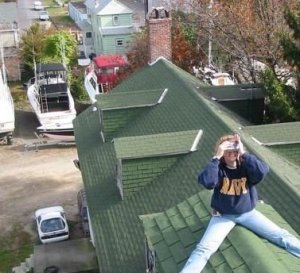 And now there’s me!
You’ll find lots of other fascinating profiles plus tips for using web 2.0, netcasts, links to heritage news roundups, and lots, lots more. Have a browse at Voices of the Past.
Let me know what you think.
After all, that’s why we’re here using social media — to exchange, communicate and build community!
Knit one, gift too…

Harris Storehouse, 1832, click image for more info
While doing some work on New England National Historic Landmarks, I discovered the National Historic Landmark district in Harrisville, New Hampshire.
Harrisville is a quintessential New England mill village where woolen yarn has been produced since 1794. Tucked into the hilly topography of southwestern New Hampshire, Harrisville is “the only industrial community of the early 19th century that survives in America in its original form” (architectural historian William Pierson).

Ten square miles of upstream ponds and watershed flow to a ravine where the water falls 100 feet over the course of a quarter mile. This created ideal conditions for the water-powered woolen mills and surrounding village mostly built between 1820-1870, when textile mills transformed the economy of New England.
Harrisville mills produced woolen cloth for nearly 150 years. As much as 45% of the village population worked in the mills as carders, spinners, dyers, weavers, finishers, and mechanics. Beyond that, the countryside supplied wool for spinning, wood for the boilers, and food for the population.
The Harris family established the factory village early in the 19th-century, followed by the Colony family and its Cheshire Mills about 1850.
Cheshire Mills, one of the last New England textile mills in operation, closed its doors in 1970.
But there remains in Harrisville a collective memory: the clang of the work bell in the cupola that brought workers into the mill; the skills required in spinning and weaving; the sound of the factory in full operation; and what it was like to grow up in the tiny, close-knit world of the factory village. — Historic Harrisville, Inc.
Local residents and preservationists formed Historic Harrisville, Inc. with the goal of preserving the town as a working community.
Their preservation efforts emphasized
- adaptive reuse of the buildings
- a system of legal preservation covenants
- historic district legislation
- revolving loan funds for restoration
- “Renovating the old buildings and leasing them to businesses created a new economic base for the town and made the buildings self-supporting both as workspace and affordable housing.”
 Preserving the textile heritage
Harrisville Designs was established in 1971 to preserve the town’s textile legacy and contribute to its economic vitality. The family-owned business started out making high-quality hand weaving yarns, followed by hand weaving looms and equipment. The company now offers a range of educational products, as well as curriculum on textile history that will introduce young people to the textile arts and the pleasure of creating with their hands.
Shop with purpose and know your gift (toys, yarn, etc.) helps perpetuate heritage!
Consider spending some Christmas dollars in this lovely National Historic Landmark village. I’m eager to visit in person and browse the range of products offered by local artists. Then I really want to eat at the General Store, where mother & daughter M’lue and Laura produce a mouth-watering daily menu based on local products.
If you can’t get the Time Machine to transport you there to shop through the village, then go virtual and browse the offerings online at Harrisville Designs. I want yarn in a rainbow of colors, even though I don’t know how to knit more than a scarf, it just looks so lovely!

Click image for the story of Harrisville yarns
The knitter in your life will love the high-quality yarns in a range of weights and blends (mmm, cashmere….) and you can drop a hint by adding a pattern for a sweater you’d like.
If you have kids on your list, there’s a whole range of toys and crafts to choose from. (Homeschooling alert!)
Love that needlepoint sampler kit (see above. There’s one with sheep too).
Remember those looms for pot holders you made in elementary school? Those were lame. These are amazing.
 And the E-Z Weaver (at right) would be great fun! (Oh, right. Shopping for kids, not for me…)
Rug-hooking kits. Felting kits. Knit-a-scarf kits. A veritable textile wonderland!
I received a needle-point kit when I was in elementary school and it opened a world of crafting for me. It wasn’t simply a gift for that Christmas, it has been a gift for my life.
The Gingerbread Man gives this gift idea five stars
Mmmmm. Christmas cookies. Quick breads. Pancakes.
You know what all these have in common? You use flour to make them.
Now, you might never think of giving flour as a Christmas present, but let me tell you why you should.
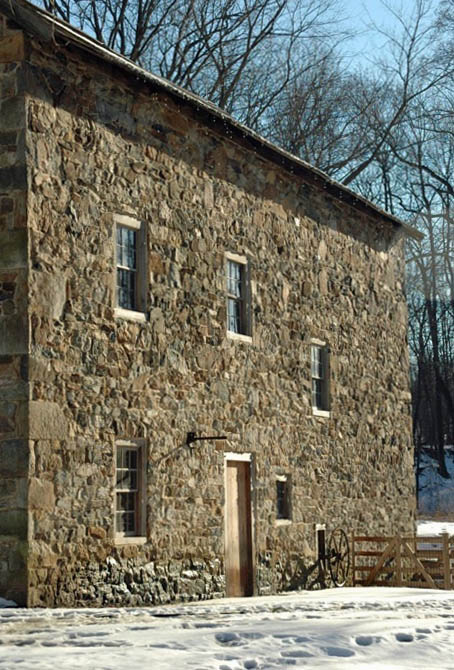
Give flour this Christmas and help support the National Historic Landmark Mill at Anselma, located in the countryside of Chester County, Pennsylvania, approximately 33 miles outside Philadelphia.
 This site could have met a fate similar to that of my great-grandfather’s mill — decay, abandonment, and due to a lack of vision, demolition.
At the end of the 1990s, the site was simply a picturesque but lifeless assembly of buildings evoking the long-ago rural industrial and agricultural history of the area.
The landscape was overgrown, the mill’s waterwheel was missing, and restoration work was needed on the various structures.
 Today, just over a decade later, the buildings are all restored and visitors may observe a functioning waterwheel power the complicated machinery that produces the mill’s stone ground flours and corn meal.
Children can follow the process of corn through interactive interpretation that allows them to shuck corn cobs at the top of the mill, crank a miniature waterwheel, and sift flour in the lower area.
None of those originally involved in preserving the site had prior experience restoring or operating a 250-year old mill, but the group honored the site’s vast potential by keeping open minds, employing creative approaches wherever possible and making community involvement a top priority from the start.
The Mill at Anselma has the perfect gift for the baker/preservationist on your list!
- Choose from a wide array of baking flours, including organic stone ground bread and pastry flours.* Options include The Miller’s Sampler ($15) and The Baker’s Special ($6). Price includes recipes and gift packaging.
- Not so good with mixing it up? Gift jar mixes make it easy to bake Dark Roasted Corn Bread, Chocolate Lover’s Cake or SuperFine Scones ($5.00 each includes decorative gift jar).
- Volunteer Quick Mix ($6) comes in a decorative cloth bag and replaces that box of Bisquick on your shelf. Recipes for pancakes, muffins, and snack cakes are included; just add eggs, oil, fruit or nuts. (I vote for chocolate chips. I love a good chocolate chip scone!)
- And don’t forget your furry best friend — Anselma also offers organic Peanut Butter Bones by PupBistro (a regular sell-out at the Anselma Farmer’s Market). Only $3 a 3/0z bag! Woof!
Order via the website or call 610/827-1906 to place an order or for more information. Shipping available anywhere in the U.S. Location mapped here.
 Want to go over the top? Create your own gift basket with Anselma organic stone ground flour, cookie cutters, and perhaps a copy of The Gingerbread Architect: Recipes and Blueprints for 12 Classic American Homes! (Thanks to Kaitlin at Preservation in Pink for this book find!)
(For more fanciful structures, from castles to lighthouses, perhaps try Making Great Gingerbread Houses.)
A gift of country heritage is just a click away! Order now.
Oh, and while you’re at it — add a membership to your order!
*The Mill at Anselma is licensed by the Pennsylvania Department of Agriculture to sell its stone ground flour products, all ground, sifted and packaged by dedicated volunteers according to Pennsylvania food safety standards.


 Nostalgic for the original Wayback Machine?
 My Own Time Machine: Buildings, Places, People & Things