FREE ART DECO architectural details — Happy Ending
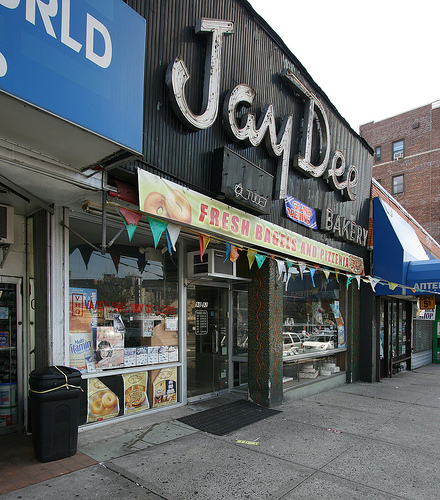
This just in from NYC’s Historic Districts Council. Please help spread the word!
Preservation Alert: Historic Jay Dee Bakery’s Art Deco Features Available Free!
Written by Historic Districts Council on August 25th, 2009
Jay Dee Bakery (98-92 Queens Blvd, Forest Hills) closed its doors after nearly 60 years. It stood as a well-known NY Art Deco landmark since the early 1950s (with features of an earlier bakery dating back to the early 1940s), and has been dear to locals and preservationists. Citywide, there are very few such surviving Art Deco style commercial buildings. On Aug 10th, my colleague and I met with the owner, and tried to convince him to preserve and adaptively reuse the property, making him eligible for grants, positive media, & awards. It will be transformed into a Russian restaurant, and the owner decided that he is not interested in preserving its historic Art Deco features.
The news is unfortunate, but the owner said he will give away any salvagable Art Deco features for free, if an individual, organization, or museum is interested. Rego-Forest Preservation Council is hoping that several features will live on elsewhere and showcased or creatively and adaptively reused, which has been done countrywide. We would be saddened if these unique businesses’ Art Deco attributes are demolished forever.
The distinctive Art Deco and decorative features include the following (some are evidently more salvagable than others. Mosaics are salvagable):
– The classic reverse channel neon sign reading Jay Dee Bakery;
– Ravenna green mosaic columns surrounding the window, which features a classic Art Deco orange and red vertical swirl pattern that resembles jewels;
– Art Deco Lucite door and steel handle with “Pull” etched vertically;
– Window featuring a variety of vintage tiered wedding and birthday cake models;
– Exterior green terrazzo exterior floor;
– Circular Art Deco recessed ceiling & indented cake displays built into upper walls (silhouettes);
– Any original counters & the brass cake tie devices hanging from the ceiling.
Photos are as follows: http://www.flickr.com/photos/8095451@N08/sets/72157621881558445/
Please contact unlockthevault@hotmail.com if you are interested in an opportunity to own rare Art Deco attributes for free from the last known Jay Dee Bakery, know of someone who may be interested, or would like to offer any suggestions. Please spread the word. Time is of the essence! Thank you!
UPDATE (September 09): Since I posted this, the bakery has found new owners who will be rescuing it and moving it to Alabama, where it seems they are creating a whole town, element by element. They have an old diner, got this bakery, are working on acquiring an old movie theater…. (To read the article, click here.)
The now-shuttered Jay Dee Bakery in Rego Park that was beloved by borough residents for more than six decades for its 1950s art deco-style architecture and array of treats will make its debut in Alabama next year, thanks to Forest Hills native Michael Perlman’s efforts to save the shop he frequented throughout his childhood.
Perlman, chairman of the Rego-Forest Preservation Council, will help business partners Joel Owens and Patti Miller next weekend dismantle elements of the Jay Dee Bakery that will soon be shown in a historical village near Birmingham, Ala. The area will include both a reconstructed Jay Dee Bakery, which was located at 98-92 Queens Blvd. and will function as an actual sweets shop, and Manhattan’s Cheyenne Diner, which Perlman also helped save.
“I’m very happy it found owners who will cherish it and grant the opportunity to future generations to enjoy this institution as we enjoyed it,” said Perlman, who grew up in Forest Hills. “It is sad that it’s not remaining close to its roots, but at the very least elements will be reused and the ambiance will be recreated elsewhere.”
Perlman said he tried to work with the owner to keep the shop’s unique details, which include a neon sign reading “Jay Dee Bakery,” green mosaic columns surrounding the window and a Lucite door and steel handle with “pull” etched on it vertically. Yelizarov mulled over the proposal for several days but eventually declined.
While the Queens preservationist was disheartened, he said he quickly moved on to his “Plan B,” which included sending out a mass e-mail about saving parts of the bakery. Miller and Owens, both of Alabama, were the first to contact Perlman, who was thrilled with their idea to recreate Jay Dee’s interior and exterior. They will use old photos of the bakery to completely recreate it.
Endangered: Memorial Bridge, Portsmouth, New Hampshire

I got my witch costume from Woolworth's in downtown Portsmouth; wonder where Caroline got hers?
My own bridge of memories. Going to town (from our village). My sister called it “the Singing Bridge.” It led from Kittery to Portsmouth, where I went to see a movie, to buy my Halloween costume (the same one Caroline Kennedy picked out, as it happens), and where my mother bought mouth-wateringly delicious cinnamon horns at a little bakery (I still remember the interior, the bakecases, the darkness after the bright light of the sidwalk).
This is Memorial Bridge connecting Portsmouth, New Hampshire to Kittery, Maine. I relate to this bridge, as I was born on the Portsmouth Naval Shipyard, on an island between two states. All my life I was never quite sure to answer the question “where are you from” since I was born between two states and never called anywhere my home for more than a couple of years. (The legal battle over ownership of the island was settled recently, with the courts giving the nod to Maine. So I guess I’m from Maine?)
Memorial Bridge is on the 2009 Most Endangered Historic Places list put out by the National Trust for Historic Preservation. (See my previous post here.) The PowersThatBe want to remove and replace the bridge, saying it would be too expensive to repair. Others suggest that removal and replacement would actually cost much more. I would argue that I wonder if a new bridge would offer the same pleasing traceries of metal or the towers in the sky that serve as a landmark from the middle of Portsmouth. What do you think?
Action: Write to the governors of Maine and New Hampshire, go to the NTHP page and email your support (there’s a form, all ready to go — check it out!). Check Save Our Bridges for more information and additional information on how to come to the rescue.
Click here for vintage Pathe news coverage of bridge’s dedication.
More info here from Seacoast Bicycle Routes which cites the bridge as an important transporation link as well as historic landmark. Their article notes the negative impacts of replacing the existing bridge with a high span:
Replacing the bridge with a new high span won’t support bicycle and pedestrian transportation needs. Approach ramps would need to start far back from the river, cutting through neighborhoods, while stairs or ramps to bring cyclists and pedestrians up to a span high enough to accommodate ships that ply the river would discourage walking and cycling.
For the latest updates, check “Save Our Bridges” , a coalition advocating for these important and historic crossings.
To review the NH-DOT webpage on the project, click here.


It’s a berry good summer

Grapevine Cottage -- for sale -- Concord, Massachusetts
Someone left a comment on a recent post about how, as a society, preserving just isn’t our thing. And while she started off talking about buildings, she cleverly noted that people also don’t “preserve” — as in filling jars with summer’s ripe bounties. But maybe that’s changing. She shared that National Public Radio did a recent feature on the subject (which you may find here, if so motivated) — it seems classes in preserves and canning are full and sales of jars and lids are up 30%. Who knew blackberries could be part of a stimulus package?
I had my own local proof of the trend at a party in a beautiful flower garden behind a house in one of the city’s historic districts. A friend and colleague (who most certainly believes in preservation) shared that she has recently discovered the joys of making her own concoctions, and I got to see the jewel-toned jars myself in the hostess gift basket she’d brought.
Is preservation a good, old-fashioned value? Is preservation a terrific way to act “green” and respect the earth? Am I talking about old buildings or tasty treats for your pantry shelves? Both actually.
Here’s to preservation, and the joys of summer, and fireflies, and grandmother’s garden, and summer roadtrips to see old buildings.
I’ve turned to Preserving Today, by Jeanne Lesem for a recipe to share. And, as I turned the pages to find a nice recipe for you, it turns out that Ms. Leesem has an appreciation for the other kind of preserving too:
Ephraim Bull tames a wild grape
Ephraim Wales Bull’s home in Concord, Massachusetts, is called Grapevine Cottage in recognition of his role in developing a grape hardy enough to survive New England’s severe winters. Bull named his hybrid the Concord grape and sold seedlings throughout the country. He cultivated America’s best-known native grape from a wild vine that grew on his own land. “Mr. Bull’s important contribution brought him fame, but little money,” Imogene Wolcott wrote in The Yankee Cook Book (1963 edition), “On the bronze tablet over his grave in Sleepy Hollow Cemetery in Concord are the words “He sowed — others reaped.”
Poking around the internet, it appears that Grapevine Cottage is for sale, price reduced. Preserve now!
My dad’s blackberry bushes are burdened with ripening fruit. While on vacation, we ate berries until our fingers were purple. If you have access to blackberries, try this. (There’s a microwave version too.)

Blackberry Jam – makes 1 1/2 cups
1 pint basket blackberries, about 2 cups
4 teaspoons fresh lemon juice
1 cup sugar
Mash berries with potato masher or pastry blender in a 2 1/2 quart saucepan. Bring to boil over high heat, and boil rapidly 5 minutes. Remove from heat, and stir in lemon juice. Either freeze in a tightly covered container to use later or add the sugar, and boil rapidly until gel tests done. Pack in hot, sterilized jars, seal, invert for 5 minutes, then set upright to cool. Label and refrigerate unless you plan to use it within 1 or 2 weeks.
How easy is that? Everyone should be preserving!

Love Your [Historic] Windows?


Flickr: Love Your Historic Windows.
I’m beginning to think that I could have made this a blog all about windows. The National Trust for Historic Preservation announced today that it’s created a special group on its flickr photostream “dedicated to the older and historic windows that make our homes, neighborhoods, and Main Streets the special places that they are.”
The Trust says “Show your favorite windows some love by joining our group and uploading your pics today.”
Well? You heard the people. Take some pics and start uploading!
Party Like It’s 1769
POSTCARD FROM NEW ENGLAND
Greetings, one and all:
Today was all about blasts from the past. I took loads of photographs, but it’s late and I have to rise early tomorrow to head out to sea to talk to whales. You’ll have to wait for visual stimuli.
But I can report that today’s historic preservation activities consisted of following ghosts of my former self — the self that rode a big red fire truck down Main Street in one 4th of July village parade, the self that pedaled a bike past [John] Hancock’s wharf to go visit a dozen donkeys, the self that always ordered a hamburger when we stopped at the roadside clam shack.
To prove to you how untrustworthy some histories can be, my sister and I got in a silly disagreement about whether I had really taken a painting class at the George Marshall Store (now a contemporary art gallery). She insisted that it had been an actual store that sold penny candy (which it was another time we lived in the area — different from when I took an art class).
The headline (“Party like it’s 1769”) is taken from a t-shirt seen in the sale bin at the Portsmouth Brewing Company with an 18th century lovely in outlandish make-up wearing a party hat. History having some fun. So much more engaging than sober history. But I guess you wouldn’t find sober history at a brewing company, now would you?
Having fun. Wish you were here.
xo


Government Offers Lighthouses for Free .
This just in from the National Trust for Historic Preservation — lighthouses that can be yours for a song! Maine, Massachusetts, Michigan, Puerto Rico, Wisconsin…. (wait. Wisconsin? Never imagined Wisconsin with lighthouses…) and more!
By the way, tomorrow I will actually be going to Maine, so perhaps I will come home with a lighthouse. At the very least, you can look forward to some photos and me reminiscing about growing up (for a few years, anyway) in a small New England village, complete with white-steepled church, memorial to settlers who died in an “Indian massacre” in 1682 and various picturesque historic buildings. (Then prepare for me to rant about how it’s all been ruined by outlet shopping…)
If wishes were horses…
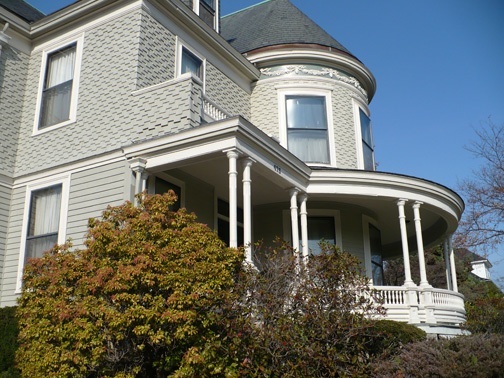
In response to my post about windows, Anne Fontaine was kind enough to share photographs of the beloved house she grew up in, as well as recollections of the challenges her family faced when it came to finding someone capable of making specialized repairs to vintage surfaces and systems.
You have really tapped into a very important issue. I’m sure I’m not the only person who had first-hand experience with the vaguaries of living in a historic home. It was definitely a privilege but one that could be very expensive to maintain. The roof is slate and taller than most people are comfortable climbing.
They definitely don’t make them like they used to but the upkeep is daunting. Anyway, your post really resonated because our culture is not accustomed to preserving anything.
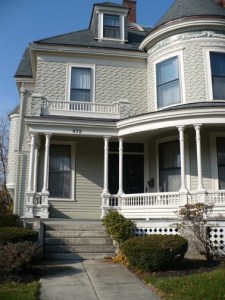
It was my good fortune to grow up in a Queen Anne Victorian house which my parents have owned for the last 40 years. My room was called the ‘Round Room’, its curved windows and roof set above the wrap-around porch. The windows of my room were heavy plate glass and I was admonished repeatedly to never slam them as they were either irreplaceable or prohibitively expensive to replace (which is much the same thing). This wasn’t always easy as they were also raised and lowered by a sometimes fickle rope system buried deep in the window’s frame. Your observation that the people with the expertise to repair this type of window (or indeed any specialised architectural feature) are rare beings is more true than ever. My mother managed to find one or two over the years and the difficulty underscored the unique challenges faced by the owner of a historic home, especially those like my mother who wanted to preserve the house’s turn-of-the-century integrity.
When most fix-it guys have no clue about the techniques or principles associated with historic house repair (and heaven help the cons who say they do when they don’t!), how does the average owner of a beloved vintage building figure out where to go for help?
You got me there.
I always figured it would be easy if one lived in New England. Call those guys you see on “This Old House.”
Or better yet, there’s the North Bennet Street School in Boston, which offers interested tradespeople “an education in craftsmanship,” including professional training in preservation carpentry, cabinet making, traditional locksmithing and more. There are also workshops to give short-term introductions to amateurs and interested professionals.
Historic New England (applause, applause because in my opinion they are doing so many things right) thinks in terms of “customer” needs and now offers a special membership category for owners of old homes. Among the many benefits of this level is access to a professional who will answer technical questions about repair issues peculiar to buildings of a certain age. The $500 fee is nothing to sneeze at, but I’d have gladly spent that to have gotten a real pro to tell me what to do about my complicated roof issue (a bad design with a poorly place chimeny and downspoput, antagonized by an aged roof and a squirrel hole). To learn more about their Historic Homeowner membership category, click here.
There are also the wonderful technical briefs published by the National Park Service and made available online. These cover a broad variety of subjects from window, paint and roofing issues to working with historic mortars (beware fixing that old wall with modern cement!) and lead paint abatement. Great for a DIY project or to help you rule out idiotic workmen you don’t want to hire, but there just doesn’t seem to be a widely available resource to find the trained, preservation-savvy fix-it guy of your dreams.
Get out your tiny violins as I share my Roof Story, a tale of woe that I suspect is rather common and exactly the reason that houses get muddled, bad repairs make maintenance situations worse, etc. It’s not for want of trying; it’s for lack of know-how on the part of the homeowner and/or the tradesperson.
My old house had a standing seam roof, and a badly designed roof merge when an addition was added to the Victorian part of the house in the early part of the 20th century. The sellers hid water damage behind drop ceilings, but once uncovered, it was apparent something needed to be done. I came up empty-handed when I tried to find someone with a clue about an old metal roof — not copper, but standing seam metal. And even as I drove through New England looking at brand-spanking-new metal roofs going on houses, I couldn’t find anyone in the mid-Atlantic region who had a clue what I was talking about.
I contacted both local and national preservation agencies both and got vague nothingness in response. The one person who was recommended did mostly slate roofs but claimed knowledge of metal (I was suspicious). I responded to an ad in the back of a magazine targeted to old house owners. I called the roofing company whose signs seemed to sprout like mushrooms in front yards around the countryside but their proposal to cover the roof with rubber just seemed wrong, especially when I looked at a nearby house that had a black rubber coating that all manner of plant material seemed to stick to.
With each storm, new water damage would appear on the newly-repaired ceiling in my son’s room Exterior wood began to rot and squirrels gamboled about in the attic. I shrugged my shoulders and gave up, opting for shingles because I could find no one with the answers about metal. The story doesn’t end there, but I can’t bear to go on. (Idiot roofer.) I hang my head and feel unworthy of the mantle of preservationist.
Suddenly New England’s trendiness seems to have worked its way down the coast and the mid-Atlantic understands metal roofs again, as I see them going in here and there.
Sadly, it seems that liability issues prevent organizations that are best equipped to answer tricky old house questions from actually doing so.
Isn’t this a business opportunity for someone? The Roving Preservationist will come to your door for a fee and tell you what TLC your old house needs? Someone? Anyone? Start that new business plan immediately!
This Old [Skeevy] House?
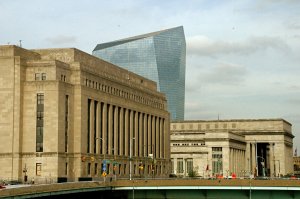
Part of what makes cities so stimulating visually are the layers and contrasts of time and architecture. For instance, the Beaux Arts architecture of the post office and 30th Street Station set off the monolithic gleaming glass of Philadelphia’s Cira Center. Dramatic contrast, don’t you think?

I can't live in someone's used house. Used houses are skeevy
Did you hear about the woman on Bravo’s “Housewives of New Jersey” who refuses to live in a used house because it’s just too skeevy? Could this be a sign of things to come as pandemics and germaphobia become regular features of life? Her custom-built house isn’t anything new or cutting-edge. It’s not exactly revival anything. It was certainly very expensive. It’s a style demanded by a client who aspires to be a Disney princess — one who believes that anything bigger is better and brand-new is best. Onyx, gold, marble, granite, with roller skates to get from one end of the house to the other.

The old house, lost in the trees: 213 Summit Avenue, Built 1894 for William & Amanda Garner (Photo by Lew Keen)
 Eventually the ladies moved on and from all accounts the building was just too far gone inside and out from deferred maintenance and water damage. It appeared the 1894 house would become a tear down. A small earthmover appeared. I took photos to document the building before it was gone for good. I geared up for the arrival of something new, akin to what I’d seen under construction in the next little town. (seen above — what is with that window arrangement?)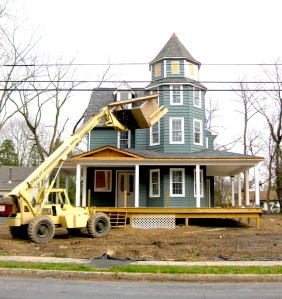
Some original details obscured, but windows in the tower are restored, and the return of the porch makes a huge difference to the presence on the street
The siding was stripped away and replaced with shingles. The flimsy storm door was removed to reveal the original entryway.. The porch was replaced. New windows were installed. With small top story window openings restored, the tower lost its gouty, pointless look and made sense again. The house’s scale and form feel “right” and the house has rejoined the street after more than a decade in netherland. Except for small detail work, the renovation is complete and a for sale sign invites a new family to claim the house as their own.
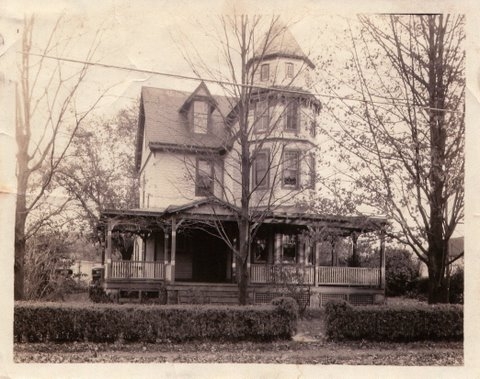
213 Summit Avenue, Built 1894
Weatherization of windows
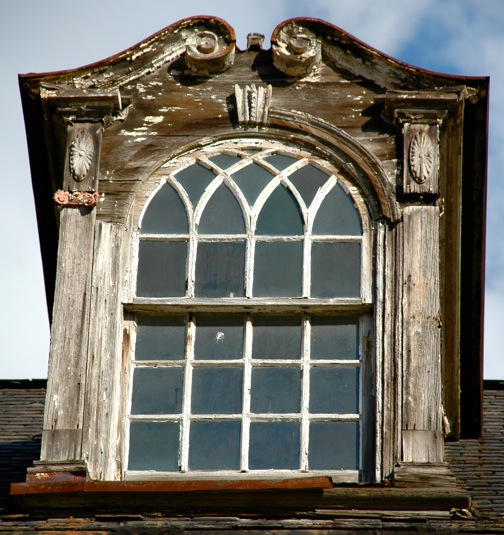
Now that's a weathered window!
The folks who sell those no-maintenance-required! vinyl windows are all over the Federal money for weatherization. I am being inundated with direct mail encouraging me to rip out my old windows and buy new (see previous post).
A lot of windows with a lot of life left in them if maintained are going to end up in the trash, replaced with windows with a short life-span that will end up in the trash when the seals fail not-so-many years from now. The general consensus is that old windows are just not energy efficient; new is better! (No, no! Wrong — see this, or see below for excerpt/summary)
Oh, I quake in my boots thinking of windows like this fine one on Wayne Avenue being ripped out and trashed by one of those direct mail window guys. About the blank eye replacement they will insert in its place. Can we use the trick the police employ, where we invite window guys to come to a hotel ballroom where they can claim free baseball tickets, but once they get there we’ll lock the doors behind them and give them a talking to about energy efficiency, storm windows, and old-growth wood windows in old houses?
Preservationists Take Heart
Our study of old windows showed that the energy savings are similar for a variety of retrofit and replacement strategies. Rates of return on investment for energy improvements are quite low when starting with typical or tight windows with storms in place, but are significantly higher when renovating loose windows with no storm.
The difference in annual energy savings between renovating an old sash and replacing it with a new one was very small–retrofits saved only a few dollars.
For preservations, the good news is that with a proper choice of renovation strategy and good workmanship, historic sashes can be almost as energy-efficient as replacements. Window renovators and homeowners can give more weight to comfort, maintenance, lead abatement, egress requirements, durability, ease of operation–and historical value–without sacrificing energy savings. For those of us who work with old windows, this is very good news indeed.
PreservationNation » Michigan Window Rehab Training Creates “Preservation and Rehabilitation Ambassadors”
I stood and cheered (and boy did the kids look at me funny) when I got to the part in this commentary about how we have convinced ourselves (to our detriment) that only “new, better, improved” will get us to a healthier, more energy-efficient future, and that getting things on-the-cheap is more important than “having vibrant economic communities based on self-sufficiency and wise conservation principles.”
It bothers me that we (I’m looking at you, Americans) seem to regard this planet as disposable. Let’s just use it up and move to the moon. That’s just not right.
PRESERVATION NATION BLOG of the National Trust for Historic Preservation: Post by Nancy Finegood
America the beautiful, or America the throw away society?
 Here in our country, there is very little that we value enough not to throw away. This value system extends from our consumer goods to our families to our very livelihoods. When you think about it, our current economic crisis is in part caused by our willingness to throw any and everything away. We have outsourced the manufacturing of all kinds of goods, as well as the creation of innovative new technologies. We have convinced ourselves that only “new, better, improved” are the labels that will lead us to a healthier, more energy efficient future. We have also convinced ourselves that getting it cheaper is more important than having vibrant economic communities based on self sufficiency and sound conservation principles.
To do its part in reversing wasteful trends in a throw-away-and-buy-it-new world, and to reinforce the values of skilled workmanship, self sufficiency, and creating opportunities for economic development in the local economy, the Michigan Historic Preservation Network, partnering with the City of Kalamazoo, offered a first-of-its-kind course on the rehabilitation of historic windows. More than 20% of the housing stock in the U.S. was built before the 1950’s. Many of these homes have features which cannot be easily duplicated. In fact, the next time you walk by a large Queen Ann with a wrap-around porch or look at a building with a protruding bay with rounded windows, be aware that the we have basically lost the expertise to manufacture curved glass for these housing applications.
The intensive, two-week historic windows rehabilitation course that we developed trained 12 individuals from diverse backgrounds (age, race, gender and Michigan geography) in skills which can provide them with a good source of income. In fact, unlike most businesses, a window rehabber can start a business with a minimal investment. What most individuals don’t realize is that old windows in good repair combined with storm windows are as energy efficient as any newer window product. Additionally, rehabilitation of an older window minimizes the amount of material that goes into a landfill by keeping the original window in place. Preservation work helps the environment and the local economy, all while maintaining our connections with the past.
Our students are enthusiastic about the skills they learned and will work as preservation and rehabilitation ambassadors. We must now create enthusiasm for local solutions to our local issues. I think the place to start is with our value system. We’ve thrown enough away. We still believe in miracles – just ask Gregory Perry, the youngest student in the program at 18 years old. It’s now time for rebuilding, rehabilitating and preserving what is valuable within ourselves and our communities.



 Nostalgic for the original Wayback Machine?
 My Own Time Machine: Buildings, Places, People & Things