Foto Friday: What did you do on your summer vacation?
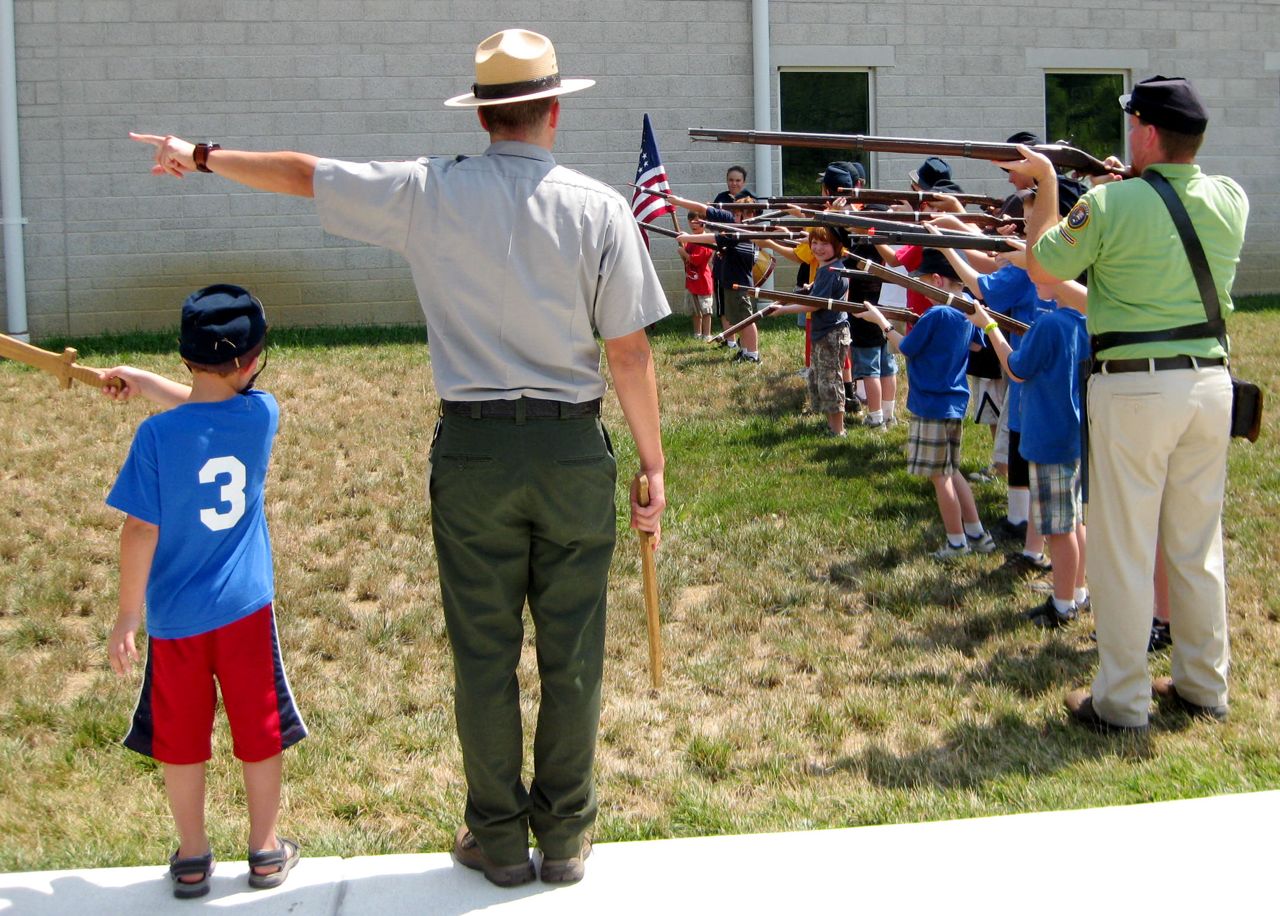
Rangers muster the troops at Gettysburg National Military Park (Photo by Sabra Smith)
What did we do on our summer vacation?
Hopped in the time machine, of course!
We visited the Civil War and thought about what life was like 150 years (or so) ago.
And here’s the thing about these young whippersnappers, these kids we lament because all their newfangled gizmos are ruining their attention spans and making them dumb and all the other fear-mongering end-of-the-world predictions we’ve been hearing since the rise of facebook and twitter and texting……
I kept meeting kids who love history.
The kid waiting under the tent with his “enlistment papers” raised his hand to tell the Ranger that the reason he was there was because he picked the family vacation destination this year after watching Civil War shows on the History Channel.
The girls in the pool at the hotel went on and on (and on and on) about all the great things there were to do in Gettysburg — every single one of them history-related. The older daughter recapped for me what she’d learned about troop movements and decisions made by various generals and commanders. She described the role the landscape played in the battles. Her imagination had been sparked by all she’d seen, and, when I asked her if history was one of her favorite subjects at school, she said that it hadn’t been before, but that she thought that it might be now.
My kids have no choice in the matter and by now they are both tolerant and enthusiastic. Since graduate school I’ve been dragging them to old houses, graveyards, city streets, and landscapes. We’ve stared at Roman sculptures, swords, cannon, castle walls, Roman numerals carved into old beams, letters, jewels, and muskets. They fire up the time machine in their imaginations and off they go.
We went time traveling this summer.
What did you do on your summer vacation?
Pest eating giant holes in PA trees
One of the treasured aspects of living in an old, established neighborhood is the mature trees that shade the sidewalks. Their branches toss in a lively breeze, in the spring they break through the grey of winter with attention-getting flowers and in the fall, the street flames as their vivid leaves change to shades of yellow, orange, and purple.
As I walked home not long ago I was alarmed to see evidence that some large pest had worked its way through the neighborhood chewing holes in some of the largest trees. I wonder what impact this has on the overall health of the tree, its longevity, and its ability to withstand storms (and I wonder this as Hurricane Irene blows her way up the east coast).
I wonder, do the pests in those trucks know what they are doing? Are they certified arborists, or just employees who come to work one morning and are handed a pole with a blade on it, to be sent out to wreak havoc on neighborhood and countryside character?


Whack a Pop-Up?

Photo by Sabra Smith (sorry, they didn't have whack a mole, so you'll have to settle for whack a gator...)
Not long ago I’d proposed historic sites consider taking advantage of the current pop-up trend to bring their stories to the people, so that the people might discover them and then venture to the home site to expand the experience.
Little did I know that pop-up backlash was about to begin. The New York Times‘ Neil Genzlinger (“Invasion of the Pop-Ups; Time for a Smack-Down“) compares the phenomenon to the boardwalk game of whack a mole and he’s twirling a heavy mallet in his hands.
Pop-ups — temporary business or cultural enterprises that materialize in empty storefronts, vacant lots and such, flaunting their own ephemerality — are hardly new, but suddenly they are everywhere. So are the news releases announcing them, which is the first clue that this phenomenon has lost any guerrilla chic it might once have had.
So, maybe it’s no longer chic, but I still maintain that there are positive possibilities for historic places that sit on a two-hundred year old stone foundation off the beaten path to consider creation of a — shall we call it a “temporary satellite location” where the people are.
Genzlinger worries these temporary flirtations will lead to broken hearts.
Tourists have enough trouble finding our most permanent, most visible attractions, as evident from the fact that you cannot linger in Midtown for five minutes before someone asks you where the Empire State Building is.
It won’t take many exchanges like this one before our tourist industry goes the way of garment-making and meatpacking:
“Excuse me, I’ve come 4,000 miles to see the Archery and Anchovies sports-booth-plus-pizza parlor that I read about last year. Can you direct me to it?”
“Archery and Anchovies? That was a pop-up, pal; it shut down last October. I think there’s a Pinkberry there now.”
And don’t children have enough impermanence in their lives, what with parents getting divorced, pop-culture heroes being jailed, pets dying, television shows being canceled and so on?
“Mommy, please tell me that the Gallery of Post-Proto-Feminist Fabric Art won’t disappear like Daddy did when he ran off with my nanny.”
“Well, Timmy, it won’t be in this same spot — I think they’re putting a Pinkberry there — but they’re sending it to a farm upstate where it can live with all the other pop-up galleries.”
And it’s right next to the fascinating old house sitting on the two-hundred year old stone foundation that has survived two centuries of trends that come and go. Check it out while you’re there.
Summer days, make me feel fine

Nubble Lighthouse, built 1879. At high tide, my classmate would travel over the channel in a bucket to get on the schoolbus. (Photo by Sabra Smith)
These hot summer days put me in mind of growing up in a little town in southern Maine. Not as one of the summer people; in winter you’d find me shivering in the snow at the top of our driveway, waiting for the bus.
Ah, but the summers. The summers were about the freedom to ride my bike past rosa rugosa out to the lighthouse to poke around in tidal pools or into town where I could perhaps choose a comic book or candy to buy with my 25¢ allowance.
Down the street was the Goldenrod, established 1896, the sort of restaurant where one might enjoy a grilled cheese sandwich or fried cod with french fries before getting an ice cream cone to cool off in the hot summer sun. I’d stand outside the window and watch large machines stretch and tease confectionary into taffy consistency. Pretty boxes of the finished salt water taffy were stacked in the window waiting for tourists to buy and take home.
At the other end of town was the amusement park, a child’s idyll so close to home. Dusk was the best time to go, when the lights came on and the spinning, twirling, toppling rides lit up the falling darkness. If the wind blew the right way, we could hear the music all the way up at our house on the hill. Magical.

This postcard of Long Sands Beach was mailed to my sister in 1967, after we’d moved away. The printed caption on the back says “The Lobster Fishermen sometimes fight a losing battle with the elements. Shown here are Lobster Traps that the unexpected heavy seas have washed ashore.” (Photo Wakefield Trading Co., Wakefield, Mass.) Our friend and neighbor, Mrs. Smith, let us know that she had mailed us “a little box from the Golden Rod.”
Our summertime neighbors ran the raft concession on Long Sands beach. We’d never have spent the 50¢ or $1 to rent a float, so it was a thrill to have the inside connection and get one to use for free, for as long as I could stand swimming in the chilly Atlantic waves. Oh, that beach. It stretched on and on, as the name Long Sands suggests. We had it all to ourselves in the off-season. Walking along one foggy fall morning, I discovered a pipe draining into the ocean that inspired me to write an environmental mystery tale, handed in as a second grade homework assignment (with hand-drawn illustrations, no less). (I was big on mysteries back then; later when we lived in a big house on Lindsay Road I wrote a [terrible] mystery story about the empty house across the street owned by summer residents.)

The Nubble Lighthouse in 1966. A beacon in the night, sometimes there are things or places that we count on never changing….
Summer was about my father hypnotizing lobsters into doing handstands on the wooden back step before they met a boiling death. It was about lazing on a big flat rock in our backyard, looking up at the sky and daydreaming. Or climbing a tree (do kids have trees to climb anymore?) that was my secret hideaway. Or finding a dead bird and bringing it home for a proper shoebox burial. Or laying in the grass and studying ants and counting the tiny periwinkle-colored flowers there — still one of my favorites all these years later, even though I don’t know its name and it’s probably a weed that lawn fanatics strive to eradicate.
Summer was my swingset, creaking as it pushed me up into the sky. It was the quiet shade of the woods on the hill above the house, where I meandered looking for jack-in-the-pulpit and lady’s slipper.
Fall would come all too fast. Back to school time, where once again I’d wait for the bus, and we’d drive out to the lighthouse to pick up the boy who lived there. Time for storms at sea, best viewed from the huge picture window at Mrs. Smith’s (no relation) house, perched on the edge of the cliff.
August always marks the waning of the summer. And in the heat, stirring my iced tea, I think back to those long days of summertime, and how I never wanted them to end.
“Pop” goes the Guggenheim
I did a post a little while ago (“If a Sense of Time Went Traveling”) about the idea of historical sites or museums following the “pop-up” trend and erecting temporary locations that would allow them to share their site and meet the community in a place where the community might more easily encounter them.
Today’s New York Times highlights the first major NYC museum pop-up, hosted by the Guggenheim on a formerly empty lot in the East Village.
There will eventually be three labs, each with its own mobile structure designed by a different architect, and each dealing with a separate theme pertaining to urban life — in the case of the lab opening on Wednesday, “Confronting Comfort.” All three will travel to cities around the world, in a project slated to last six years. In each city curators will invite leaders in fields including architecture, art, design, technology, education and science to participate in programs: lectures, workshops, games, performances and film screenings. All events will be free to the public.
The labs are the brainchild of two Guggenheim Museum curators in their early 30s, David van der Leer and Maria Nicanor, who stress that this is not some sort of ephemeral museum.
“It’s a new hybrid, a place where we can learn from each other,” Mr. van der Leer said…“We wanted the Guggenheim Labs to be in the middle of an urban environment where people live, work and hang out.”
Loose lips sink ships — so do holes in the hull

Click here to donate to the National Trust's Olympia fund (Photo by Sabra Smith)
Here’s today’s update from Alan Jaffe at PlanPhilly on the repairs to the hull of the USS Olympia, a National Historic Landmark. There’s a fabulous slide show so you can watch them at work patching the holes.
This is simply a stopgap measure, of course. Olympia needs a qualified new owner to take her on, raise funds and embark on the substantial repairs that she’s overdue for.
Want to help save this amazing ship? You can get more information or donate to the fund to save the USS Olympia at the National Trust for Historic Preservation.
For more background information on the Olympia, see this previous post.
Slideshow in right-hand sidebar.
Foto Friday: Fan Time
 I honestly don’t know how my great-grandmother survived wearing layers and long skirts, in the days before air conditioning. How did she cook on a day like today, when the temperature has already reached 90 and it’s not even 9 am yet?
My grandfather told us about getting up in the wee hours of the morning, before sunrise, to open up the ice house, load the wagons and get the ice repacked in sawdust before it melted away. About how, while waiting between wagon loads, they’d collapse on the ice and rest. With temperatures like these, how can it be possible that when they opened the doors they did not discover a pond where ice was supposed to be?
I can’t really imagine it, though I come close when I go to Franklin Fountain. The long list of ice creams promises a brief respite from the heat. The fans overhead create a soothing breeze. I’m thrown back in time, and as I taste the black raspberry cone, I think of my great-grandmother and decide, if she can stand it, so can I. (Then I rush back to the respite of modern air conditioning.)
(The secrets of life without air conditioning revealed. Hint: Think smart architecture and my great-grandparents’ front porch. All lessons for a world talking “green” and “sustainability.”)
Help the Olympia

USS Olympia at low tide at Penn's Landing in Philadelphia (Photo courtesy Independence Seaport Museum)
One of the most important ships in U.S. history continues to founder at Penn’s Landing.
The Olympia Fund at the National Trust for Historic Preservation is collecting donations for the preservation of the ship, and the sum will be transferred if a qualified new owner is identified. Walter Gallas, Director of the Northeast Field Office of the National Trust, recently posted an update on the ship’s condition, including the dramatic photograph above. (Interior images I took in the spring are below.)
Read his post here.
Olympia’s claim to fame is often reported as being the flagship of Commodore Dewey, the location where he uttered the words, “You may fire when you are ready, Gridley,” and that it is the last ship surviving from the era of the Spanish-American War.
In my experience, most of that means nothing to anyone but Naval historians.
To me, Olympia is a marvelous steampunk relic of a bygone era, when sailing ships gave way to steam-powered vessels. She has belt & suspenders engineering — sailing masts and the most powerful, state-of-the-art steam engines of her time. The San Francisco yard that built her earned a monetary bonus because she was able to exceed the speed required by the specs. She’s like something from the imagination of H.G. Wells, but instead of a giant squid trying to pull her to the bottom of the ocean, it’s simply rust and lack of funds.
Steampunk is Victorian science fiction in a nutshell. It is airships, submersibles and mad scientists with fantastical inventions in the era of steam technology. It is the romance and excitement of a period in history when people still believed in optimism, ornamentation and manners. — Steamcon III, “20,000 Leagues Under the Sea“
Olympia is a time capsule of Navy life, from its wood-paneled officer’s quarters to the hammocks hanging in the enlisted area. Throughout the ship you’ll find beautiful little details from the period when manufacturing delighted in adding flourishes and making even an industrial object a thing of beauty.
She marks the time period when the United States was putting the Civil War behind it, rebuilding its Naval forces and looking out at new horizons. Olympia’s decisive defeat of the Spanish navy in the Philippine’s Manila Bay was the keynote in the era when this country became a world power for the first time.
This ship has been rescued from destruction in the past — by a president, by schoolchildren, by Philadelphia’s steelworkers and fire fighters.
Will she be rescued again?

USS Olympia hull interior, Photo by Sabra Smith, click for "virtual tour" at Flickr or click slideshow in sidebar at right
Foto Friday: Split the difference
Mr. Binder goes to war

Lithograph after a drawing by T.F. Laycock, published by Endicott & Co., New York, 1865, depicting the North Atlantic Blockading Squadron bombarding Fort Fisher, North Carolina, in preparation for its capture. The print is dedicated to Commodore S.W. Godon, USN. Ships present, as named on the original print, are (from left to right in the main battle line): USS Tacony; USS Maumee; USS Ticonderoga; USS Shenandoah; USS Tuscarora; USS Juniata; USS Wabash; USS Susquehanna; USS Colorado; USS Minnesota; USS Brooklyn; USS New Ironsides and USS Mohican. Ships in the foreground are (left to right, from the center of the view): USS Powhatan; USS Mackinaw; USS Vanderbilt and USS Malvern (Flagship of Rear Admiral David Dixon Porter). Monitors in the right middle distance are: USS Monadnock (with two turrets); USS Mahopac; USS Saugus and USS Canonicus. Collections of the Library of Congress.
In a recent post, Signs of the Times, I discovered some interesting signs from a 19th century shop on South 13th Street. Since then, I made an interesting discovery about the man that owned the shop. Mr. Binder, he of the latest hair fashions for special occasions, was a Civil War hero, a Medal of Honor recipient!

Richard Binder (Image: U.S. Naval Historical Center)


 Nostalgic for the original Wayback Machine?
 My Own Time Machine: Buildings, Places, People & Things