The musicbox house
Coolest project ever!
It’s art, architecture, a music box, creation of a neighborhood landmark, an experiment in audience engagement, it’s pretty, it’s witty, it’s…..
Swoon’s Musical Architecture!
This installation will be built from salvaged remains of a 100-year-old Creole cottage that used to be on the site.
Interesting in learning more or being a supporter? Watch the vieo and click here to learn more at Kickstarter.

(Photo by New Orleans Airlift - neworleansairlift.org)
Kinetic sound artists from New Orleans and across the country are coming together this fall to build The Music Box, A Shantytown Sound Laboratory. This is our testing ground for singing walls, organ floorboards, and percussion triggered by the human heartbeat.
Your support will directly benefit these artists who need time and money to develop their ideas. Interactive, mechanical art can be finicky and we need to get it right before we build the house. Our sound laboratory will be a place for collaboration, imagination, and public exploration. It is an important next step in realizing Swoon’s vision of a musical architecture.
This campaign goal will help fund the prototyping of instruments for the house, but don’t stop the pledges coming. We still have a house to build!
Time to help

Click here to view the photo gallery at Flickr (Photo by Preservation Massachusetts)
In early June a tornado ravaged towns in Central and Western Massachusetts.
Preservation Massachusetts put out a call to preservationists to assist the towns and property owners affected by the devastation (click the image at left to see their photo gallery). To date, nearly 100 people have offered their time and expertise, some with prior experience in the aftermath of Hurricane Katrina.
More details in this piece by Margaret Foster at Preservation Online. Help is also being provided by the National Trust for Historic Preservation’s Northeast Office.
“You can’t recognize neighborhoods [anymore],” [Michele Plourde-Barker of Preservation Massachusetts] says. “Going through these streets that I was familiar with and seeing that trees are totally gone, these mid- to late 20th-century subdivisions are decimated as well as whole areas of downtown, it’s just unbelievable. You see it on TV, but you don’t think it’s going to happen here in Massachusetts.”
I arrived in Springfield the week after the tornado blew through. Along the train tracks edging the river, you could see the damaged trees — branches ripped off, whole trees toppled over, some of the trees stripped of all their leaves, save for a few stragglers at the end of a few branches.
Our conductor said his brother had lost half of his house, and that a huge tree fell across both of the family cars, destroying both.
The car rental agent said a friend described the tornado as feeling a tremendous pressure in his ears and a sound outside. Then the roof lifted up once and crashed down, lifted up again and crashed down again, and then all the windows blew out of the house.
There are communities that want to put things back in order and move along. They need help figuring out how to do that; their buildings need expertise to help plan correct repairs and avoid unnecessary costs. Can you help? Click here for more information.

Click this image for Preservation Massachusett's website and to find out how you can help (Photo by Preservation Massachusetts)
Foto Friday: Signs of the times
I love walking down the street and catching a glimpse of the past that someone long ago used to see every day. It’s quite the time machine.
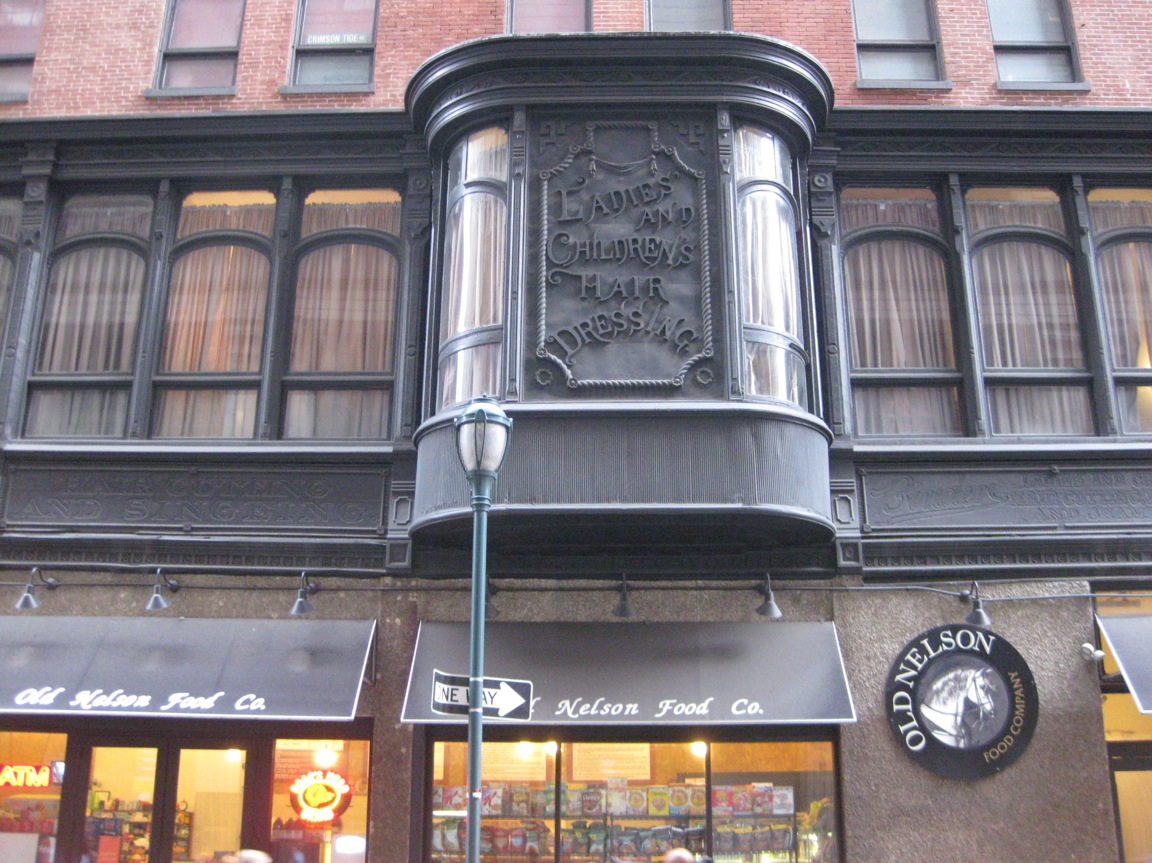
Why, just the other evening I was bustling along 13th Street in Philadelphia, on my way to meet an old friend for dinner when I spied a historical leftover.
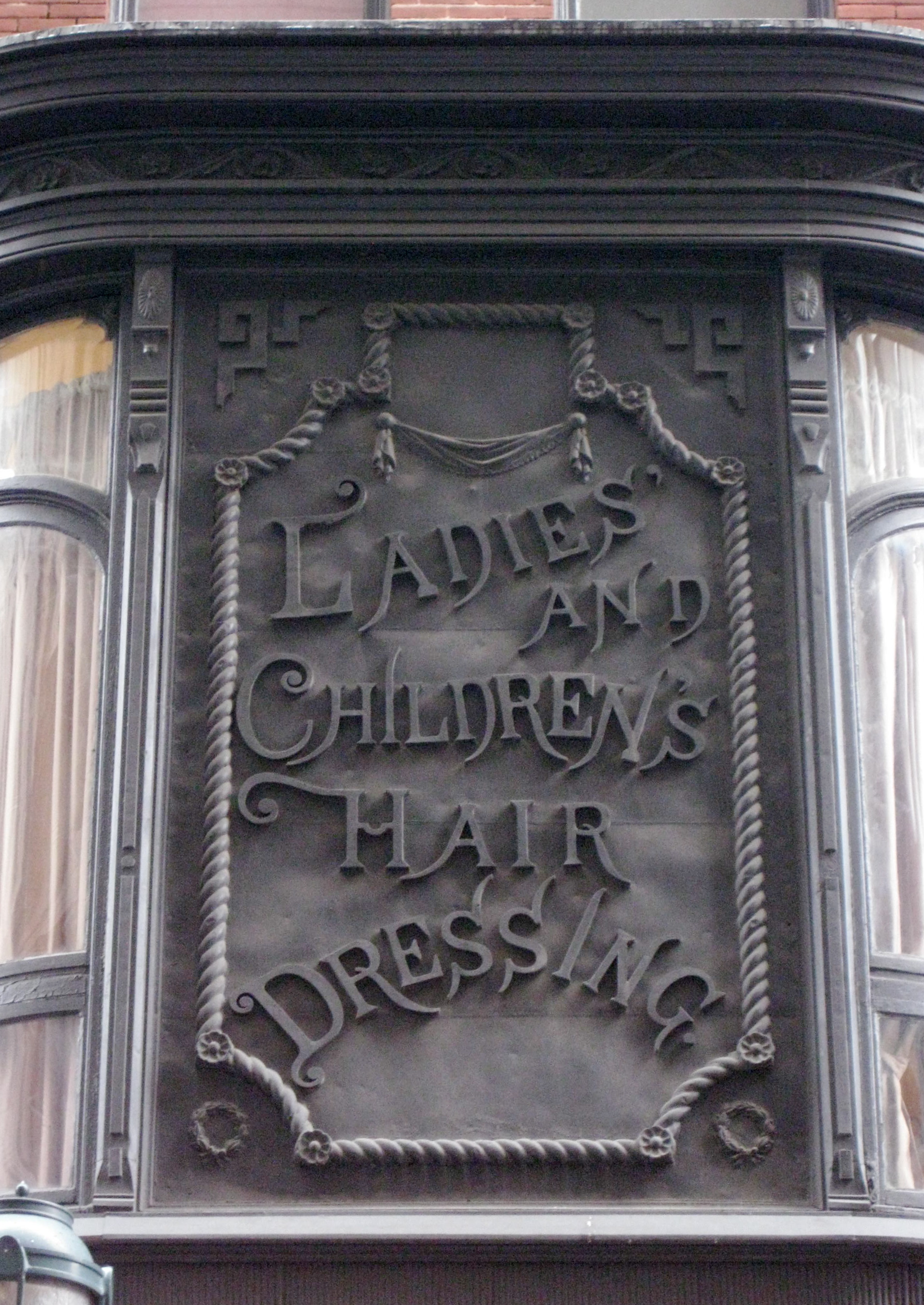 I pictured mothers taking their little darlings for their first haircuts, young daughters making appointments to have their hair dressed for some fancy occasion…
Then I noticed the signs on either side, painted over, but still legible.

Binder's Ladies' and Children's Hair Cutting, Dressing, and Shampooing

Hair Cutting and Singeing
“Hair Cutting and Singeing”? Suddenly I could imagine the scent of burning hair. Ugh.
But what was this? A clue! “Binder”
In the 1890-91 Boyd’s Blue Book for Philadelphia, one may discover (on page 677 and thank heavens for Google books!) the following ad.
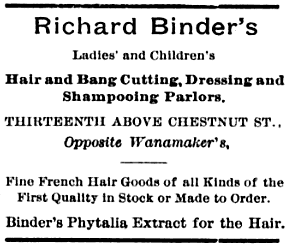 My confidence was restored when I read Fine French Hair Goods of all Kinds of the First Quality in Stock or Made to Order. I wonder what kinds of hair goods were made to order…… Could a gal match some ribboned fancy to her dress?
Ah, how a stroll down a side street can teach you something new about a place. How a painted-over sign can spark the imagination….
 Oh, and if you are wondering about Mr. Binder’s famous product “Phytalia” (also available across the street at Wanamaker’s!), it “positively cures dandruff and strengthens the hair.” Click the 1889 ad in Lippincott’s monthly magazine (Vol. 43) to see a bottle of the stuff. I think it was a big seller for Mr. Binder.

Click the advertisement to see a bottle of Mr. Binder's phytalia product at "Hair Raising Tales" website
City Paper confirms Mr. Binder’s successful career with a little research of their own on the history of 13th Street:
The Binder Building (29-41 S. 13th St.) –Home of the Binder Company hairdressers and makers of wigs, toupees and soaps. According to the Philadelphia Register of Historic Places, Richard Binder, who commissioned the building in 1887, was one of the most successful hairdressers in 19th- and early 20th-century Philadelphia. Before the 1860s most hairdressing was done in the home. Binder was one of only 100 hairdressers in Philadelphia, most of whom did not have stores. Now the spot hosts the Carmel Deli, but the Binder sign is still visible.
Bill’s query about a map (now below) showing this location (35 S. 13th Street) re-sparked my curiosity and I discovered a photo and some new info about our subject, Mr. Binder.
Turns out he was a Civil War hero who earned the Medal of Honor! First I came across the Roster of the Medal of Honor Legion, a military and naval order of the United States of America, from April 23, 1890, date of organization, to March 1, 1898, inclusive (Cornell Library). It lists Binder, Richard, Sgt. U. S. Marine Corps, U. S. S. Ticonderoga 35 S. 13th St., Philadelphia, Pa as a first class member and Binder, Richard C. R., son of Richard Binder, 35 S. 13th St., Phila., Penna. is listed as a second class member. So Mr. Binder had his shop there and his family lived there as well.
The U.S. Naval Historical Center offers up a photo as well as this description of Sgt. Binder’s war service on the U.S.S. Ticonderoga. (Click the ship link for great images of the ship.)
Richard Binder, variously described as having been born in Philadelphia, Pennsylvania, in 1840 and in Germany on 26 July 1841, served in the U.S. Marine Corps during the Civil War. In 1864-65, he was assigned to the sloop of war USS Ticonderoga. He participated in the two assaults on Fort Fisher, North Carolina, on 24-25 December 1864 and 13-15 January 1865 and was awarded the Medal of Honor for his performance at those times.
Photo: U.S. Naval Historical Center
The official Navy publication “Medal of Honor 1861-1949 — The Navy” contains the following entry on page 15:
“BINDER, RICHARD, Sergeant, USMC. Born 1840, Philadelphia, Pa. Accredited to Pennsylvania.”
“On board the U.S.S. Ticonderoga during the attacks on Fort Fisher, 24 and 25 December 1864; and 13 to 15 January 1865. Despite heavy return fire by the enemy and the explosion of the 100-pounder Parrott rifle which killed 8 men and wounded 12 more, Sergeant BINDER, as Captain of a gun, performed his duties with skill and courage during the first 2 days of battle. As his ship again took position on the 13th, he remained steadfast as the Ticonderoga maintained a well-placed fire upon the batteries on shore, and thereafter, as she materially lessened the power of guns on the mound which had been turned upon our assaulting columns. During this action the flag was planted on one of the strongest fortifications possessed by the rebels.”

Mr. Binder died in 1912, at the age of 71 (or thereabouts), and is buried in West Laurel Hill Cemetery.

Photo: Home of Heroes website (click image)
Wow. Who knew I’d come across a national war hero just having a ramble after work?
If a Sense of Time Went Traveling
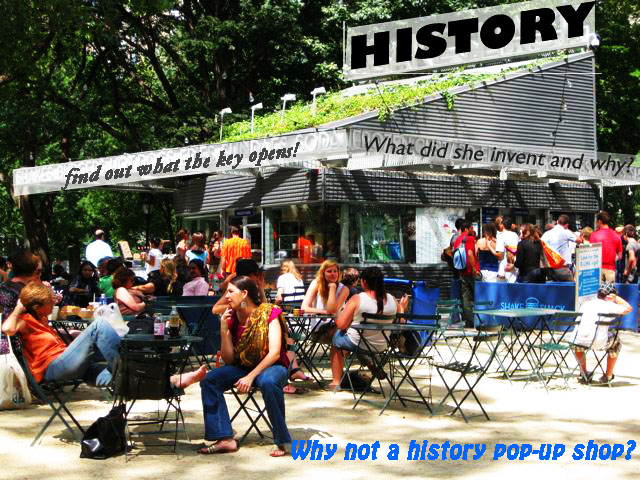 Are you one of those people who doesn’t RSVP until the last minute? You’re motivated by the deadline, right? Don’t want to miss the fun?
This sense of deadline often leads to a rise in visitation at historic sites that are about to go broke, or shut down, or move (the tragic saga of the Barnes, anyone?).
Without the ax looming, could healthy historic sites capture new audiences if they were available for a limited time period only, creating that sense of urgency? (I’m not talking about limited opening times — that’s generally a sign of low visitation or limited staffing and still assumes a potential guest will make the trip to the site itself.)
Let’s have history hop on the “pop-up” trend.
Fabulous chefs are opening pop-up restaurants that become the must-have reservation of the month. Retail impresarios delight shopaholics with fabulous pop-up stores full of goodies.
Going! Going! Gone!
Now you see it — now you don’t!
There’s a limited time frame to enjoy the experience and you’d better get there now or you’re going to miss it. The limited run aspect makes it fashionable. If you don’t get one of the few spots available for the experience, you’ll miss out.
What if a historic site brought its compelling tales to the people with a pop-up historic site? In a sense, the notion is completely contrary to historic site DNA — the place that’s noteworthy for its years and years and layers and layers connected with a specific place.
But we’re not rejecting that place.
It’s just that if you can’t get the people to come to you (and let’s admit right here, chez nous, that it’s a problem for many historic sites and small museums), why not load up a magic carpet and go to them? Give them a taste of the secrets you might reveal if they were to come visit the real site. Tempt them. Answer some of the mysteries, but not all. Demonstrate that there’s more to the place than butter churns and egg & dart detailing. The historical society might look up their house on old insuranc surveys or vintage photos. The museum with gorgeous gardens might bring their plant sale to the local farmer’s market. Sell them something; people love to take a little something home to show to friends (and it’s one more way to get the word out).
If you want them to pop over for a visit, why not try popping up first?
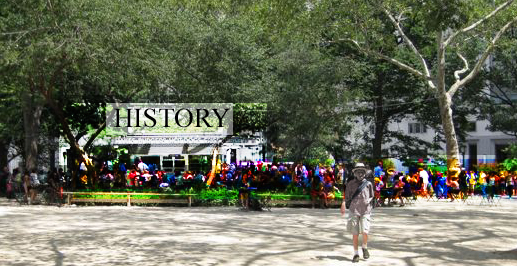
Photos for this post by Sabra Smith (and then photoshopped into a fantasy of every small historical society -- a line out the door) Sites still working on the "if we open the doors, they will come" model need to look for new opportunities to connect with the community.
It was Nina Simon’s post about the process of developing an exhibit celebrating the sesquicentennial of Minnesota (combined with the NYT touting the pop-up trend) that got me thinking about this idea of taking the story to the people if the people won’t come to the story. The Minnesota History Center wanted to honor 150 major influences on the state’s history and culture. Simon’s team started with a web-based survey. Concerns about “preaching to the choir” led to meetings with community groups to reach a more diverse audience. When an opportunity to staff a booth at the Minnesota State Fair arose — the biggest state fair in the country — it seemed an ideal opportunity to connect directly with a wide cross-section of Minnesotans.
A meet n’ greet of this kind works on so many levels — you get direct answers to the questions you’re asking, you get unsolicited feedback about your organization that, if you pay attention, can provide some insights about awareness/branding/customer service issues, and you have an opportunity to capture people’s imagination and make an impression. Simon’s group found that the face-to-face activity at the fair helped drive traffic to the website (underscoring the need for a well-organized, informative web presence).
Hallelujah, spoke the neighborhood

Time is always a crucial aspect of preservation.
Bulldozer rumbling means you’ve run out of time.
Birds chirping, footsteps on the sidewalk mean you’ve bought some time.
The Church of the Assumption was given the gift of more time this week when Philadelphia’s L&I Review Board voted in favor of the Callowhill Neighborhood Association, overturning the Historical Commission’s demolition grant and allowing the church to stand awhile longer.
From Alan Jaffe for PlanPhilly:
Andrew Palewski, a contractor who specializes in restoring historic landmarks and the coauthor of the nomination of the church to the Philadelphia Register of Historic Places, said he was “very happy” with today’s decision. He noted that the review board members voted to sustain the appeal with a “proviso,” which Palewski said he hadn’t read yet. “I’m anticipating something along the lines of a limitation of time to find a buyer, or work with this out one way or another,” he said.
“What makes me optimistic today,” Palewski said, is that the Clay Studio directors will now be able to pursue the property without the threat of the wrecking ball hanging over them. “They want to get an engineer and architect to come up with ideas for the building, but they didn’t want to spend that kind of money if right around the corner was this impending demolition. I think there will be a higher comfort level for them now.”
Full story at PlanPhilly.
Church of the Assumption: Decision Time

Photo by A. Palewski
Philadelphia’s Licenses & Inspections Review Board will vote on Appeal #13415, 1123-1133 Spring Garden Street — aka The Church of the Assumption — on Tuesday, May 17 at 1:15pm.
Attend the meeting at 1515 Arch Street, 18th Floor
This meeting will decide the success or failure of the Callowhill Neighborhood Association’s challenge to the Historical Commission’s grant of permission to demolish the Church of the Assumption.
The current nonprofit owner made a successful hardship application, stripping the building of the protection provided by 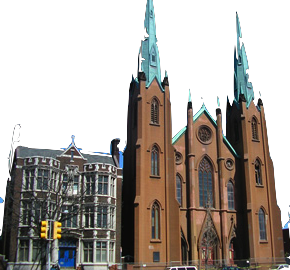 its listing on the Philadelphia Register of Historic Places. (No sign of who’s currently leading the organization; their out-of-date website still lists their executive director as Joe Lukach, who left in December 2010.)
As you can see in the photograph above, those twin spires are landmarks in the neighborhood, on a major thoroughfare that is slowly rebounding and leading the neighborhood in a resurgence of vitality and optimism.
Though the building is currently for sale, even an expert Googler or Binger would be hard-pressed to actually find any listing information online, so as things are now, the likelihood of a potential new owner coming across the property is extremely unlikely.
Finding an owner with the cash to rehabilitate the building may be a tall order, but this is a they-don’t-build-’em-like-this-anymore structure that could be an anchor for a neighborhood rebirth and it would be a shame to see it fall.
Background info on the saga at PlanPhilly.
More info about the church (including vintage images) at Philly Church Project.
Foto Friday
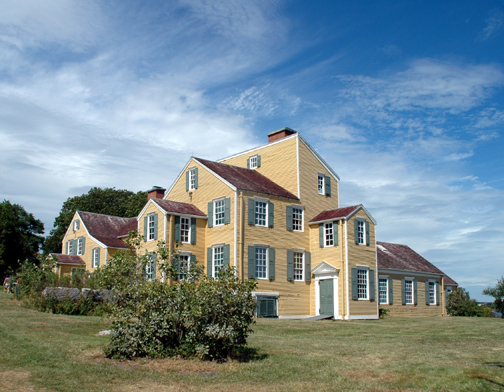
Wentworth-Coolidge Mansion in Portsmouth NH
It was a pleasant mansion, an abode
Near and yet hidden from the great high-road,
Sequestered among trees, a noble pile,
Baronial and colonial in its style;
Gables and dormer-windows everywhere,
And stacks of chimneys rising high in air,
Pandaean pipes, on which all winds that blew
Made mournful music the whole winter through.
Within, unwonted splendors met the eye,
Panels, and floors of oak, and tapestry;
Carved chimney-pieces, where on brazen dogs
Revelled and roared the Christmas fires of logs;
Doors opening into darkness unawares,
Mysterious passages, and flights of stairs;
And on the walls, in heavy gilded frames,
The ancestral Wentworths with Old-Scripture names.
— Henry Wadsworth Longfellow, from the poem “Lady Wentworth” published in 1862 in his collection Tales from a Wayside Inn
Benning Wentworth (1696-1770) was appointed royal governor by King George II following New Hampshire’s separation from the Massachusetts Bay Colony in 1679. He rented a brick residence in Portsmouth (Warner House), capital of the new colony. However, when the colonial assembly refused to provide funds for his purchase of the house, he relocated his governmental headquarters to Little Harbor, outside Portsmouth and built a mansion. Today, the Wentworth-Coolidge House is an outstanding example of a colonial governor’s mansion.
The excerpt from Longfellow’s poem (above) recounts the widowed governor’s marriage to his servant, Martha Hilton. He was 64; she was said to be 23. (A Wentworth descendant wrote Longfellow after publication to dispute details of the poem, insisting her age was actually 35.)
The state-owned site celebrates each season’s blooming lilacs with a festival. I’m feeling festive because the lilacs are blooming here so am re-sharing this post with you.
How fabulous would this job be: Barn Census Director

How fabulous would this job be?
POSITION: Barn Census Director
EMPLOYER: Vermont Division for Historic Preservation, Vermont SHPO office
LOCATION: Montpelier, VT
Manage the Barn Census, a wonderful project that engages volunteers in collecting information about historic barns and other agricultural buildings and sharing the information in a central GIS database. Find out more at the Barn Census website at http://www.uvm.edu/~barn . If you have a Master’s degree in Historic Preservation, and skills and experience in historic resource surveys, historic and architectural analysis, and GIS databases, and love working with people, we encourage you to apply. The job is funded through a Preserve America grant that extends through October 2012.
All images on this page are from the Barn Census. Click on the picture for more information about the barn pictured.


Is music a time machine?
Once I fell in love… and he sent me the link to this video and I watched it and it felt like watching love — colors, bubbly, bright, unexpected, an energy, an urgency, a sadness, a hopefulness, an overwhelming natural force that can’t be denied…. a journey with an end.
Isn’t it odd how music can bring us back to a moment in time? What song takes you to when?
Foto Friday: Maxfield Parrish

Detail of wall decor from the Mask & Wig Club, painted by member Maxfield Parrish


 Nostalgic for the original Wayback Machine?
 My Own Time Machine: Buildings, Places, People & Things