Crowd-sourcing and the museum

We explore and wander and discover. (Photo by Sabra Smith)
I failed to post on Foto Friday last week, and while you all dry your eyes, I”ll explain that it was because I swept my darling sons off to the Big City to celebrate No. 1 son’s Big Birthday.
We took photos — lots of photos (No. 1 son received a camera for his birthday for that express purpose). Some of our many photos were taken at the Metropolitan Museum of Art on Fifth Avenue (see above). The Met has always been one of my favorite places in all of the city. When I lived in New York (as an impecunious publishing gal) the museum’s freebie nights were my refuge from an apartment too crowded with roommates and lacking light and air. I visited favorite paintings and rooms and remembered the story of Mrs. Frankweiler’s mixed up files. I seduced the man I’d marry by producing a chilled bottle of champagne from the bubbling fountain out front. I attended lectures on fashion and literature and more. I created traditions around the Angel Tree at Christmas and the American Wing’s blossoming cherry trees in the Spring.
In short, I claimed ownership of the museum. I made it mine. And now I’m letting my kids find their own favorites and create their own happy, familiar trails through the vast array of galleries, hallways, and staircases. It gives me great joy that No. 1 son already loves the Greek and Roman Galleries and No. 2 son always insists we visit the Arms & Armor.
Cleverly, the Met decided to both celebrate and take advantage of this personal relationship with its visitors by crowd-sourcing images for a marketing campaign from submissions to its Flickr page. The theme — “It’s Time We Met” (get it?)
The first outing of the contest/campaign resulted in almost 1,000 photographs from which seven witty, artful and amusing images were selected for use in marketing materials and ads. Click here to see the slideshow of original images and the resulting Met ads.
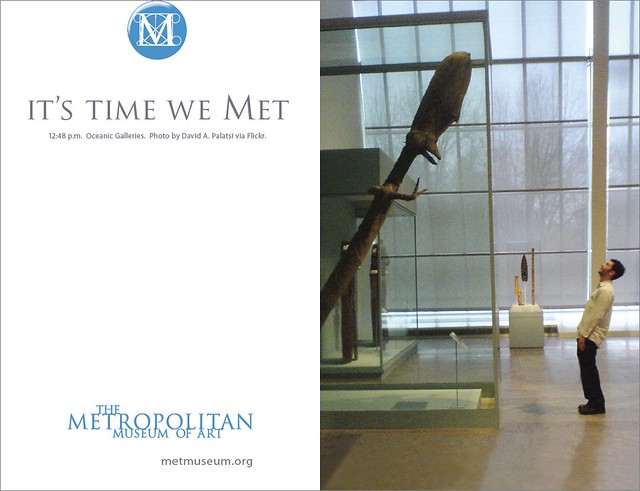
The 2010 “Time We Met” contest ends July 6. (Among the judge’s many choices will be a photograph No. 1 son took on his brand new camera!) It’s worth browsing the collection of images to see the many ways people engage with the museum and its collections. There’s humor, there’s wonder, and there’s a special look you see on the face of someone whose imagination just took flight.
Of course, there’s also just silly. That would be my adorable goofball son who came up with the idea for this picture (below).

Is this what they mean by “Participatory Museum”? (Photo by Sabra Smith)
UPDATE: I thought I had added a p.s. about the contest results. There was one winner and two runners up. Guess who was one of the runners up? Yup! Rock and roll knight, seen above. Congrats to the Youngest, for coming up with the idea.
Foto Friday
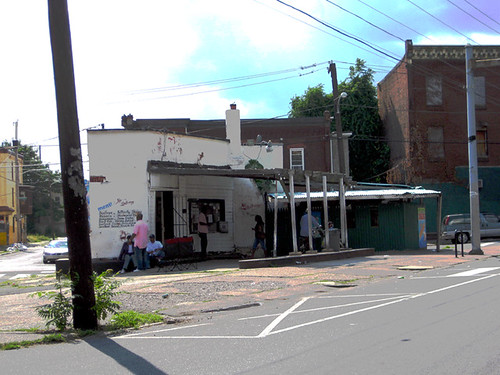
Philadelphia, Ridge Avenue at N. 27th Street and W. Berks
Interior becomes exterior
Brownstoner (Philadelphia edition) offers a thoughtful column by Libbie Hawes on the wonderful (yet sadly ghostlike) tracings of buildings that once were on the party walls of buildings that still stand. See her collection and read her thoughts at Brownstoner here.
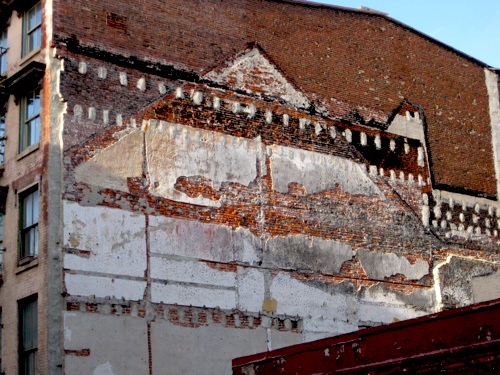
The ghost in the wall, Photo by Sabra Smith
Foto Friday

Wentworth-Gardner House, Portsmouth NH
Tourist season is here. House museums are counting on summertime visitor fees to help pay for maintenance against wintertime weather assaults (and more).
Invite the public, engage the public, make friends with the public. How? Check out The Participatory Museum by Nina Simon and her blog, Museum 2.0 (see also blogroll in sidebar) (Well, and my thesis might give you some ideas — see blogroll.)
“Gee, Lassie, what did you just dig up?”
Philadelphia Archaeological Forum, The Kelpius Society, and
The Roxborough-Manayunk-Wissahickon Historical Society present
ARCHAEOLOGY ROAD SHOW: DIGGING IN ROXBOROUGH
Wednesday, June 23, 6:30 p.m. — FREE!
at The Center at Journey’s Way, 403 Rector Street in Roxborough
No shovels required for this evening of history, artifact identification and fun with local archaeologists at an “Archaeology Road Show.”
Doug Mooney, president of the Philadelphia Archaeological Forum, will share intriguing nuggets about what’s underground in Philadelphia. Specialists will offer scientific appraisal of any treasures you or Rover might have discovered or dug up. (Monetary appraisals not included, so forget that dream of retiring on the proceeds of the dino skull you think you found.)
Amateur discoveries are increasingly becoming an important source of information for those researching how we lived in the past.
If you’ve ever found an unusual artifact in your garden, dug up something using a metal detector, or stumbled across an item while walking the family dog, bring it to the road show and find out what it is or learn about its historical context.
 Roxborough area residents are invited to bring anything they’ve found, whether whole or fragments of old bottles, pottery, ceramics, metal objects and implements, arrowheads or other American Indian artifacts, beads, jewelry, glassware, toys, stones, marbles, buttons, and the like. Any supporting documentation that would help identify the location of where items were found is particularly encouraged.
Artifact guidelines and additional information about the program can also be picked up from June 10 at the Front Desk at the Center for Journey’s Way.
Tom Carroll, president of The Kelpius Society, says this program “is part of a broad effort of the Kelpius Society to form partnerships with organizations and individuals in and around the Roxborough-Wissahickon area. These neighborhoods are the site of the historic Kelpius community, which was established along the Wissahickon Creek in 1694.”
The Roxborough-Manayunk-Wissahickon Historical Society is also collecting old photos from residents for inclusion in a history book to be published by Arcadia Publishers next year. Please contact historical society president Karen Sears (215-483-9268) for more information.
The Kelpius Society is embarking on an oral history project with Journey’s Way, as well as working to restore the original Kelpius settlement site located in Fairmount Park. Click here for more info.
The Philadelphia Archaeological Forum advises and educates historians, architects, government officials, tourism concerns, and others about urban archaeology. Each October it hosts an all-day seminar (free to the public, with kid-friendly activities) that explores recent findings and developments at various projects throughout the City.
Philadelphia communities or school groups are encouraged to host a road show (click the link above).
Foto Friday

Garden benches at the Colorado Chautauqua, a National Historic Landmark in Boulder, Colorado, Photo: Sabra Smith
Foto Friday
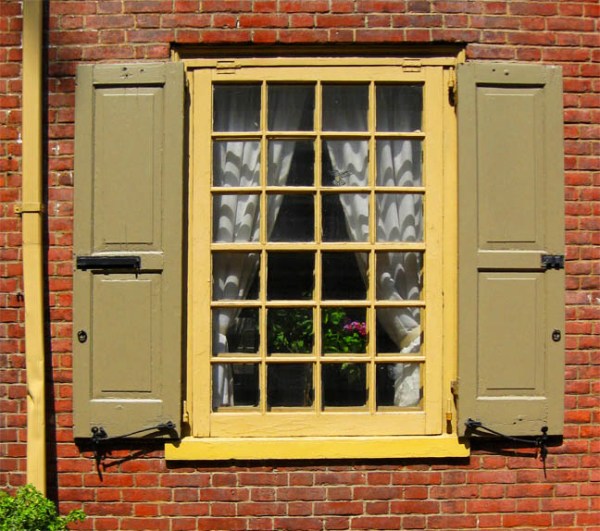
Did you notice yet that it's not a double-hung window? Elfreth's Alley window photo by Sabra Smith
Can’t get enough of the National Historic Landmark Elfreth’s Alley in Philadelphia? You can see more of it here, or click their website and plan to see it in person.
Love that window? So do I. Click here to read a compelling argument for historic windows and against those windows you keep seeing on all the discount coupons in your mailbox. The word “replacement” windows is misleading. They should be called “disposable” windows.
Foto Friday: The Obvious Invisible
The everyday becomes invisible after awhile. It’s how preservationists find themselves in the position of defending a two-hundred year building scheduled for demolition — everyone always assumed it would be there and no one paid much notice until the death knell was sounded.

I love this series of bas relief sculptures by Donald De Lue (1897-1988) found on the exterior of the U.S. Post Office that extends from Chestnut to Market Streets. I pass them each day on my way to work, and I admire how they change in all kinds of light and weather.
The man in this photo — and many others who pass the monumental figures each day — barely seem to notice. But I suspect they take in the magnificence and contribution to “sense of place” on some unconscious level.
Honoring Civil War Volunteer Nurse Sarah Priest

Saturday, May 22, 2010 starting 12 noon
Sarah Priest, a volunteer nurse during the Civil War, was put to rest in Old Swedes Church Burial Ground, Swedesburg, PA, located across the river from Norristown. Within the stone walls of the 250 year old cemetery one will also find fellow nursing volunteer Anna M. Holstein, as well as soldiers who served their country in war and many of the area’s notable founding families of Swedish descent.
According to a 2009 article in the King of Prussia Courier, Priest’s marker was stolen, probably by someone seeking Civil War collectibles. However, that stone had only been placed in 2007 by the Daughters of the American Revolution to mark Priest’s previously unmarked grave site.
 Priest spent ten months working at Sharpsburg, site of the Battle of Antietam, the bloodiest single-day battle in American history, with 23,000 men wounded or dead. In 1867 Holstein published an account of their experiences and her narrative makes all too clear the gore, hopelessness and daily tragedies they encountered.
In a miserable little log house near the Potomac, thirty men lay upon the floor, ill with fever; some had a little straw, but no pillows were to be found; at that time it was unavoidable, but their food was hardly fit for well men; medicines very scarce; — this house the counterpart to many others…
The article notes that research about Sarah Priest revealed that upon returning home from war, she was labeled as crazy by her family, though she probably was suffering from what we now recognize as post traumatic stress disorder. When she died, the family did not place a marker at her final resting place.
The new marker will honor Sarah Priest’s contributions to helping the sick, injured and dying during the Civil War and her service to her country.
Friends of Old Swedes invites one and all to attend this grave marker ceremony, especially current military, period reenactors, civilians and heritage groups. Refreshments to follow.
To read more about the service of Montgomery county women in the Civil War, read Anna Morris Holstein’s 1867 book, Three Years in Field Hospitals of the Army of the Potomac. It is a heart-wrenching eyewitness account of working among the Civil War wounded and dying. Holstein’s notes and letters home are housed at the Historical Society of Montgomery County in Norristown.
Philadelphia Inquirer reporter Bonnie Cook wrote about Civil War nurse and Montgomery County resident Elizabeth J. Brower who, like Priest, came home from war deeply affected and mentally unstable. Brower was committed to an insane asylum. Read the article
See the Time Machine’s previous post about Old Swedes here.
For images of Old Swedes/Christ Church cemetery, click here (Carla Zambelli) or here (Sabra Smith)
For more information about preservation and conservation of burial grounds and cemetery markers, the National Park Service’s National Center for Preservation Technology & Training offers technical assistance here.
Directions to Old Swedes Church in Bridgeport/Swedesburg, PA: Take I-76 West, Take to pa-23 Exit 332 Toward Conshohocken. Merge onto Matsonford Road, Turn Left onto Front Street, Pa. 23, Continue to Follow Pa 23. 740 River Road, is on the left. Parking behind the church.
Foto Friday
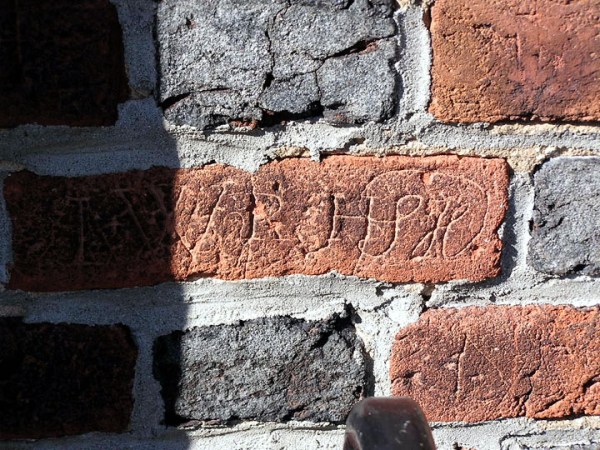
Pride of Place: When constructed in 1722, the family and mason put their initials in the brickwork of their new home. Photo by Sabra Smith (Click image to view Historic American Buildings Survey info)


 Nostalgic for the original Wayback Machine?
 My Own Time Machine: Buildings, Places, People & Things