Free… hello modernist fans!
Want your very own home by a noted mid-century architect?
It’s free. (But not without cost — you have to transfer and reassemble the building.)

Stonorov steel home

Harmon House
Modernist architect Oskar Stonorov designed and built two steel houses on his family’s property in Chester County around 1946. At the urging of Walter Reuther (who was looking for opportunities to continue employment of war-time steel workers), Stonorov designed the houses as prototypes for mass-produced pre-fab houses that could be marketed to returning veterans.
Stonorov’s designs went by the name of Harmon Houses and were manufactured in Wilmington, Delaware. Only a very few were built before the company went out of business.
This available house once stood on Stonorov family property that was subdivided for development. The house was disassembled, stored and is now available to a new owner.
Ideal as a small starter or vacation getaway home, this building is a fine example of the work of an architect noted for his interest in housing innovation.
Flown the coop — 100 Abandoned Houses

Kevin Bauman, 100abandonedhouses.com
When I’m stressed I have stress dreams. You probably do too. Which type do you have? The kind where you’re naked giving a speech in front of a crowd? Where your teeth crumble in your mouth? Where you have to catch a plane and you’re late? Mine are most often about moving. Well, not so much the moving as the packing. Generally in the dream I have an hour, or a day, to be somewhere else and I have a huge office/room/house full of stuff that has to get from one place to another and no boxes to put anything in. You can imagine the rest. *shudder*

Photo by Laura Kicey, from "Blurb Abandoned" Images available on etsy.com
Oh, sure, it’s pretty obvious to me this probably relates to the fact that I spent my life moving from one place to another. It may also help explain my fascination with abandoned places. Life interrupted, not a museum with things artfully arranged. It’s real life, given up on.
Why? What’s the story? Why did that person just close the door and walk away?
I’m not the only one who wonders.
In Detroit, photographer Kevin Bauman started documenting the city’s many abandoned houses and his photo collection comprises a candy-box like assortment of styles, forlorn and empty, richly evocative of times past. He describes what started out as a hobby:
As the number of images grew, and a documentary style emerged, I switched from mostly black and white, to color, and decided to name the series 100 Abandoned Houses. 100 seemed like a lot, although the number of abandoned houses in Detroit is more like 12,000. Encompassing an area of over 138 square miles, Detroit has enough room to hold the land mass of San Francisco, Boston, and Manhattan Island, yet the population has fallen from close to 2 million citizens, to most likely less than 800,000. With such a dramatic decline, the abandoned house problem is not likely to go away any time soon.
Photo by Kevin Bauman, images available at 100abandonedhouses.com

“History” in the recesses of my mind
Here is an example of how “history” (if one defines that as daily living from another time) goes on as just a part of regular life…
I clicked over to Elements of Style to see what her “The wind in my hair” post was about and I saw this:

And that old school bike got me thinking about sitting at the dining room table at my grandparent’s house when I was trying to wring as much info as possible from my grandfather about the mill where he grew up. He talked about how he and his little sister used to ride one of their horses up the road to the one-room school (and swat it on the flank to send it on its way back to the barn once they were delivered). But when it was time to go to high school in nearby Sellersville, his dad ordered a bicycle for him from the Sears catalogue. And he rode that bicycle the first day and was mortified because it had no mud fender on the back and there was a stripe of dirt up the back of his jacket.
I can imagine he felt like the country kid, coming in to town to the “big” school and the last thing he wanted was to look like a hick. That stripe of mud was a blaze of social suicide. He described using the phone at the livery stable where he parked his bike to call his father. He asked permission to order a mud fender for the bike. And even telling the story decades later, you could sense his worry if his dad said no.
But his dad said yes.
Seventy years later and he still seemed relieved by the answer.
And I thought of that story when I looked at this bike, and I noticed it already has a rear fender and I knew Erin would be safe from mud stripes up her back, no matter what charming outfit she was wearing while travelling around Boston.
Travelling around?
That reminds me of my grandfather’s story about steep hills he encountered while making deliveries with the horse and wagon and the “thank you, ma’am” plateaus on the hill to give the horse a rest….
See how history can sneak up on you?
Souvenirs

Photo by Paul Orleman
 Souvenirs are for remembering.
It would seem that there are a bunch of people out there looking to remember the recently demolished Addison Mizner Main Line mansion La Ronda by acquiring a chunk of it. My blog stats are showing lots of search engine results for “pieces of La Ronda” and the like.
Hmm.
I’m wondering if folk are planning to incorporate the bits in an attempt to give architectural heft to a McMansion, or as garden statuary, or… what? If you are one of them, do please share what you have in mind.
Update: Rumor has it the salvage commission was given this place. But “search” reveals no obvious La Ronda sale stuff and poking through their website you being to understand the importance of “context” — was that the railing in the great hall? Was that one of those stained glass windows? Links elsewhere that directed to Mizner stuff at this place are all dead now. I was only able to follow up and find out where they went because I’m a good web researcher with a few tricks up my sleeve. Another source says it was this place (maybe you can see bits of La Ronda on their tv program!) but search there reveals nothing. Read more about the entire La Ronda saga, right down to the torn apart bits and pieces, here at the Hysterical Preservationist.
Support Tax Credits in Congress NOW
This just in from the National Trust for Historic Preservation:
If National Parks are “America’s Best Idea,” then surely one could make the case that the Federal Rehab Tax Credit has been proven to be one of America’s best historic preservation ideas.
Since it was enacted in 1976, the tax credit has generated over $50 billion in renovation and revitalization dollars. With a five-to-one ratio of private investment to federal tax credits, the program has developed more than 35,600 projects nationwide. In 2008 alone the credit produced $5.64 billion in private investment and created over 67,000 new jobs about 55 new jobs per project.
Just one of those 35,000+ projects is the successful rehab of Knoxville’s historic Tennessee Theater, where a top to bottom makeover of the 1,631-seat theater turned a downtown eyesore into a state-of-the-art performing arts facility. Reopened in 2005, the theater served as an anchor for the revitalization of downtown, and brings 150,000 residents and visitors to the city center for its concerts, plays, operas, and special events annually.
On October 1, 2009, Representatives Allyson Schwartz and Pat Tiberi and Senators Blanche Lincoln and Olympia Snowe introduced a measure that would make a great idea even better!
The Community Restoration and Rehabilitation Act is a package of amendments that would further the mission of the rehab credit by encouraging substantial energy savings in historic buildings while spurring greater investment in commercial projects particularly with smaller businesses located in older neighborhoods where there is a critical need for revitalization.
Although the rehab credit is currently the nation’s largest federal incentive for promoting sustainable development through private investment, a greater potential for revitalizing communities could be realized with the proposed amendments.
Learn more about the existing federal rehabilitation tax credit and the proposed amendments and stay tuned to learn how you can get involved in supporting these important changes to the tax credit program.
La Ronda Manor Goes Down
Vodpod videos no longer available.
Remembering life at La Ronda
 By Bonnie L. Cook Inquirer Staff Writer
Suzanne Atterbury remembers sending her playmates into La Ronda’s hedgerow maze – “They would come out crying.”
Dominic Conicelli remembers his father’s being summoned at all hours to chauffeur the widow Foerderer – “his Madame,” Dom’s mother said – in a black Cadillac.
And everyone who lived or worked there remembers Christmas at La Ronda. Cooking smells wafted down the corridors from a cast-iron stove as big as a buffalo. A hundred radiators clanked with the startup strain of heating the Bryn Mawr mansion’s many rooms. Trimming the towering yule tree took two weeks, says former owner Arthur J. Kania. Then, “the kids would explode into the room, looking for presents,” he remembers. “These are the kinds of things it is hard to let go of.”
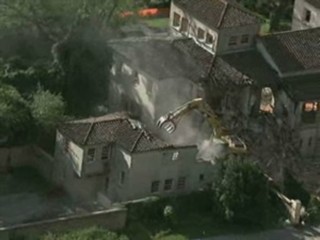
Despite outcry from preservationists, a Florida man’s offer to buy and move it, and a last-minute rescue effort by the head of Lower Merion’s commissioners, the demolition of La Ronda is under way. A sales agreement makes today the first day the new owner, Joseph D. Kestenbaum, can carry out his plan to tear down famed architect Addison Mizner’s final, 51-room creation to make way for a new house with a curving driveway and a pool.
When word spread that the castle might fall, families who lived at La Ronda or waited on its occupants came forward with nostalgic glimpses of life there. Ethel Davis, granddaughter of Percival Foerderer, the leather-tanning magnate who built La Ronda in 1929, recalls Christmases in the 1960s when she was in her teens. The Foerderers lived at La Ronda from 1929 until 1968. “Grandman,” as they called Percival Foerderer, had chauffeur John Conicelli drive the black Cadillac to 30th Street Station to pick up relatives arriving from Connecticut. “He would say, ‘Hurry up, we’ve got to get back home in time to catch Santa Claus,’ but of course Santa Claus wouldn’t be there, but the lights would be up,” Davis said.
John Conicelli started at La Ronda in 1929 as a weed-puller. He stayed 42 years, becoming the Foederers’ driver and personal assistant – and a child-friendly presence in the adult-centered house. “When I was down there as a child, John would go out and pick flowers, and I followed him around,” Davis said. While John drove the Foerderers in the 1940s, his son, Dom, would water the potted plants on the patio “until I got tired.” When he got older, Dom Conicelli cut the grass on the 250-acre estate, using a tractor mower. “I don’t remember getting paid, but it kept me out of trouble,” said Conicelli, 76 and retired. The Conicellis didn’t own a car, so father and son walked three miles each way from their home in Conshohocken up the hill on Route 23 to work at La Ronda. Foerderer found an old station wagon for Johnny Conicelli. That put him “on call” to run errands for the Foerderers – at all hours. Dom Conicelli remembers the calls: “My mother used to say, ‘Your Madame’s on the line.’ ” Little Dom went inside the mansion only when the Foerderers were away. He gazed at the bathroom fixtures. “They were probably brass, but they looked like gold to me.” To him, Foerderer adults seemed “aloof” from their employees – up to 30 cooks, butlers, maids, gardeners, dining-room servers, a stable manager, grooms, and drivers who took care of the 18,000-square-foot mansion, its grounds, outbuildings, and occupants.
Percival Foerderer typed 15 pages of gardening instructions for the landscaping crew, but he hardly ever spoke to his driver’s son. “One time, Mr. Foerderer came out and asked me to pull weeds for 50 cents an hour,” Conicelli said. Sometimes, he would sneak into the Cadillac while it was parked in the garage and pretend he was the boss. “I would sit in the back and talk to my buddies in the front seat over the intercom.” On summer days he might play with the Foerderers’ little daughter, Florence. The two would splash in the cross-shaped pool in La Ronda’s gardens. “If it was hot enough, you jumped in,” Dom said. Or, if he was especially lucky, he got to ride one of the estate’s horses, a mare named Black Beauty. He remembers the other horses stabled at La Ronda: Baloney and Fiddlesticks. There was a steeplechase, too; his father drove the Foerderers to the Devon Horse Show and the Radnor Hunt.
Dom Conicelli was a rambunctious teenager. After he got his own car, he’d climb in the window of La Ronda’s garage to steal gasoline – though his father had a key. Later, he owned up to his father about the theft. “I knew it. I didn’t want to make it too easy for you,” he said his father replied.
He finally left his job at La Ronda to enroll in college – but he didn’t go after all. So Foerderer offered him a job in his Center City office at 50 cents an hour. Instead, Conicelli joined a labor gang at Alan Wood Steel Co. at 85 cents per hour. “That was not too bright a decision,” Dom said. But it paid off in the end. He started a car dealership. When his fledgling business foundered, Ethel Foerderer, Percival’s widow, lent him $10,000 in 1963. Conicelli repaid the debt with interest 10 years later. By then, it was easier – the Conicelli Auto Group was on its way to becoming one of the best-known business names in the region. John Conicelli, meanwhile, stayed on as an assistant to Ethel Foerderer after her husband died in 1969. The ailing widow had a nurse, but Dom Conicelli said, “I don’t think she ever trusted anyone but my dad.” His father used to set La Ronda’s burglar alarms each night. “Where’s Dad?” a family member would ask. He remembers his mother’s arch reply: “Tucking his Madame in.”

Channel 6 ABC News WPVI
The Kid in the Castle
Suzanne Gallagher’s schoolmates nicknamed her “the kid in the castle.” Her parents bought La Ronda in the early 1970s, and the family lived there until 1981. “It was incredible. I loved the architecture,” Suzanne Gallagher Atterbury said. “That’s what inspired me to go to Harcum [College] and study interior design.”
The 14 Gallagher children and stepchildren ate in the kitchen “in shifts,” she said – except at Christmas. Then, the family dined at the 20-foot table in the formal dining room. Their Christmas tree was a Douglas fir, as tall as the table was long. Men from Farley Bros. landscapers lugged it in from Lancaster County. Mammoth logs in the fireplace seemed to warm half the house. The fire “would stay lit for weeks,” Atterbury remembered.
The Farley brothers lived at La Ronda – in the gatehouse. “We had cables and a little gadget” to raise the tree, Tom Farley, 69, remembered. “The tree was so huge, nobody could see under it anyway. Once we got it up, the little Gallaghers decorated it. It was magic when it was all lit up.”
Percival Foerderer was long gone by then, but Suzanne Gallagher delighted in running up and down the spiral staircase in the tower that led to “Grandman’s office.” When her schoolmates came over, she took them into La Ronda’s maze of boxwood hedges. She kept the way out a secret. “We used to torture our friends,” she said, but they clamored to visit again and again.
In 1983, lawyer Kania bought the house. His family lived there until June 2008. “It became a love affair,” says Kania, 78. “Four of our children were married there. We had our 50th wedding anniversary there. Christmas was something special.” The Kanias bought their towering Christmas tree from the same place that sold trees for John Wanamaker in Center City, Kania said. Then they invited up to 300 friends, children and all, for “Christmas at La Ronda.” A toy train was set up in the ballroom. Nutcracker toy soldiers were displayed. Kania played Santa Claus. His children learned golf on La Ronda’s putting green. But when the children were grown, the Kanias decided 18,000 square feet was too much for two people.
The couple moved out in 2008, but they regard their La Ronda years as magical. “I wouldn’t trade it for anything. We will always have fond memories,” Kania said. The connection to La Ronda lived on, too, for those who tended its flowers and pulled its weeds. Tom Farley remembered seeing Dom Conicelli’s father, John, visit the mansion years after his chauffeur days were over. “Johnny would come and chat with us,” Farley said. “He was lonely for the place and kept coming for old time’s sake.”
Contact staff writer Bonnie L. Cook at 610-313-8232 or bcook@phillynews.com.
This Place Matters
 In an effort to engage people of all ages and backgrounds across this great land of ours, the National Trust for Historic Preservation created its This Place Matters campaign, encouraging aforementioned folk to print out the TPM sign and submit photographic evidence of a place that matters to them (preferably with a why included).
If you look at the map that shows where submissions come from, it skews heavily to the east, but click through the slideshow and you will enjoy a tremendous armchair adventure from coast to coast and over the ocean to Hawaii.
I’d say they’ve succeeded in reaching people who don’t seem to fit the “preservationist” stereotype. Have a look at what I mean when you go to vote for the best This Place Matters photograph from the 12 photos selected as finalists in this year’s photo contest. [I think the proof of the interest in people comes from my observation that several of the finalist images barely feature the building.] Don’t forget to vote!
Update: I went to vote and found that registration is required. I think I already did that, but don’t remember the password, etc. and so clicked off to do something else on the interweb. Then I noticed on my facebook page that on the National Trust’s recent This Place Matters post, in which people are encouraged to vote, there were a string of complaints about the cumbersome process. I’m not sure what the Trust’s overall goal was with this particular outreach tactic. On the face, I thought it was about showing large numbers of votes, of engaging people with “places” and showing that preservation has a broad appeal. Requiring registration to vote suggests that the goal is really to capture personal data, probably to use in campaign appeals and fundraising. That seems inappropriate in what is, on its face, a populist effort.
I’m no Julie… or, this blog talks a lot about old windows and is unlikely ever to become a movie
Blogging is a great way to build community, as I discovered more than five years ago when I started up my first blog to serve as the on-call virtual girlfriend I needed to blather about the experience of going from married to single. I was welcomed into other people’s lives and the internet became a kind of kaffeeklatsch that was there for me any time of day or night. [One blogger friend is nodding, remembering how she kept me company — online — until three in the morning while I worked through an angsty thesis moment.]
Of course, the absurd angle on blogging are those blogs that exist in a land filled with the sound of crickets and tumbleweeds blowing down a dusty street and the author writing posts that amount to an echoey “hello?” Other people just want a place to ponder or rant and could care less if anyone ever comes to call. It all reminds me of advice from my mother each time we moved to a new town, “sometimes the best way to make friends is by saying “hi” first.” In other words, the best way to get readers, is to be a reader (even better, be a commenter because otherwise you are known, in this virtual world, as a “lurker”).
I like to hop on my surfboard and cruise around, window shopping here, waving cheerfully there, finding one spot and really poking around through archives and links to see what’s there and what treasures await.
Beginning bloggers (yes, I’ll admit I was this way in my blogger youth) can fall into a funny obsession about how many hits they’ve had and craving [“please, please, when?!”] comments. Some are narrow-eyed envious of the blogger with 78 comments on a post about the mother-in-law’s visit and wonder why their own clever observations on changing a diaper goes unrecognized by the outside world.
It’s such a common affliction, this desperate desire for linky love, that it’s tweaked for those in the know in the charming film “Julie & Julia” when beginning blogger Julie, writing about cooking Julia Child’s French cuisine, chirps in triumph when she finally gets her first comment. I had to giggle when she started talking to her husband about “her readers” and worrying about what they would think, feeling an obligation to the invisible people she was sure were sitting poised at their computers waiting for the next installment of her adventures in the kitchen.
A bloggity friend and I used to obsess over the rankings on technorati, comparing notes and devising strategies for boosting our numbers. (She excelled and built a remarkble network truly deserving of the word “web”; I did fine and then realized I was going a little crazy over the whole thing.)
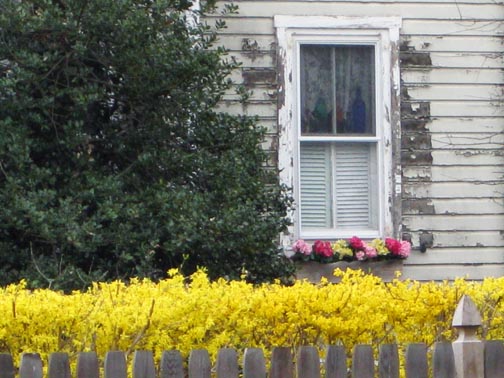
The point of this post, dear friends, is simply a very long and meandering introduction to point you to this post by the National Trust for Historic Preservation with more information about what has become a sub-theme here — preservation of old windows. And why that relates to all the above blather about links and blogs and connections is simply because they used a photo I took last spring.
I love the photo because I loved the fact there were fake silk flowers in the window box even though it was spring and there were neon-bright blooms everywhere else, including the highlighter-yellow forsythia in the foreground. I love the paint peeling around the window, the shape of missing shutters suggesting that the last housepainter worked around any given obstacle, not deigning to shift a shutter in order to do a thorough job. (Reminds me of my terrible experience with Roger Simon painters who seemed such scam artists to me that I marvel they get work every time I see their sign on a job site.)
Do check out the page and all its excellent links for window info. And the NTHP invites you to submit your own photos to their “Love Your Historic Windows” flickr group. You can get some linky love too!
Farewell, paradise

It’s the end of the summer. Nostalgia wafts along the boardwalk. We brush the sand off our feet. It’s time for shoes again. And sweaters. I’ve been chilly lately.
While riding the train into the office, I took one last summer excursion, courtesy of Diablo Cody’s (“Juno”) recent Entertainment Weekly column (link to full column below). Cody waxes poetic about Coney Island which she calls “New York’s kitsch classic.” It got me thinking about how memory, nostalgia and the scent of hotdogs mingled with salty air combine to make us love a place. The sort of place we want to save to remind us of the happy feelings we connect with it.
Cody writes about Astroland (some once upon a time amusement designer’s notion of “space age”) and its demise to make way for hotels (that will probably destroy the very charm that made people want to visit in the first place — a sort of east coast example of Waikiki that’s paved paradise to put up the same ol’ same ol’…). Farewell. It’s always a little sad when the summer ends. And it always feels like you’ve lost a best friend when a place you loved is no more.
Astroland, one of Coney’s best-known amusement parks, closed last fall. What was once billed as a “space-age” park ironically became a psychedelic boneyard of dismantled thrill rides. Apparently some mustache-twirling developer thinks that Coney Island could be a good place to build hotels, and a lot of beloved attractions may fall victim to progress. If life was an ’80s teen comedy, a ragtag group of locals would surely band together to save the Scrambler (and possibly lob a few coconut cream pies at Mr. Nasty Developer). Unfortunately, life is a lot more like a Coen brothers movie: No one has enough money and the ending feels ambiguous. Rest in peace, A-land.
Diablo Cody on Coney Island – EW.com
Shared via AddThis


 Nostalgic for the original Wayback Machine?
 My Own Time Machine: Buildings, Places, People & Things