Some things change, nothing stays the same

The New York Times Building, Image: New York Times Company Archives
When I was a publicity gal working at a Boston publishing firm in New York City, I must have typed the address for The New York Times about a million times (perhaps I exaggerate; blame the publicity training). That address rolled easily off my tongue as I called packages in to the messenger service for delivery. All these years later, I can recite it still: 229 West 43rd Street, New York, New York, 10036 (I didn’t even have to look up the zip code; my fingers typed it automatically, though on a computer keyboard now instead of my hefty grey IBM Selectric Typewriter — not the self-correcting kind).
All these years later, with my publishing career a distant memory and now an “official” historic preservationist (with a masters degree to prove it), it’s with some mixture of nostalgia and curiosity that I read Dan Barry’s New York Times account of “adaptive reuse” in which the Grey Lady’s newsrooms become Bowlmor Lanes. (The newspaper’s offices have moved to a new building not far away.) The journalist visited the soon-to-open entertainment spot with a photographer and the newspaper’s archivist, who was armed with a map of what used to be where.
Affirming that old adage “you can’t go home again,” Mr. Barry suffers a shock to the system to see the 1913 building’s grungy newsrooms transformed ($25 million later) into seven “bowling lounges,” each with a different New York City theme. He writes “the concept hovered between the genius and the absurd, which made it all the more New York….”
IN the dozen years I spent working in the newsroom of the historic New York Times building, just off Times Square, I must have contemplated my future a hundred times, a thousand times. Would I become a national correspondent? A foreign correspondent? An editor? Should I chuck journalism and embark instead on a career in interpretive dance?
But I am fairly certain that I never thought: Maybe someday I will stand in this room with a bowling ball in my hand, admiring the Chinatown décor and hoping to pick up a spare in Lane 12.
Allow me a moment to double-check my memory.
Nope. I never thought this.
To read the full article (and you should), click here.

Bowlmor layout, showing themes available
PreservationNation » Artists & Architecture: Giving Life to Buildings “In Between”
PreservationNation » Blog Archive » Artists & Architecture: Giving Life to Buildings “In Between”.
Hmmm. I seem to have a theme this week. Don’t give up on old buildings. There are things to be done. Think. Be creative. It might take outreach, cooperation, and a little extra effort but, oh, the benefits!
Click the link above to a post by Christine Madrid French, director of the National Trust’s Modernism + Recent Past program. Her theme comes down to the idea that when the market tanks, fill in the blanks. She includes this wise observation:
A search for “Artists” and “Vacant Buildings” brings up many other noteworthy efforts with the same goal in mind. Community Visual Restoration Project, funded in part by a grant from the Pepsi Refresh Project, worked in Minneapolis to benefit both property owners and creative residents of the city by increasing foot traffic at vacant sites, promoting available rental opportunities in the spaces, and creating revenue for businesses located nearby each installation. Filling empty window spaces with art is emerging as a legitimate venue for artists nationwide and as well as in Britain and Ireland.
Occupying vacant buildings with artists and artworks is not a new idea, perhaps, but triangulating the business owner, the artist, and the preservationist is less widely utilized. Here is an opportunity, however, to keep a building on the preservationist “watch list” from falling into dereliction. Providing people with the opportunity to interact with an historic building through the third-party of creative arts can reveal hidden potentials and benefit everyone involved.
Go read. Now. You heard me.

Art in the Age of Reproduction's storefront
Art in the Age of Mechanical Reproduction recently did a post called “Losing Landmarks” on history, landmarks, loss and what we lose. The focus of the post was Philadelphia’s threatened Church of the Assumption (previously discussed in this blog) and Cramp’s Shipyard, but the big question is: “What price progress?” The blog notes:
While it is important to focus on the needs of today, we can’t forget that the present is ephemeral and will soon be a part of history, that unwavering beacon lighting our way.
Then highlights the insightful Philadelphia Inquirer op-ed by Michael Greenle, excerpted here (click link below for full piece)
Outmoded buildings are difficult to reuse. But rather than abandoning them, we should ask that our public institutions be more patient in protecting them, identifying developers, and extending their lives for future generations. This means supporting the Callowhill Neighborhood Association’s appeal of the Assumption decision, working with groups such as the Preservation Alliance and the [Partners] for Sacred Spaces to nominate and reuse outmoded but significant buildings, and asking city officials to fully fund Historical Commission staff to handle building and district nominations. We should encourage public officials to preserve the city’s fabric as not just a legacy of the city’s past, but a keystone of its future. — Michael Greenle in the Philadelphia Inquirer
Re-using former school buildings: Saving the sense of place
I was reading the Hudson Valley Preservation News blog and came across a post about a former neighborhood school (built in 1915 with additions in 1939 and 1974), now transformed by adaptive reuse into an arts center. The challenge of what to do with old school buildings faces communities all across the country (previous post here: “Now that clapping erasers has gone out of style….”
My own neighborhood has several old school buildings of similar early 20th century vintage and the township sees no future for the buildings and wants to tear them down.
These buildings date from the era when schools were in the neighborhood — walking distance from homes and therefore, easily accessed without use of a car. Isn’t that what we’re supposed to be striving for these days? Where’s the creativity to see how these buildings (“they don’t build them like that anymore”) could continue to contribute to the community and maintain their value as key contributors to sense of place that help define the neighborhood?
Atticus Lanigan, a land use planner for Orange County, NY, describes the layers of history and ghosts of dreams that can be found in the old high school in Beacon, New York. Transformed into Beacon Studios, the former school now hosts a number of creative entrepreneurs. Lanigan describes the threat now facing the site:
It is exactly this type of space that is crucial to the fabric of a community, and perhaps to the region. With rentals as low as $1.18 a square foot, some might call it an incubator where artists and professionals with small budgets can establish a foothold. And indeed, this building is shared by a mix of artists; as well as professionals and budding entrepreneurs, including a baker, woodworkers, Cornell Cooperative Extension’s Green Teen program (matching Dutchess County youth to gardening projects), a seamstress and a recording studio. In fact, the recording studio is now being utilized by popular Americana band, The Felice Brothers. And even though the space is refined there are opportunities for more formal presentation of work. For instance, it has a Premier Studio of over 3000 square feet that can be rented out provided that the renter obtains the proper insurance.
As fertile as this building could be, Beacon Studios is in danger of closing. It is owned by the Beacon City School District which considers the structure to be an extra limb. Although a group of tenants have formed an advocacy group, interfacing with the District from time to time, advice from the State to the District has been to cut itself free of the burden of the building. Thus, the building is currently for sale and the future is unsure. My only hope is that the building continues its other life as inspiration to future generations of artists and entrepreneurs, and continues to teach us inspiring lessons beyond the classrooms of its former use.
via Preservation News.
For more on Upper Dublin schoolbuildings ripe for transformation (I’d like to live in one of them if someone would just study other school-to-condo transformations and get busy), click here.
From mountain tops to battlefields: Winners of the National Historic Landmark Photo Contest

Mount Rainier in the Morning, by Matt Bell, Lost Delta Photography
Historic Landmark designation is the highest honorific bestowed upon historic sites in the United States, signifying those that “possess exceptional value or quality in illustrating or interpreting the heritage of the United States.” There are fewer than 2,500 NHLs and they tell stories about revolution, abolition, women’s history, civil rights, industrial and technological advances, creativity and inspiration.
The 11th Annual National Historic Landmark Photo contest was a fantastic opportunity to see how people across the country view these special places. Contestants were asked to submit no more than 10 images of their favorite National Historic Landmarks and the winners were selected by National Park Service employees across the country.
To read about the contest and this year’s winners, visit National Parks Traveler. (See if you can figure out which part they pulled from text I wrote!) You can also visit the NHL Photo Contest Flickr page to see all the entries and enjoy a little armchair traveling or just check out this gallery of the winner and honorable mention images.

Clock Tower, Administration Building, PSHS, Pullman Historic District, by kmc_Chicago. This was one of my favorite images but it wasn't a finalist. For more info on the Pullman Historic District: http://www.pullmanil.org/factory.htm
Foto Friday: Paterson, New Jersey

What I learned about historic preservation from Lisa Simpson
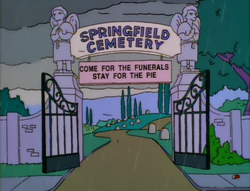
Walking through the Springfield Cemetery late one night, Lisa Simpson tries to calm herself with a wise observation:

“If Scooby-Doo has taught me anything, it’s that there’s nothing to be afraid of but crooked real estate developers.”
Foto Friday: Vertical and horizontal lines
 For years I’d look out the train window of my daily commute and wonder what that weathered grey barn was doing surviving in an urban neighborhood, surrounded by rowhouses that had seen better days and a huge factory crumbling on a triangular wedge of land near a major thoroughfare.
It turned out to be Stenton, a National Historic Landmark operated by the Colonial Dames. Their old website touts the site as “one of the earliest, best-preserved and most believable historic houses in Philadelphia.”
“Most believable”? That’s a curious claim to fame.
They explain: “Its distinguished Georgian architecture, its outstanding collection, and its superb documentation combine to create one of the most authentic house museums in the region. As part of Philadelphia’s Historic Northwest, Stenton now sits on three acres of the original 500-acre plantation. The site includes an elegant c. 1730 mansion, a kitchen wing, privy, icehouse, barn, and Colonial Revival garden.”
They plan to debut a new website soon. Check in for news about their award-winning educational programs and other events.
Women in preservation: the real meaning of “house keeping”?

Daughters of Revolution, by Grant Wood, in the collection of the Cincinnati Art Museum
Little old ladies in tennis shoes. (Also known as “LOLITaS” I’ve been told.)
Junior League, Colonial Dames, Daughters of the American Revolution.
Heiresses with a connection to place.
Women are not just the sprinkles on top of the confection that is preservation of place, they are key ingredients. You might see them as berry swirls of red, white and blue considering the patriotic connections and motivations of days gone by. Yet, far too often, they are the unsung heroines.
Is there something about the female personality that lends itself to the connective, communicative requirements for preservation success?
For years (and even today) women were supposed to know their place was in the home or in the mill or typing pool. Women’s biographies tended toward birth, marriage, children, death because what more of value was there to report? Even at historic sites with compelling women’s history, the tendency is to tell the tale from the man’s point of view, and the house is named for the man who owned it.
For example:
Barrett Wendell (1855-1921), one of Jacob Wendell II’s four sons, inherited the Portsmouth home in 1917 and lived there after his retirement from Harvard University. A well known scholar of English literature, he traveled extensively with his wife, Edith Greenough Wendell (1859-1938). She was very active in local and state organizations.
The end.
“Active in local and state organizations“? Well, the real story is that without Edith Greenough Wendell, one of the finest mansions in New England would be the site of a gas station today.
Here’s to “Women who saved the day (and the house)” and the story of Edith Wendell’s “house-keeping,” which saved Portsmouth, New Hampshire’s extraordinary Macphaedris-Warner House, built 1716-18 and designated a National Historic Landmark in 1960.
Mrs. Wendell lived in the Wendell ancestral home (1789) on Pleasant Street — a house stuffed with family heirlooms and antiques that might have made an ideal house museum. The Wendell Family had a strong sense of documenting its own history, as well as a compelling urge to preserve the heritage of Portsmouth. (Read this fascinating article about the Wendell antiques in the Strawbery Banke collection written by Gerald W. R. Ward and Karen E. Cullity.)
Early in the 20th century, the seaside town began to see changes. The waterfront saw significant commercial development. By 1923 traffic increased with completion of the Memorial Bridge spanning the Piscataqua River to connect Portsmouth to Kittery, Maine. A filling station replaced the Judge John Sherburne House. The same fate might have befallen Warner House (1716-18) at the corner of Daniel and Chapel Streets if not for Mrs. Wendell.
 In 1931 with the country still reeling from the ’29 stock market crash, Mrs. Wendell raised $10,000 for the rescue purchase of Warner House.
Named for Captain Archibald Macpheadris who built the house in 1716-18 and for Portsmouth merchant Jonathan Warner, the house is one of the earliest and most elegant brick mansion houses in New England. The dramatic wall murals, featuring Native Americans, are the oldest colonial wall paintings still in place in the United States. The Warner House opened its doors to the visiting public in 1932 and has served the community as a house museum ever since.
In 1937, William Appleton (founder of the Society for the Preservation of New England Antiquities, now Historic New England) described her effort as “one of the most remarkable instances of preservation work in America.”
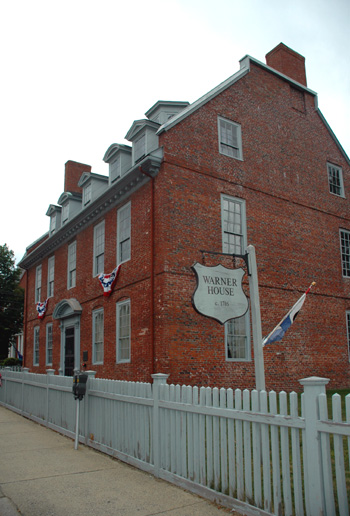 Today, like so many historic house museums across the country, the Warner House works hard to maintain the National Historic Landmark building and its collections and may be negatively affected by construction work connected with replacement of the nearby Memorial Bridge (1922).
Will the ladies of Portsmouth and Kittery come to the rescue once again?
Preservation & Design
So often the survival of a historic old building or site comes down to creative vision and energy devising a new use that brings the building into relevance of the current period. This, my friends, is known as design. I’m not sure why there isn’t a more obvious nexus of preservation and design. Perhaps it goes back to the ongoing debate we’ve been having about the inadequacy of the words “historic preservation” to encompass all that they do (community development, revitalization, storytelling, education, design (and re-design), sustainable development, affordable housing, etc and so on….).
In celebration of Design in a city noted for its history, I give a great big shout out to DesignPhiladelphia — a month-long, biggest-in-the-nation, celebration of design that encompasses more than words can express!
Click for a complete list of events! For example, on October 7, Carol Bruce and Peter Gittleman from Historic New England talk about interior design inspired by original historic home furnishings and finishes. (They have a magnificent wallpaper archive — see here for previous post.) And don’t miss the great shop and demonstrations (sometimes with beer tastings!) at Hudson Beach Glass on Strawberry Street (see if that darling little green glass frog bottle is still for sale…).
Want just architecture-related events? Click here and be dumb-founded by the fabulous array of workshops and open house days at genius pools like Venturi, Scott Brown and Associates, Andropogon Associates and Re:Vision Architecture. If you like awards and chicken dinners you can attend the AIA Philadelphia Design Awards Presentation & Dinner to see the best of the best!
Feeling more of a history-vibe? Click here for related events, like spooky goings on at Eastern State Penitentiary, a consideration of the history of modern design, and a happy hour with skyline views that exposes you to a wild array of museum and exhibit design (psst… just ask about the 5Bs– and the last one is beer).

Window at Hudson Beach Glass


 Nostalgic for the original Wayback Machine?
 My Own Time Machine: Buildings, Places, People & Things